

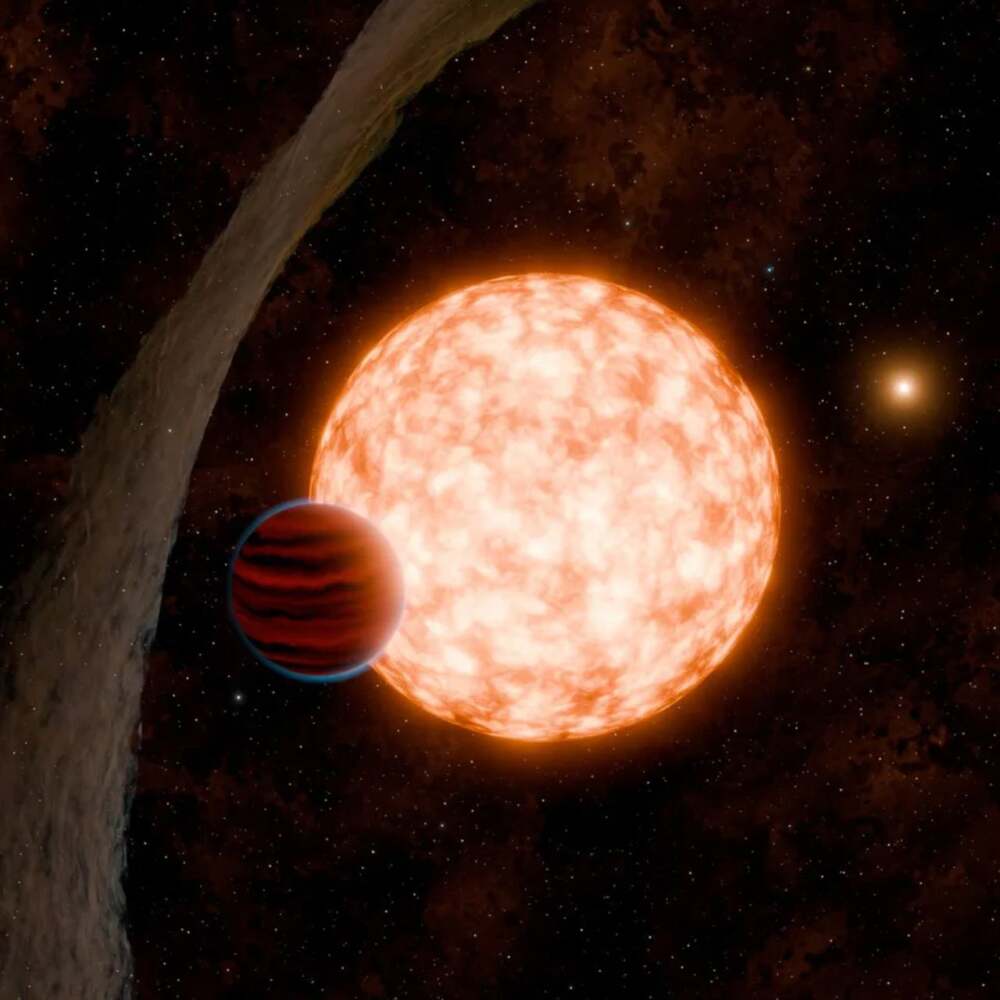
In a discovery that feels like witnessing cosmic history in the making, astronomers have observed a young planet forming around a sun-like star — offering a live look at the process that likely created Earth itself billions of years ago.
What’s Been Found
- The star, named WISPIT 2, is very young — only a few million years old — and surrounded by a spectacular disk of dust and gas with concentric rings.
- Within a gap of this multi-ringed disk, scientists detected a glow from a forming gas giant, we’re calling WISPIT 2b, still gathering mass from its surroundings. It’s estimated to be about five times the mass of Jupiter.
Why This Matters
- This is one of the clearest “snapshot” moments we have of planet formation in action — an opportunity to see mechanics like gas accretion, disk interaction, and early structure while they’re happening.
- It allows astronomers to test theories about how planets form, how disks evolve, and how massive planets can shape the disks around them.
How It Was Observed
- State-of-the-art telescopes were used to image WISPIT 2b in near-infrared light, where the forming planet’s heat and glow are more visible despite the surrounding dust.
- Because the disk is well defined — with rings and a gap — it makes it easier for scientists to pinpoint the location of the forming planet and monitor how it interacts with its disk.
Challenges & What’s Still Unknown
- While WISPIT 2b is bright and clear in images, many details — like exactly how fast it’s growing, its ultimate size, and its atmospheric composition — are still under study.
- The dust, gas movement, gravitational interactions, and related phenomena make modelling complex. It’s difficult to know for certain how similar this formation process will be to that which created our solar system.
What Comes Next
- More observations are planned to track how WISPIT 2b evolves: how its orbit might change, how the disk’s structure shifts, and whether other budding planets exist in the same system.
- As scientists gather more data, this system might become a benchmark example of early planetary development, helping refine models not just for WISPIT 2, but for systems across the galaxy.
Final Thought
This discovery reminds us that our universe is constantly renewing itself — stars being born, planets forming, and the same basic processes that shaped Earth still happening elsewhere. Observing a planet in its infancy gives humanity a chance to see the foundations of worlds in formation, offering both inspiration and insight into our own origins.







Leave a Reply