

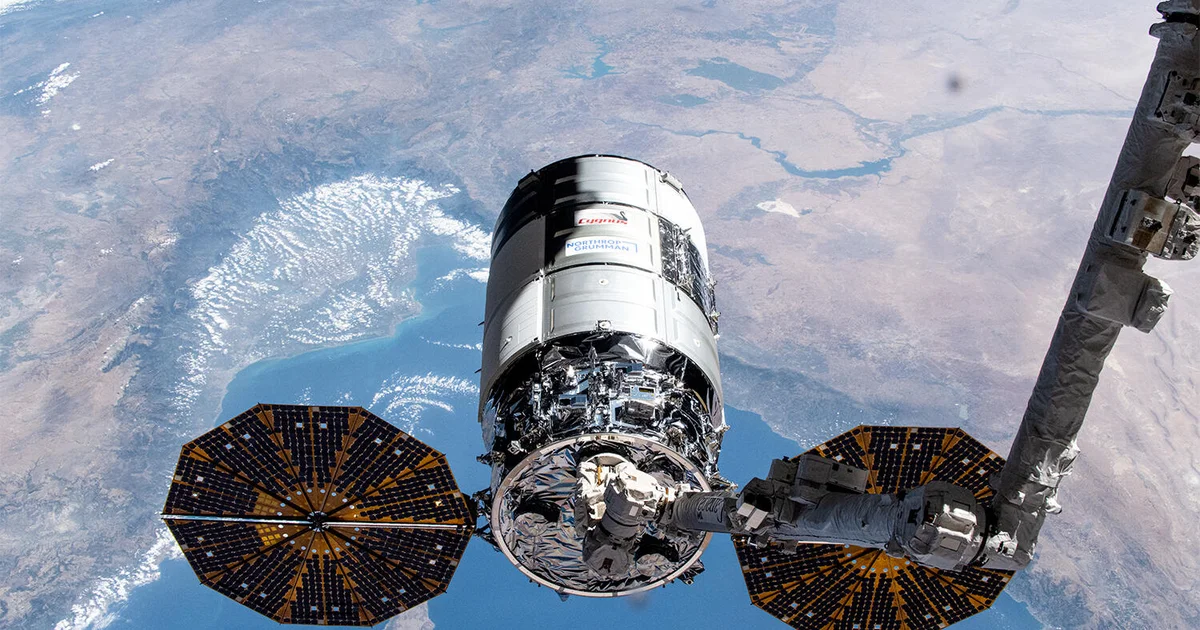
A supply mission to the International Space Station (ISS) suffered a delay when its cargo spacecraft experienced a software-triggered engine shutdown—not a hardware failure—as it prepared to dock. The issue, which turned out to be a conservative safety setting in the software, forced NASA and its contractor to reset the rendezvous schedule.
What Happened
- The spacecraft in question is the Cygnus XL, built by Northrop Grumman. It had launched on schedule, carrying nearly 11,000 pounds of essential supplies for astronauts aboard the ISS, including scientific experiments, food, spare parts, and equipment.
- During one of its planned orbital burns—maneuvers used to raise the spacecraft’s altitude for rendezvous—the main engine shut down earlier than planned. Initially, this raised fears of a mechanical issue.
- After investigation, officials determined the shutdown was triggered by a built-in safety measure in the software. The system had been configured conservatively, so when certain parameters were met (even though they weren’t dangerous), it caused the engine to stop.
Resolving the Issue & New Docking Plan
- Engineers quickly developed an alternative burn plan to get the spacecraft back on track toward the ISS. They also reviewed the software safeguard settings to prevent unnecessary engine shutdowns in future burns.
- The docking was postponed by one day. Astronauts aboard the ISS were prepared for the delay, which did not threaten crew safety or the viability of the cargo.
- The capture of the spacecraft is planned using the station’s robotic arm (Canadarm2), which will berth it to an external docking port. Once docked, the supplies will remain attached to the ISS for several months.
Significance of the Delay
- While space missions have many moving parts, software plays an increasing and critical role. An overly cautious configuration, though meant to protect, ironically caused a delay. This illustrates just how much mission success depends not only on hardware, but on software settings and pre-launch checks.
- This mission is notable because it is the first flight of the upgraded “XL” version of Cygnus, which has increased cargo capacity over previous models. As systems scale, such software-related glitches can have outsized impacts.
What to Watch
- Whether the revised software setting will become standard for future missions of the Cygnus XL, and how similar systems will be audited for safety-vs-efficiency balance.
- The performance of the alternative burn plan: if that executes smoothly, it will boost confidence in mission flexibility and the ability to recover from unexpected software behavior.
- Feedback from astronauts about any timing or logistical ripple effects caused by the delay—especially for experiments sensitive to scheduling or supply delivery.
Final Thoughts
The episode is a reminder that “software glitches” are real hazards in complex space systems, not mere inconveniences. In mission operations, even safety mechanisms must be finely tuned—not just to prevent disaster, but to avoid unnecessary disruption. Fortunately, this time the glitch won’t have lasting consequences for the ISS crew.















Leave a Reply