

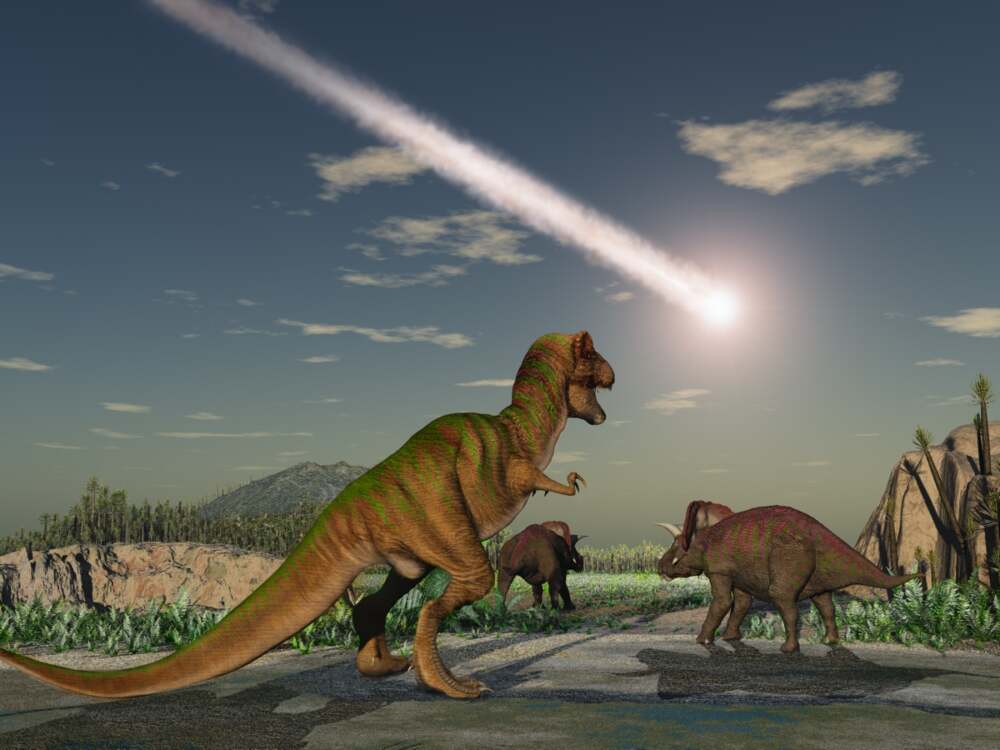
Scientists studying the mass extinction that wiped out the non-avian dinosaurs around 65 million years ago say that Earth’s landscapes and rock records didn’t just lose dinosaurs—it changed in ways much more fundamental than previously thought.
What the Research Found
- Geologists have compared rock layers deposited just before and just after the non-avian dinosaurs vanished, and discovered startling differences. Layers before the extinction event show certain sediment types, soil features, and chemical signatures that largely disappear in the layers immediately following the event.
- In particular, the study highlights changes in how land and rivers were eroded, how vegetation covered the ground, and how soils formed. These changes show up globally in many regions, indicating a planetary shift—not just a local or regional event.
- One of the surprising conclusions: it wasn’t just the comet or asteroid impact (often credited as the main extinction driver) that altered Earth’s systems—but the disappearance of the dinosaurs themselves may have played a bigger role in shaping soils, erosion, and vegetation cover than scientists had recognized.
Why the Dinosaurs’ Absence Might Have Mattered
- Dinosaurs weren’t just large animals—they were ecosystem shapers. Their feeding, trampling, movement, and waste production all affected vegetation, soil compaction, and the distribution of nutrients across landscapes. Without them, plant growth, leaf litter, soil stability, and river sediment loads all would have been altered.
- The loss of large herbivores (and large carnivores) likely meant less disturbance in many ecosystems—fewer trails, less soil turnover, less spread of seeds by large animals. That in turn could change what plants dominate, how water flows across land, and how soil layers build up.
- Over time, those effects accumulate: soils that were compacted or disrupted may get deeper, river channels might shift, floodplains may develop differently, and sediment deposition in many areas could change significantly.
Implications for Understanding the Mass Extinction
- This study suggests that to understand the full impact of the dinosaurs’ extinction, scientists need to look beyond the immediate causes (asteroid, climate change, volcanic activity) toward how ecosystems and geology responded after the die-off.
- Models of Earth’s recovery post-extinction may need updating: vegetation, soil, and sediment flux may have recovered more slowly or differently than we thought.
- It may also affect how scientists interpret fossil-bearing layers and ancient climates, since many of the signatures used to reconstruct past environments depend on assumptions about steady state ecosystems—including plant cover, soil structure, and erosion rates.
What Comes Next
- Further field studies in many parts of the world to verify whether these changes show up everywhere or mostly in certain regions—some environments may have been more affected than others.
- Closer geochemical and sedimentological work to track how quickly soils and vegetation rebounded, and how that affected climate feedbacks (for instance, soil erosion releasing dust, which can affect atmospheric conditions).
- Integration with climate and ecological models—seeing how the loss of large animals might have changed water flow, plant cover, and rainfall-runoff dynamics, and whether those changes could have themselves fed back into climate or weather systems.
Bottom Line
The extinction of non-avian dinosaurs wasn’t just about life being lost—it appears to have reshaped Earth itself. From soil textures to river systems to the spread of plants, the planet’s surface and ecology shifted in dramatic ways. This new research reveals that the aftermath of one of Earth’s greatest extinctions was a reshaping of Earth’s physical systems just as much as its biological ones.
Hashtags
#EarthHistory #Dinosaurs #MassExtinction #Geology #Paleontology #EcosystemChange #AncientEarth













Leave a Reply