

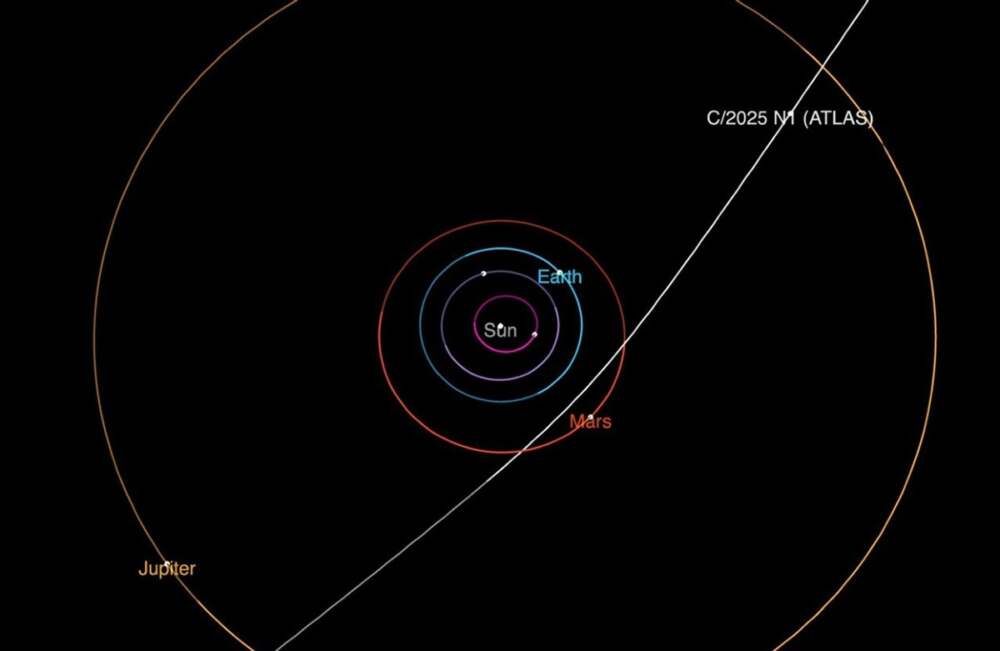
Scientists are keeping a close eye on 3I/ATLAS, a rare interstellar object currently speeding through our solar system, after evidence emerged that it may have collided with a solar coronal mass ejection (CME). The event offers a unique opportunity to see how an alien comet responds to intense solar activity.
A Brief Primer on 3I/ATLAS
3I/ATLAS was first detected in July 2025 and is only the third known interstellar object ever confirmed to pass through our solar system. Its trajectory is hyperbolic, meaning it came from outside the Sun’s gravitational influence and is not bound to our system.
Observations with the James Webb Space Telescope (JWST) showed that its coma (the cloud of gas and dust around the nucleus) is strongly dominated by carbon dioxide, with other volatiles like water, carbon monoxide, and dust also present. Its CO₂ to H₂O ratio is unusually high compared to typical solar system comets.
Spectroscopy suggests that the nucleus is outgassing more intensely on its sunward face, indicating active sublimation of ices as the object draws closer to the Sun.
Polarimetric studies reveal an unusual signature: a deep negative polarisation at small phase angles, which is stronger and narrower than typically seen in comets or asteroids. That suggests a surface or coma structure unlike any well-known comet.
The Solar Encounter: Collision with a Coronal Mass Ejection?
In late September 2025, the Sun unleashed a powerful coronal mass ejection—a massive burst of plasma and magnetic field lines. Models and space weather tracking indicate that this CME was likely directed toward 3I/ATLAS, potentially “hitting” the object as it raced past Mars at speeds exceeding 130,000 miles per hour (over 200,000 km/h).
While comets from within the solar system have experienced such events before—such as when comet Encke’s ion tail was momentarily stripped by a CME—this may be the first time an interstellar object is known to have merged paths with a solar blast. The effects are still speculative.
What Might Change?
- Tail disruption or variation: The CME may have disturbed magnetic field lines in the comet’s plasma environment, altering or temporarily severing ion tails. In prior solar encounters, comet tails sometimes regenerate within minutes.
- Coma brightness or structure: The influx of charged particles or plasma could trigger new activity, producing jets, outbursts, or changes in the coma’s density or symmetry.
- Gauge resilience of interstellar materials: Because 3I/ATLAS likely formed in a completely different environment, observing how it endures or reacts to this solar shock provides clues about its physical structure and durability.
It is generally believed that the CME impact is unlikely to significantly alter 3I/ATLAS’s trajectory, especially if its mass is large (estimates suggest a nucleus mass on the order of tens of billions of tons). But surface or coma features may be more immediately affected.
Why This Event Is Scientifically Valuable
- Rare natural experiment: There are few precedents for observing how interstellar objects respond to solar events, giving scientists a rare comparative case.
- Composition tests under duress: Any changes triggered by the CME could reveal hidden volatiles or structural weaknesses that remain hidden under normal solar heating.
- Understanding comet evolution: Seeing how different materials (ices, dust, organics) respond under extreme conditions helps refine models of cometary activity and degradation.
- Clues to interstellar formation: Because 3I/ATLAS may have formed in a distant protoplanetary disk, its response to the solar blast may hint at how cometary bodies from other systems differ from ours.
What’s Next & What to Watch
- As 3I/ATLAS moves closer to perihelion (its closest approach to the Sun), astronomers will monitor its brightness, tail structure, and coma shape for signs of anomalous behavior linked to the CME.
- Observatories such as Hubble, JWST, and large ground-based facilities will aim to capture high-resolution spectra and imagery before the comet is blocked from view (solar conjunction).
- Spacecraft around Mars or other inner solar system probes may attempt opportunistic imaging or tracking if the object passes near their line of sight.
- The community will look for temporal changes—jets, asymmetric outflows, sudden fading or brightening—that coincide with the CME timeline.
Bottom Line
3I/ATLAS is already a rare interstellar visitor, but the possibility that it was “nuked” by a solar explosion elevates its importance. It presents a once-in-a-lifetime chance to see how material from another star system responds to one of the most intense environments in our neighborhood. Depending on how the object weathers this event, astronomers may unlock new insights into the composition, structure, and resilience of interstellar bodies—information that could reshape how we understand cometary and planetary formation across the galaxy.











Leave a Reply