

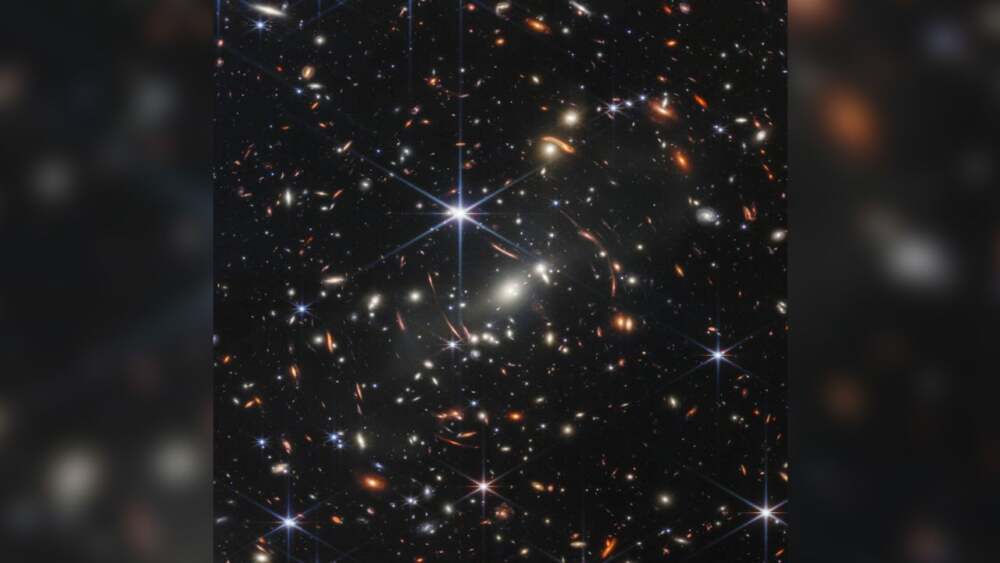
In a stunning technological achievement, scientists have used artificial intelligence to fix a subtle but significant problem that had been affecting the clarity of the James Webb Space Telescope’s images. The correction — accomplished entirely through software — has sharpened the telescope’s cosmic vision without requiring any physical intervention in space.
A Space Telescope in Need of a Tune-Up
Since its launch, the James Webb Space Telescope (JWST) has transformed our understanding of the universe with breathtaking images of distant galaxies, exoplanets, and star nurseries. However, astronomers recently noticed that one of Webb’s most advanced imaging systems — the Aperture Masking Interferometry (AMI) mode of its Near-Infrared Imager and Slitless Spectrograph (NIRISS) — was producing slightly blurred images.
The culprit turned out to be a subtle detector issue known as the “brighter-fatter effect.” This occurs when electronic charge spreads between neighboring pixels in the telescope’s camera sensors, causing faint distortions in the captured images. While the effect was minor, it reduced the precision of observations crucial for studying exoplanets and faint celestial phenomena.
The AI Solution
A team of researchers developed an artificial intelligence-based correction system called AMIGO (Aperture Masking Interferometry Generative Observations). The neural network was trained to recognize and correct these distortions by analyzing both real and simulated Webb data.
Instead of replacing hardware or sending a costly servicing mission into space, scientists applied this AI model directly to Webb’s data pipeline. The results were immediate — images that were previously blurry became crisp and detailed.
This approach effectively gave the telescope a software-driven vision upgrade, ensuring that Webb can continue to capture the universe with unprecedented accuracy.
Sharper Images, Deeper Discoveries
With the fix in place, Webb’s interferometric imaging system can now resolve finer details than ever before. Astronomers can:
- Detect fainter exoplanets orbiting nearby stars.
- Study the intricate structures of distant galaxies and nebulae.
- Observe subtle atmospheric signatures that could reveal signs of life on other worlds.
This marks a major step forward in space science — showing how artificial intelligence can enhance the performance of billion-dollar space instruments without the need for physical repairs.
A New Era of “Smart” Space Telescopes
This breakthrough represents more than just a technical fix. It’s a glimpse into the future of astronomy, where spacecraft and observatories may rely heavily on AI for self-diagnosis, correction, and optimization.
By applying adaptive software solutions like this, future telescopes could automatically compensate for aging hardware, sensor drift, or environmental effects in space — extending their lifespan and improving data quality for decades.
The James Webb Telescope’s AI-assisted recovery also showcases the power of international collaboration, uniting engineers, astrophysicists, and computer scientists in solving a complex problem that blends physics and machine learning.
Looking Ahead
With its new AI-enhanced clarity, the James Webb Space Telescope is now better equipped to tackle its most ambitious goals: exploring the first galaxies, mapping distant solar systems, and uncovering the secrets of cosmic evolution.
This innovation proves that even in the vacuum of space, intelligence — both human and artificial — can work hand in hand to keep our eyes on the stars sharper than ever.










Leave a Reply