

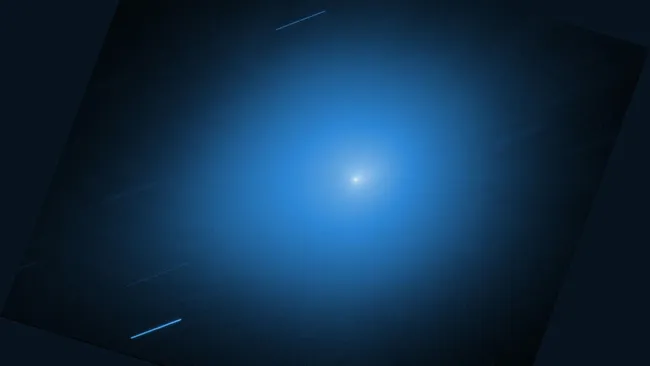
Astronomers around the world are celebrating an unexpected holiday treat: the interstellar comet 3I/ATLAS is making a close approach to Earth, providing a rare opportunity to study material from beyond our solar system. Such interstellar visitors are exceedingly uncommon, and each encounter offers a unique window into the composition and dynamics of distant planetary systems.
A Rare Interstellar Visitor
3I/ATLAS, first detected in 2023, is only the third confirmed interstellar object observed passing through our solar system, following the discoveries of ‘Oumuamua in 2017 and Comet Borisov in 2019. Unlike objects that orbit the Sun within our solar system, interstellar comets originate from distant star systems, traveling vast distances across the galaxy.
Its trajectory brings it unusually close to Earth, allowing astronomers to collect high-resolution data on its structure, composition, and tail activity. Scientists describe this proximity as a “once-in-a-lifetime” observational opportunity.
What Makes 3I/ATLAS Special
Several features distinguish 3I/ATLAS from other comets:
- Interstellar Origin: Its hyperbolic trajectory confirms that it is not gravitationally bound to the Sun, meaning it originated from outside the solar system.
- Compositional Clues: Spectroscopy of the comet’s coma and tail can reveal the presence of ices, dust, and organic molecules, offering insights into the building blocks of planets in other star systems.
- High-Speed Passage: Traveling at tens of kilometers per second relative to the Sun, the comet’s rapid motion provides a natural laboratory to study how interstellar objects interact with the solar wind and radiation.
Observational Opportunities
The comet’s close approach allows astronomers to use both ground-based telescopes and space observatories to gather data. Observatories will focus on:
- Imaging the coma and tail to study dust and gas release.
- Spectroscopic analysis to identify chemical compounds and compare them with solar system comets.
- Trajectory monitoring to refine models of interstellar object dynamics.
Citizen scientists and amateur astronomers are also encouraged to observe the comet, as its brightness may make it visible through medium-sized telescopes under dark skies.
Why This Matters
Studying 3I/ATLAS can provide critical insights into the formation and evolution of planetary systems beyond our own. By analyzing its composition, scientists hope to understand the diversity of materials present in other parts of the galaxy and how interstellar objects may contribute to planetary formation or even seed life-bearing compounds.
Additionally, every interstellar encounter helps refine our ability to detect and track similar objects, improving preparedness for future discoveries.
A Cosmic Holiday Treat
The comet’s timing—approaching Earth during the holiday season—has led many astronomers to call it an “early Christmas gift”. Beyond its scientific value, the event has captured the public imagination, inspiring stargazers to marvel at the presence of a visitor from another star system in our night sky.
As 3I/ATLAS continues on its hyperbolic path, astronomers are racing to collect as much data as possible before it fades into the depths of space, leaving behind only the knowledge gained from this rare and fleeting cosmic encounter.












Leave a Reply