

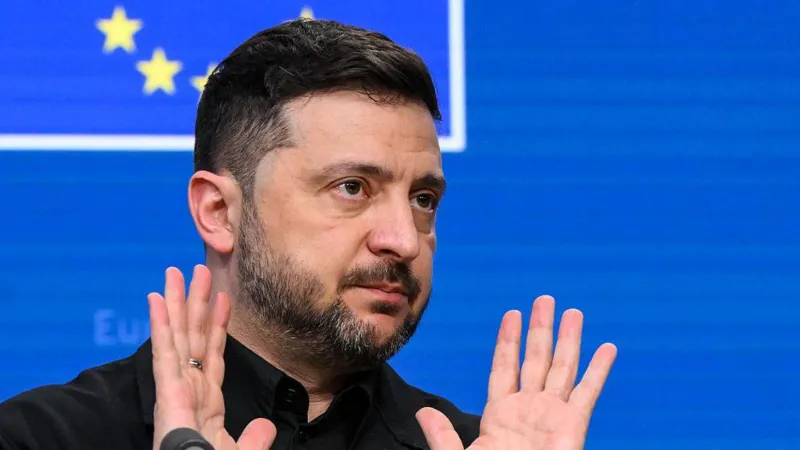
As European Union leaders gather for high-stakes discussions on the future of Russia’s frozen assets, Ukrainian President Volodymyr Zelensky has issued a stark warning: hesitation now could prolong the war and undermine Europe’s credibility in confronting aggression.
Speaking amid growing battlefield pressure and deepening economic strain on Ukraine, Zelensky argued that the vast sums of Russian state money immobilized in European financial systems should no longer sit idle. Instead, he said, those funds must be transformed into tangible support for Ukraine’s defense, reconstruction, and long-term stability.
Billions in Limbo
Since the early days of Russia’s full-scale invasion of Ukraine, Western governments have frozen hundreds of billions of dollars’ worth of Russian central bank reserves and other state-linked assets. A significant portion of that money is held within EU jurisdictions, making Europe central to the debate over what happens next.
Until now, the EU has largely limited itself to using the interest generated by those frozen assets to help fund aid to Ukraine. While this approach has avoided legal and financial risks, critics argue it falls far short of what is needed as the war grinds on and Ukraine’s reconstruction bill continues to soar.
Zelensky made clear that incremental measures are no longer enough. In his view, allowing Russia’s wealth to remain untouched while Ukrainian cities, infrastructure, and lives are destroyed sends the wrong signal—not only to Moscow, but to the wider world.
A Warning to Europe
The Ukrainian president framed the issue as a test of resolve. He cautioned that failing to act decisively could embolden authoritarian states and normalize the idea that large-scale aggression carries limited consequences. According to Zelensky, Europe must show that violating international law comes at a real and lasting cost.
He also emphasized that the assets in question represent resources Russia accumulated through years of integration into the global financial system—benefits that, he argued, should be forfeited once that system is violently challenged.
“Every delay,” Zelensky suggested, “is another day Russia believes time is on its side.”
Divisions Within the EU
Behind closed doors, EU leaders remain divided. Some member states support the idea of seizing the frozen assets outright and redirecting them to Ukraine. They argue that legal pathways can be created and that extraordinary circumstances justify extraordinary measures.
Others are more cautious. Concerns range from potential violations of international law to fears that confiscation could undermine trust in Europe as a safe place for foreign reserves. There are also worries about setting precedents that could one day be used against EU countries themselves.
Financial stability is another factor. Central banks and legal experts have warned that abrupt seizures could trigger market uncertainty or provoke retaliatory actions from Russia, including further economic or cyber measures.
The Stakes for Ukraine
For Ukraine, the outcome of these talks could be pivotal. The country faces mounting costs to repair energy systems, housing, transport networks, and public services damaged by relentless attacks. At the same time, military aid remains essential as fighting continues along multiple fronts.
Zelensky has repeatedly stressed that frozen Russian assets are not merely a source of funding, but a matter of justice. From Kyiv’s perspective, using Russian state money to rebuild what Russian forces have destroyed is both morally and politically justified.
A Defining Moment
As EU leaders deliberate, the pressure is intensifying. The decision they make—or fail to make—will shape not only Ukraine’s future, but Europe’s role as a geopolitical actor willing to back its principles with action.
Zelensky’s warning underscores the broader message: neutrality and caution may feel safe, but in times of war, they can carry their own risks. For Europe, the question now is whether it is prepared to move from freezing assets as a symbolic gesture to using them as a strategic tool with real-world impact.










Leave a Reply