

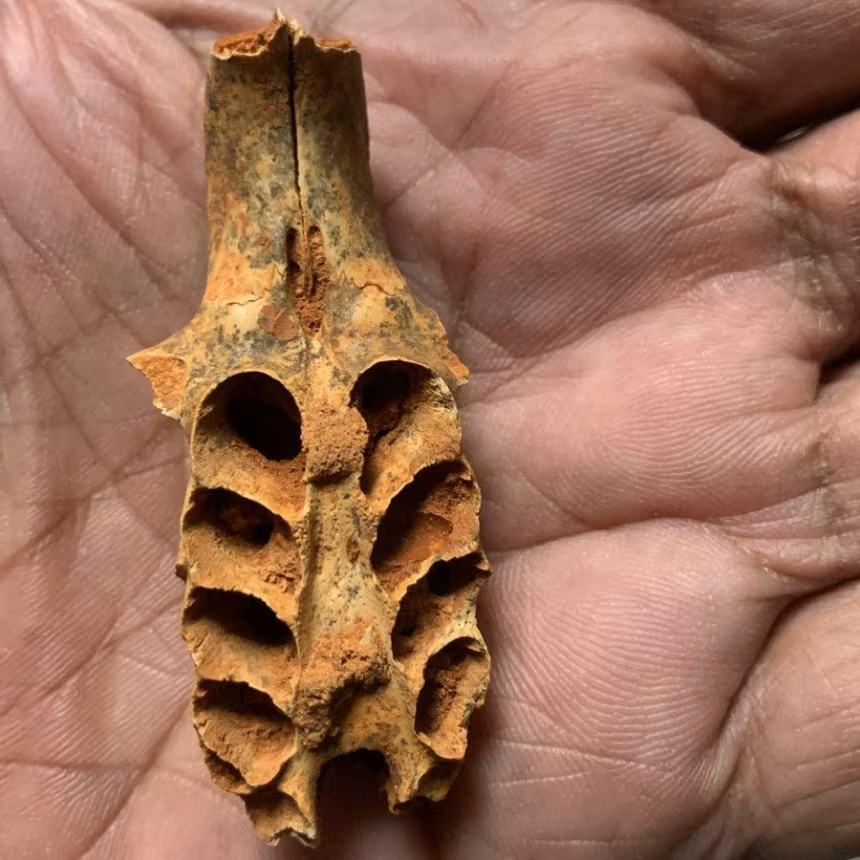
Paleontologists have uncovered ancient bee nests preserved in fossils, offering a remarkable glimpse into behaviors that have not been observed in modern bee species. The discovery sheds light on the social and ecological practices of bees millions of years ago, providing new insights into the evolution of these crucial pollinators.
Unearthing the Fossilized Nests
The fossils, discovered in sedimentary rock formations dating back tens of millions of years, contain remarkably well-preserved nests with evidence of individual and communal activity. Researchers used high-resolution imaging and careful excavation to study the intricate structure of the nests, revealing details about how ancient bees constructed and organized their colonies.
A Never-Before-Seen Behavior
What makes this discovery particularly extraordinary is the evidence of a nesting strategy not seen in contemporary bees. Unlike modern solitary or highly social bees, the fossilized nests suggest a hybrid approach:
- Bees built interconnected chambers for individual offspring while maintaining communal areas for shared resources.
- The layout indicates coordinated construction and cooperative defense, hinting at a level of social complexity previously unknown in ancient bee species.
Dr. Elena Martinez, a lead researcher on the study, explained, “These nests challenge our understanding of bee evolution. They show behaviors that bridge the gap between solitary and eusocial lifestyles, suggesting that bees experimented with a variety of social structures long before modern species emerged.”
Implications for Evolutionary Biology
The discovery has profound implications for understanding how bee social behaviors evolved. By studying the fossilized nests, scientists can infer:
- How ancient bees adapted to environmental pressures, such as predators or resource scarcity.
- The origins of cooperative behaviors seen in modern species like honeybees and bumblebees.
- The evolutionary experimentation that may have led to diverse nesting strategies in contemporary pollinators.
Broader Ecological Significance
Bees play a critical role in pollination, both historically and today. Understanding their ancient behaviors provides context for the development of ecosystems and flowering plants over millions of years. Fossil evidence like this helps reconstruct ancient landscapes, revealing interactions between insects, plants, and other species.
Future Research Directions
Researchers plan to study additional fossil sites and apply micro-CT scanning to examine nest interiors in 3D. By doing so, they hope to map behavioral patterns across different ancient bee species and better understand how environmental changes influenced social evolution.
This remarkable discovery underscores the complexity of ancient ecosystems and offers a rare window into the lives of insects that shaped the evolution of pollination on Earth.
















Leave a Reply