

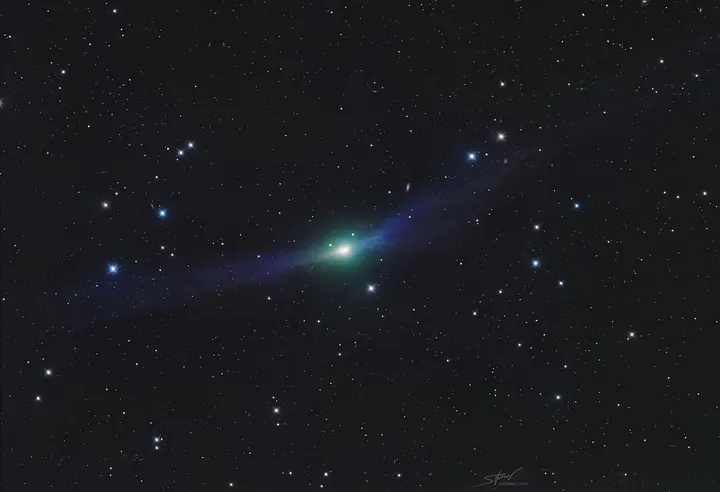
Astronomers have confirmed that the interstellar object 3I/ATLAS will pass through the solar system without posing any danger to Earth, offering a rare opportunity to study a visitor from beyond our stellar neighborhood. Observations indicate that the object is on a hyperbolic trajectory, meaning it is merely passing through and will continue on its journey into deep space.
What is 3I/ATLAS?
3I/ATLAS is the third confirmed interstellar object detected within our solar system, following 1I/‘Oumuamua in 2017 and 2I/Borisov in 2019. It was identified by the Asteroid Terrestrial-impact Last Alert System (ATLAS), a wide-field survey designed to detect near-Earth objects. Unlike asteroids and comets native to our solar system, interstellar objects originate from distant star systems, carrying unique chemical signatures and physical characteristics.
Trajectory and Distance
Current calculations indicate that 3I/ATLAS will not approach closer than several million kilometers from Earth, effectively “ignoring” our planet in its swift transit. Scientists emphasize that there is no risk of collision, and its hyperbolic orbit confirms it is not gravitationally bound to the Sun.
Scientific Opportunities
Although the object poses no threat, it provides astronomers with a valuable research opportunity. Spectroscopic analysis can reveal its composition, potentially offering clues about conditions in its home star system. Early data suggest unusual surface characteristics that differ from typical solar system bodies, hinting at its interstellar origin.
Researchers plan to track 3I/ATLAS as long as it remains visible, using both ground-based telescopes and space observatories. Observations of its trajectory, spin, and potential outgassing events will help scientists better understand how such interstellar objects behave when passing near a star.
Public Fascination
Interstellar objects like 3I/ATLAS capture the imagination, reminding the public that our solar system is not isolated but part of a vast galaxy filled with wandering celestial visitors. Social media and astronomy communities have responded with excitement, sharing observation tips and virtual tracking resources for amateur astronomers.
While Earth remains untouched by this cosmic traveler, 3I/ATLAS represents a small window into the universe beyond our solar neighborhood. Its fleeting visit reinforces the importance of continuous sky monitoring and offers a rare chance to glimpse materials from another star system before it vanishes into the depths of interstellar space.














Leave a Reply