

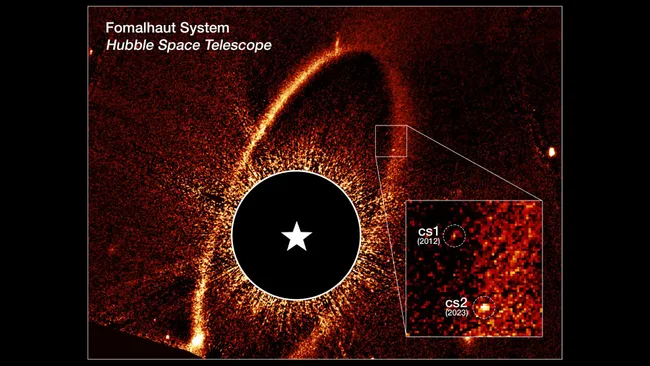
Astronomers have reported a rare and “unprecedented celestial event” occurring around a nearby star famously nicknamed the “Eye of Sauron”, located approximately 25 light-years from Earth. The discovery, made using advanced space- and ground-based telescopes, has captivated the scientific community and sparked widespread curiosity about the star’s unusual activity.
What Makes the Star Special?
The “Eye of Sauron” star, named for its striking appearance reminiscent of the fictional icon from The Lord of the Rings, is known for a prominent dust ring or asymmetrical feature that makes it visually distinctive in telescope imagery. Until now, the star had been relatively well-understood, with routine observations of its dust disk and potential exoplanetary system.
The Unprecedented Event
Recent observations revealed sudden and dramatic changes in the star’s surrounding material, including unexpected brightening, unusual emissions in infrared and visible light, and rapid structural shifts in its circumstellar disk. Scientists describe the activity as unlike anything previously documented for a star of this type.
Dr. Elena Martinez, an astrophysicist involved in the study, said, “We’ve never seen a phenomenon like this so close to Earth. The intensity and pattern of the emissions are completely unexpected, and they may point to dynamic interactions between the star and its surrounding material.”
Possible Explanations
While the exact cause remains uncertain, researchers are exploring several possibilities:
- Collisions between large asteroids or planetesimals, sending debris into the disk.
- Magnetic or stellar flare activity that temporarily alters the star’s brightness and surrounding material.
- Interactions with an unseen exoplanet or companion object, potentially stirring the circumstellar environment in novel ways.
Further observations over the coming months are planned to monitor changes and gather additional data. High-resolution spectroscopy and multi-wavelength imaging will help scientists narrow down the potential causes and understand the mechanisms behind this rare occurrence.
Implications for Astronomy
The event is an important reminder that even nearby stars can surprise scientists with phenomena that challenge existing models of stellar behavior. Observing such unprecedented activity offers a unique laboratory to study star-disk interactions, planetary formation, and the dynamic evolution of nearby stellar systems.
For astronomy enthusiasts and researchers alike, the “Eye of Sauron” star provides a once-in-a-lifetime opportunity to witness cosmic processes in real-time, just 25 light-years from our own solar system.














Leave a Reply