

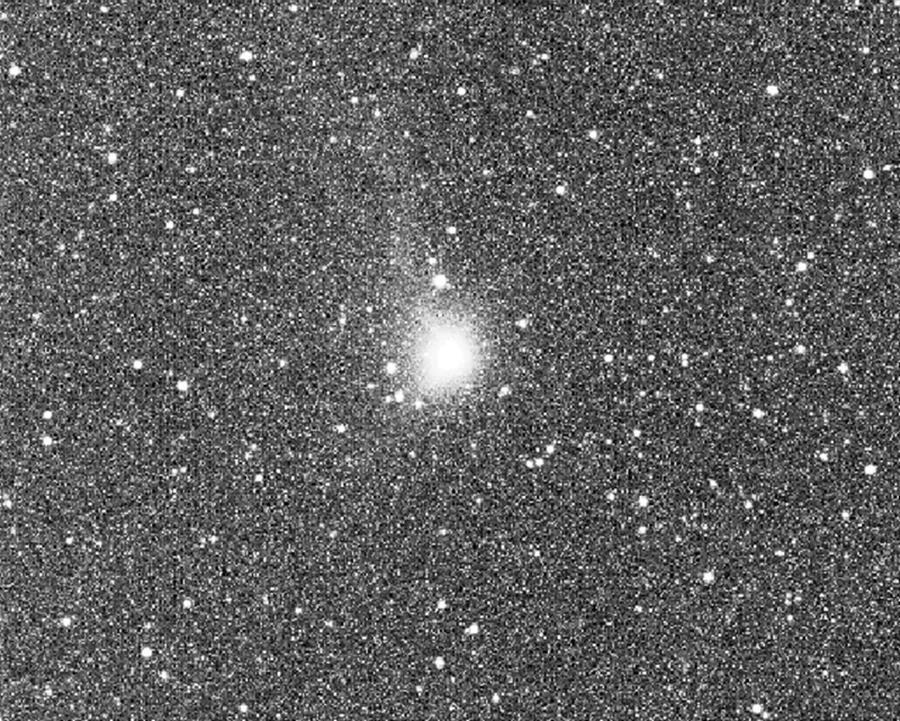
The European Space Agency’s (ESA) Jupiter Icy Moons Explorer (JUICE) mission has provided fresh insights into 3I/ATLAS, one of the intriguing celestial objects in the Jovian system. Recent observations reveal unexpected activity, shedding light on dynamic processes occurring in Jupiter’s complex satellite environment.
JUICE, launched to study Jupiter and its icy moons, has been collecting high-resolution data on magnetic fields, radiation, and surface features. The latest findings from 3I/ATLAS indicate subtle but consistent changes in its activity patterns, suggesting interactions with Jupiter’s powerful magnetosphere and possible surface or subsurface processes that were previously undetected. Scientists are particularly excited about evidence pointing to transient plumes or surface emissions, phenomena that could provide clues about the object’s composition and internal dynamics.
The mission’s suite of instruments, including spectrometers, imaging systems, and particle analyzers, has allowed ESA researchers to detect variations in electromagnetic signatures and particle flows near 3I/ATLAS. These variations may indicate ongoing surface activity or interactions with Jupiter’s charged particle environment, which could have implications for understanding both the object’s geologic history and potential habitability factors.
ESA scientists have emphasized the significance of these findings in the broader context of solar system exploration. Understanding activity on smaller Jovian bodies like 3I/ATLAS helps researchers piece together the evolution of moons and minor objects in the gas giant’s orbit, offering a comparative perspective with other icy satellites such as Ganymede, Callisto, and Europa.
The JUICE team plans to continue monitoring 3I/ATLAS closely as the spacecraft approaches its target moons. Detailed analysis of the object’s surface and magnetic environment will provide further insights into its composition, rotational dynamics, and interaction with Jupiter’s magnetosphere. Early indications suggest that these processes may be more active and complex than previously believed, opening up new avenues for exploration and study.
ESA’s JUICE mission, already celebrated for its ambitious goal of investigating Jupiter’s habitability potential, continues to demonstrate the value of sustained observation in the outer solar system. By tracking activity on 3I/ATLAS, the mission not only advances our understanding of Jupiter’s satellite system but also informs models of planetary formation and evolution across the solar system.
As data from JUICE continues to stream in, astronomers and planetary scientists anticipate additional discoveries that could challenge existing assumptions about small Jovian bodies. The ongoing revelations from 3I/ATLAS underscore the importance of missions like JUICE in expanding humanity’s knowledge of the outer solar system, highlighting the dynamic and active nature of objects once thought to be static.















Leave a Reply