

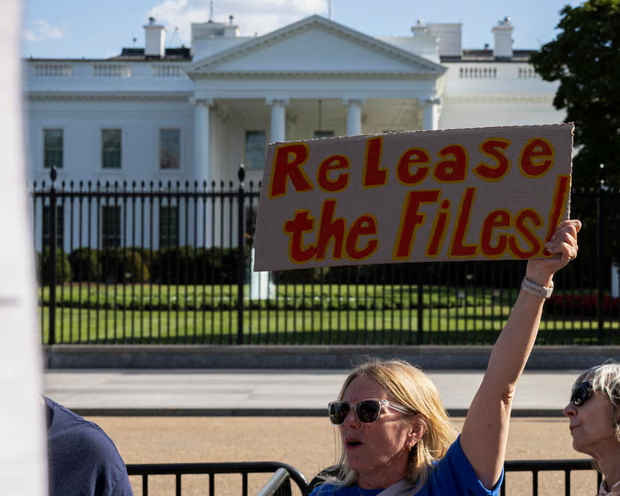
Former U.S. President Donald Trump has voiced fresh frustration over the renewed public focus on Jeffrey Epstein, arguing that the ongoing release and discussion of Epstein-related files is unfairly damaging people who had only superficial or innocent contact with the disgraced financier. Trump’s remarks add to an already heated debate about accountability, guilt by association, and the line between transparency and reputational harm.
Epstein, a wealthy financier with extensive social and political connections, died in jail in 2019 while awaiting trial on federal sex trafficking charges. Since then, his name has become synonymous with elite scandal, secrecy, and unanswered questions. Court filings, witness statements, and document releases tied to Epstein have periodically resurfaced, reigniting public interest and speculation about the powerful figures who once crossed paths with him. Each new disclosure tends to trigger waves of headlines and social media scrutiny, even when the documents themselves make no criminal allegations against many of the people mentioned.
Trump has argued that this dynamic is fundamentally unjust. According to him, simply appearing in Epstein-related records, photographs, or contact lists does not equate to wrongdoing. He has suggested that Epstein deliberately cultivated relationships with prominent individuals and that many of those encounters were brief, professional, or social in nature, without any knowledge of Epstein’s criminal behavior.
In Trump’s view, the current climate risks turning association into accusation. He has warned that reputations built over decades can be damaged overnight by implication alone, especially in an era when nuance is often lost in viral headlines. Trump’s comments reflect a broader concern shared by some legal experts and civil liberties advocates: that public discourse may be blurring the distinction between documented criminal conduct and mere proximity to a criminal figure.
At the same time, Trump’s remarks have drawn criticism from those who argue that transparency is essential, particularly in cases involving alleged abuse and exploitation. Victims’ advocates emphasize that Epstein was able to operate for years precisely because of his access to wealth and influence. From this perspective, public scrutiny of his network is not about punishing the innocent, but about understanding how power structures can shield wrongdoing and silence victims.
The debate highlights a central tension in modern accountability culture. On one hand, there is a strong demand for openness, especially in cases involving sexual abuse, trafficking, and systemic failures. On the other hand, there is growing unease about the potential for overreach, where names mentioned in documents become targets of suspicion without evidence of criminal activity.
Trump’s own history with Epstein has been scrutinized in the past, though no criminal allegations have been made against him in connection with Epstein’s crimes. Trump has previously said he distanced himself from Epstein years before the financier’s legal troubles became public. By speaking out now, Trump appears to be positioning himself not only in defense of his own reputation, but also as a critic of what he sees as a broader cultural tendency to assume guilt by association.
Legal analysts note that court documents can be misleading when taken out of context. Names may appear because someone attended a party, shared a business introduction, or was mentioned by a third party, not because they engaged in illegal conduct. Without careful reading, the release of such material can fuel speculation that goes far beyond what the facts support.
Still, others counter that discomfort among elites should not overshadow the experiences of victims. They argue that if document releases prompt deeper investigations, cultural reckoning, or reforms that protect vulnerable people, then the scrutiny serves a public good—even if it is messy and controversial.
As Epstein-related material continues to surface, Trump’s comments underscore how divisive the issue remains. The conversation is no longer only about Epstein himself, but about how society balances transparency, justice, and fairness. Whether the focus will shift toward clearer accountability standards or continue to play out in the court of public opinion remains an open question, with reputations, trust, and credibility all hanging in the balance.
















Leave a Reply