

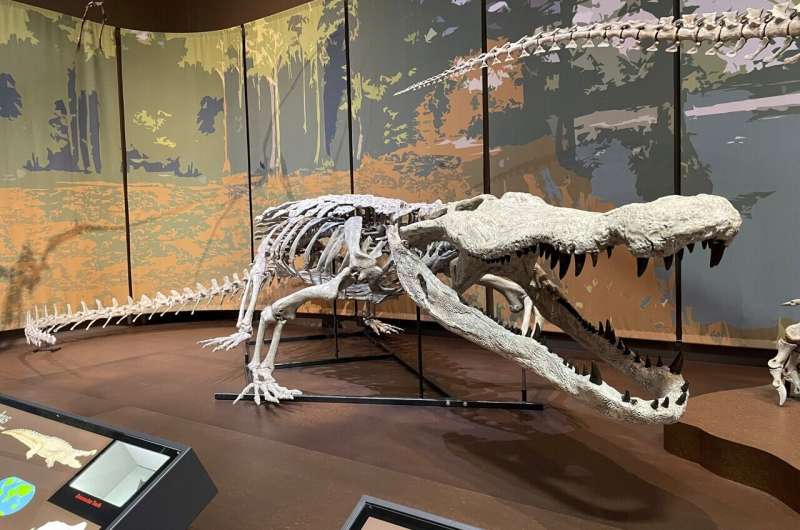
After decades of research and meticulous reconstruction, paleontologists have unveiled the first scientifically accurate fossil replica of a prehistoric crocodile that once dominated ancient ecosystems—and may have hunted dinosaurs. The replica, based on extensive fossil evidence and cutting-edge reconstruction techniques, provides an unprecedented glimpse into the anatomy, behavior, and ecological role of one of history’s most formidable predators.
The crocodile in question, a giant species from the Mesozoic era, has long captivated scientists for its size, power, and predatory adaptations. Fossil fragments discovered over the last century hinted at its massive jaws, armored body, and lethal hunting capabilities, but incomplete skeletal remains made it difficult to fully reconstruct the animal. The new replica combines decades of discoveries from multiple sites, digital modeling, and traditional paleontological expertise to create a lifelike representation of this apex predator.
Dr. Helena Marlowe, a lead paleontologist on the project, explained the significance of the replica: “This is more than just a display piece. It’s a tool for research and education. By accurately reconstructing the skeleton and musculature, we can study its biomechanics, estimate its bite force, and better understand how it coexisted with dinosaurs and other prehistoric species.”
The replica was created using a combination of high-resolution 3D scanning, laser imaging, and anatomical modeling. Researchers painstakingly compared fossilized bones from multiple specimens, filled gaps using comparative anatomy with modern crocodilians, and employed digital sculpting to ensure precision. This multidisciplinary approach allowed them to produce a reconstruction that is faithful to current scientific understanding while remaining visually striking.
One of the most fascinating aspects of the project is the insight it provides into the crocodile’s predatory behavior. Analysis of jaw structure and tooth placement suggests it was capable of ambushing prey far larger than itself, potentially including juvenile dinosaurs. Its robust tail and heavily armored body would have made it a dominant predator in its aquatic and semi-aquatic habitats. Researchers hope the replica will serve as a foundation for further studies on predator-prey interactions during the Mesozoic era.
The unveiling of the replica has already generated excitement among scientists, museum curators, and the public. Life-size casts are planned for several natural history museums worldwide, providing visitors with the chance to see a prehistoric predator in striking detail. Educational programs accompanying the displays aim to highlight not only the animal itself but also the scientific methods involved in reconstructing extinct species.
Beyond its immediate scientific and educational impact, the replica demonstrates the evolution of paleontological techniques. Earlier reconstructions of prehistoric crocodiles often relied on incomplete fossils or speculative anatomy. Today’s approach, which integrates technology with classical paleontology, allows for unprecedented accuracy and offers a template for reconstructing other extinct species with limited fossil records.
Dr. Marlowe emphasized that this milestone represents both an achievement and a stepping stone: “We’ve answered many questions about this incredible predator, but there’s still so much to learn. Each fossil we find, each new technique we develop, brings us closer to fully understanding the ecosystems of the past.”
The completion of this fossil replica underscores the importance of perseverance, collaboration, and innovation in the scientific community. Decades of fieldwork, lab analysis, and creative problem-solving have culminated in a tangible, research-backed model that will inspire future generations of paleontologists and enthusiasts alike.
As museums prepare to showcase the replica, the public will gain a rare opportunity to witness a creature that ruled ancient waters and perhaps even stalked the shores alongside dinosaurs—a true window into a long-extinct world brought to life by modern science.










Leave a Reply