

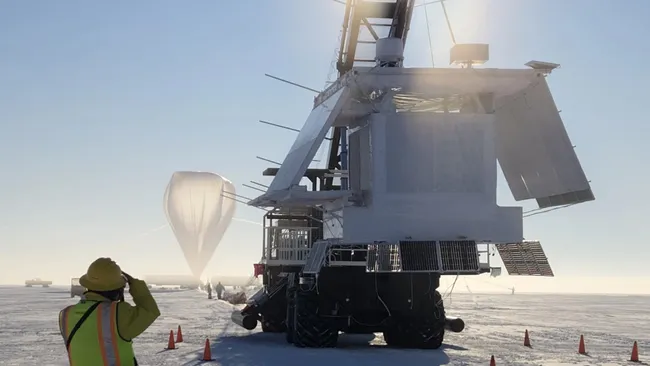
NASA has successfully launched a high-altitude science balloon over Antarctica, marking a significant step in the agency’s ongoing efforts to study cosmic phenomena and Earth’s atmosphere. The mission, conducted in collaboration with international research teams, aims to collect critical data on cosmic radiation, magnetic fields, and other astrophysical processes, offering unique insights that are difficult to obtain through satellite or ground-based observations.
The balloon, equipped with a suite of advanced scientific instruments, ascended to the stratosphere above Antarctica, reaching altitudes of more than 40 kilometers (25 miles). At these heights, it operates above the bulk of Earth’s atmosphere, providing a nearly unobstructed view of cosmic sources of radiation and other space-based phenomena. This environment allows researchers to conduct precise measurements and experiments that would otherwise be compromised by atmospheric interference.
Dr. Laura Mitchell, a lead scientist on the mission, explained the significance of Antarctic launches: “The Antarctic environment is uniquely suited for long-duration balloon flights. The stable polar vortex winds allow the balloon to circumnavigate the continent, giving us extended observation time over pristine skies with minimal atmospheric disturbances.”
The mission is part of NASA’s broader program of balloon-borne science, which has been instrumental in studying cosmic microwave background radiation, cosmic rays, and high-energy astrophysical events. The instruments aboard the balloon are designed to detect high-energy particles, observe cosmic radiation, and capture data that could improve our understanding of the universe’s origins, as well as the behavior of our planet’s magnetosphere.
One of the key objectives of this flight is to study the interactions between cosmic rays and Earth’s atmosphere. By analyzing how these high-energy particles interact with atmospheric molecules, scientists hope to refine models of particle physics, gain insights into solar activity, and even improve predictions of space weather events that can impact satellites and global communications systems.
The balloon’s payload also includes advanced imaging and spectrometry instruments capable of observing distant celestial objects and phenomena. Researchers are particularly interested in tracing the origins of ultra-high-energy cosmic rays, which remain one of the most enduring mysteries in astrophysics. The data collected could help identify potential sources, such as supernovae, neutron stars, or other energetic cosmic events.
In addition to scientific exploration, the Antarctic balloon program serves as a testing ground for new technologies that may eventually be deployed on satellites or deep-space missions. Instruments are evaluated for their resilience to extreme conditions, including low temperatures, high radiation exposure, and mechanical stress, ensuring that future space-based systems are reliable and effective.
Public fascination with the mission is growing, as images and live updates from the balloon provide a rare glimpse into the upper reaches of Earth’s atmosphere. The combination of scientific discovery and the breathtaking Antarctic landscape highlights both the technological sophistication and the adventurous spirit of modern space research.
NASA expects the balloon to remain aloft for several days, completing a carefully planned trajectory before returning its payload safely via parachute. After recovery, the data will be analyzed by teams across multiple institutions, contributing to ongoing research in astrophysics, atmospheric science, and space weather prediction.
This launch underscores NASA’s commitment to innovative and cost-effective methods for exploring the universe. By leveraging high-altitude balloons, the agency can conduct world-class research without the expense and complexity of orbital missions, while continuing to expand humanity’s understanding of both the cosmos and our own planet.














Leave a Reply