

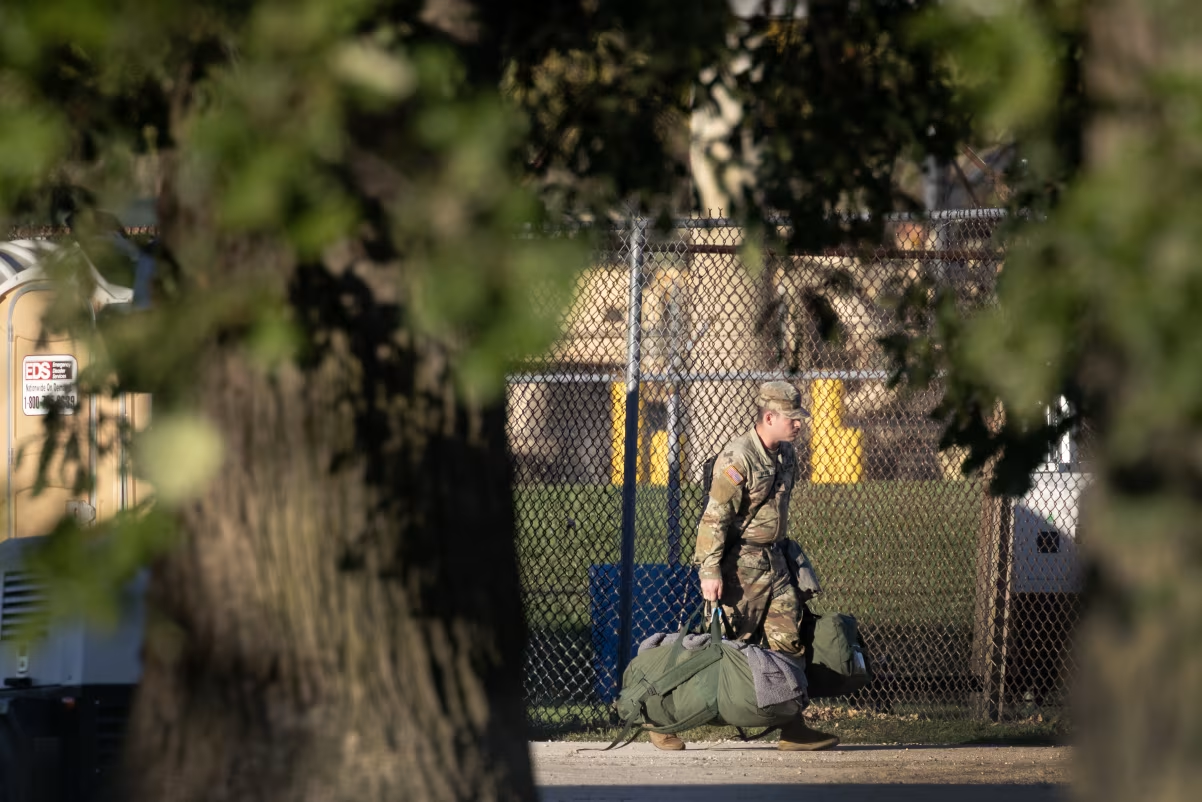
A recent Supreme Court decision clarifying federal authority over the National Guard has reopened a long-simmering debate in Washington about the scope of presidential power—particularly how a future Trump administration could invoke the Insurrection Act during periods of domestic unrest.
While the ruling itself focused narrowly on command authority and the relationship between state governors and the federal government, legal experts say its implications reach much further. At the center of the renewed controversy is the Insurrection Act, a centuries-old law that grants the president sweeping powers to deploy military forces inside the United States under specific circumstances.
Why the Decision Matters
The Supreme Court’s decision reinforced the federal government’s ability to assert control over National Guard units when they are placed under federal authority. Although the case did not directly address the Insurrection Act, it clarified legal boundaries that would likely shape how such a move is carried out in practice.
Constitutional scholars note that the ruling strengthens the legal foundation for federal intervention, potentially lowering barriers for a president to override state objections during emergencies. Critics argue this could weaken long-standing norms that prioritize civilian control at the state level except in the most extreme situations.
Renewed Focus on the Insurrection Act
The Insurrection Act allows the president to deploy the military domestically to suppress rebellion, enforce federal law, or protect civil rights when state authorities are unable or unwilling to do so. The law does not require approval from Congress or governors, giving the president unilateral discretion.
During his first term, Donald Trump openly considered invoking the Insurrection Act amid nationwide protests, alarming civil liberties groups and prompting pushback from military leaders. Although it was never formally used at that time, the episode left unresolved questions about limits, oversight, and accountability.
The Supreme Court’s National Guard ruling has now brought those questions back into the spotlight.
Trump Factor Looms Large
With Trump once again a central figure in American politics, lawmakers and legal analysts are reexamining how the Insurrection Act could be applied under a future administration. Supporters argue the law is a necessary tool to restore order in extraordinary circumstances. Opponents counter that its vague language leaves too much room for political misuse.
Some Democrats and civil rights organizations say the Court’s decision underscores the urgency of reform. They argue that clearer statutory definitions and stronger checks are needed to prevent what they see as potential abuse of military power against civilians.
Republicans, meanwhile, caution against weakening executive authority, insisting that presidents must retain flexibility to respond rapidly to national emergencies.
Calls for Reform Grow Louder
In the wake of the ruling, bipartisan discussions have quietly resumed on Capitol Hill about updating the Insurrection Act. Proposals include requiring congressional notification, setting time limits on deployments, and clarifying what constitutes an “insurrection” or “domestic violence” under the law.
However, passing reforms remains politically difficult, especially in an election-charged environment where questions of law, order, and executive power are deeply polarized.
A Legal Debate Far From Over
The Supreme Court may not have intended to spark a broader constitutional debate, but its decision has done just that. By reaffirming federal authority over the National Guard, the ruling has highlighted how existing laws—some written centuries ago—interact with modern political realities.
As the possibility of another Trump presidency looms, the balance between public safety, state authority, and civil liberties is once again under scrutiny. Whether Congress acts to redefine that balance or leaves it to presidential discretion could shape how domestic crises are handled for years to come.











Leave a Reply