

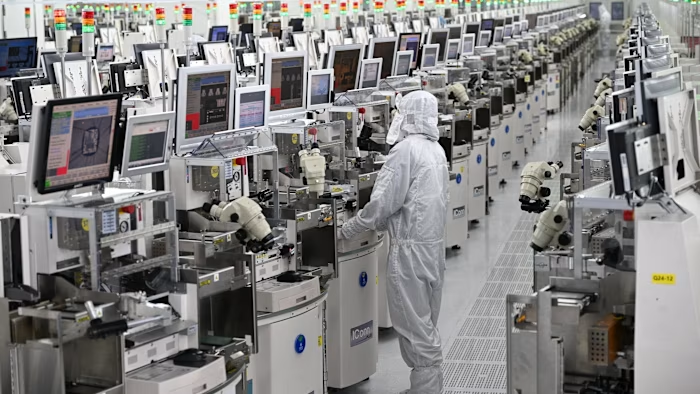
The United States has accused China of engaging in unfair trade practices in the global semiconductor market, deepening an already tense standoff between the world’s two largest economies over technology, supply chains, and national security.
US officials allege that Beijing has used heavy state subsidies, preferential financing, and market barriers to tilt the playing field in favor of Chinese chipmakers, harming foreign competitors and distorting global competition. The accusations come as semiconductors remain a strategic priority for both countries, underpinning everything from consumer electronics to artificial intelligence and military systems.
Claims of Market Distortion
According to US trade officials, China’s industrial policies have enabled domestic semiconductor firms to expand rapidly while operating under conditions that would be unsustainable in a fully competitive market. Washington argues that these measures suppress global prices, discourage private investment elsewhere, and weaken supply chain resilience.
US authorities also raised concerns about technology transfer requirements and opaque regulatory practices, which they say pressure foreign companies to share sensitive know-how in exchange for access to the Chinese market.
Strategic Stakes in the Chip Race
Semiconductors are increasingly viewed as the backbone of economic and geopolitical power. Control over advanced chip production is seen as essential for leadership in emerging technologies such as artificial intelligence, autonomous systems, and high-performance computing.
The US has invested heavily in strengthening domestic chip manufacturing and reducing reliance on overseas supply chains. Officials say countering what they describe as unfair practices is necessary to protect innovation and national security.
Beijing Pushes Back
China has rejected the accusations, insisting that its policies comply with international trade rules and are aimed at developing a resilient domestic industry. Chinese officials argue that the US is using trade claims as a pretext to contain China’s technological rise and maintain its own dominance in the sector.
Beijing has also pointed to US export controls and restrictions on Chinese firms as evidence of double standards, saying such measures disrupt global markets and harm cooperation.
Global Implications
The dispute adds uncertainty to the global semiconductor industry, which is already grappling with cyclical demand swings, high capital costs, and complex cross-border supply chains. Industry leaders worry that prolonged trade tensions could lead to higher costs, fragmented markets, and slower innovation.
Allies of the US are watching closely, as many are deeply integrated into both American and Chinese chip ecosystems. Any escalation could force difficult choices for governments and companies alike.
What Comes Next
Trade experts say the accusations could lead to formal investigations, new tariffs, or additional restrictions if talks fail to ease tensions. At the same time, there is cautious optimism that dialogue could prevent a full-blown trade war in chips.
For now, the latest US claims underscore how semiconductors have moved from being a commercial product to a central arena of global competition, with far-reaching consequences for the world economy and technological progress.
















Leave a Reply