

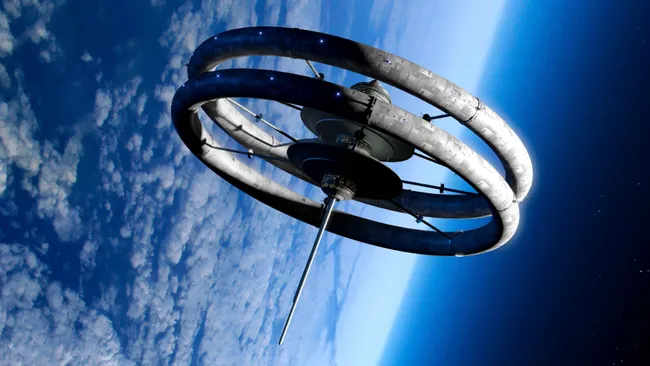
Russia has taken a bold step in space exploration by patenting a revolutionary space station design aimed at generating artificial gravity, potentially transforming the future of long-duration human missions in orbit. The new concept, which was recently submitted to the Russian Patent Office, reflects growing international interest in mitigating the physiological challenges faced by astronauts in microgravity.
The Challenge of Microgravity
One of the most persistent challenges for long-term space habitation is the effect of microgravity on the human body. Extended exposure to weightlessness can lead to muscle atrophy, bone density loss, cardiovascular issues, and changes in vision. Current space stations, such as the International Space Station (ISS), require astronauts to engage in rigorous daily exercise and medical monitoring to combat these effects, but artificial gravity has long been seen as a potential game-changer.
By introducing a controlled gravitational force, astronauts could perform daily tasks and exercise more naturally, potentially reducing the long-term health risks associated with space travel.
The Patented Design
According to the patent details, the Russian space station would feature a rotating structure capable of generating centrifugal force, simulating the effects of gravity. The design includes a central hub surrounded by a large rotating ring or series of modules, with the rotation speed adjustable to provide variable gravity levels, from partial to near-Earth gravity.
Engineers envision the station accommodating multiple astronauts, with living quarters, laboratories, and recreational spaces positioned strategically along the rotating modules. The concept also integrates docking bays for visiting spacecraft and provisions for energy generation and life support systems, emphasizing sustainability and long-term habitation.
Potential Advantages
If successfully developed, the artificial gravity station could offer several advantages over traditional microgravity habitats:
- Health Preservation: Long-duration missions, including those to Mars or deep space, could be safer and more sustainable by mitigating the negative physiological effects of weightlessness.
- Operational Efficiency: Tasks that require physical strength or dexterity could be performed more effectively under simulated gravity, improving productivity for scientific research and maintenance activities.
- Psychological Benefits: Simulated gravity may also reduce the psychological stress associated with prolonged microgravity exposure, contributing to the overall well-being of crew members.
International Context
Russia’s patent emerges amid increasing global interest in artificial gravity technologies. NASA, the European Space Agency (ESA), and private companies such as SpaceX and Blue Origin have expressed interest in exploring centrifugal-based habitats for future deep-space missions. While no artificial gravity space stations currently exist, conceptual studies and small-scale experiments have shown that rotation can produce measurable and adjustable gravitational effects.
Experts note that Russia’s design could position the country as a leader in long-term space habitation technology, potentially rivaling or complementing international efforts. However, technical challenges remain, including ensuring structural integrity at high rotation speeds, managing motion sickness, and integrating complex life support and energy systems.
Looking Ahead
The Russian space station patent marks an important milestone in the vision for sustainable human presence in space. While it may take years or even decades before a fully functional artificial gravity station is operational, the concept demonstrates the potential for next-generation habitats that allow astronauts to live and work in orbit more safely and comfortably.
As global competition in space exploration intensifies, innovations like Russia’s rotating station could redefine how humanity approaches life beyond Earth, bringing long-term space missions closer to reality.












Leave a Reply