

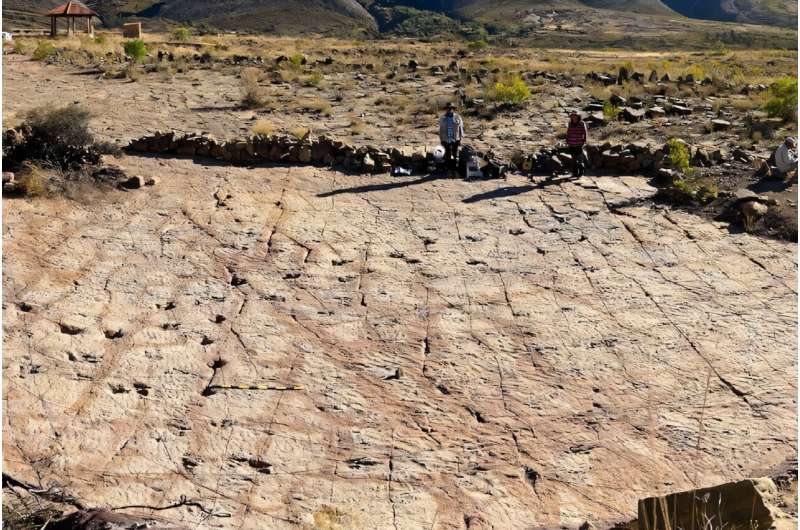
Paleontologists in Bolivia have uncovered an astonishing trove of more than 16,000 dinosaur tracks at a newly identified site, providing one of the largest and most detailed snapshots of prehistoric life in South America. The discovery promises to offer unprecedented insights into dinosaur behavior, movement patterns, and the ecosystems they once inhabited.
The site, located in the southern region of the country, spans several hectares and contains a remarkable variety of tracks, ranging from small theropods to massive sauropods. Researchers report that the footprints vary in size, depth, and spacing, indicating a diverse mix of species and suggesting that the area served as a popular migratory or feeding ground during the Mesozoic Era.
Experts are particularly excited about the density and preservation of the tracks. “This is a paleontological treasure,” said Dr. Mariana Villarroel, a lead researcher on the project. “The sheer number of footprints allows us to study not only individual species but also their interactions, group behaviors, and movement across the landscape.”
Analysis of the tracks may reveal important information about dinosaur locomotion. Variations in stride length, depth, and orientation can help scientists estimate walking or running speeds, weight distribution, and even social behavior. Early observations suggest evidence of herding among some species, while predatory dinosaurs may have left more scattered and irregular patterns, hinting at hunting strategies and territorial dynamics.
Bolivia’s Ministry of Culture and Tourism has emphasized the site’s significance for both scientific research and cultural heritage. Plans are underway to protect the area, while also developing it as an educational and tourist destination. Local authorities see the discovery as an opportunity to highlight Bolivia’s rich natural history and to attract international researchers and paleontology enthusiasts.
This extraordinary find also contributes to the broader understanding of South American dinosaur populations, which are less studied than those in North America and Asia. By comparing these tracks with fossils and sites from other regions, scientists hope to reconstruct ancient ecosystems, track evolutionary patterns, and identify previously unknown species.
The Bolivian discovery has already drawn international attention, with universities, museums, and research institutions expressing interest in studying and preserving the site. Field teams are documenting the tracks using 3D scanning, photogrammetry, and other modern techniques to ensure detailed records before erosion or weathering can affect the footprints.
For the scientific community and dinosaur enthusiasts alike, the Bolivian site represents a rare opportunity to walk in the literal footsteps of these prehistoric giants. Beyond its research potential, the discovery captures the imagination, offering a tangible connection to a world that existed millions of years ago and reminding us of the planet’s deep and complex history.















Leave a Reply