

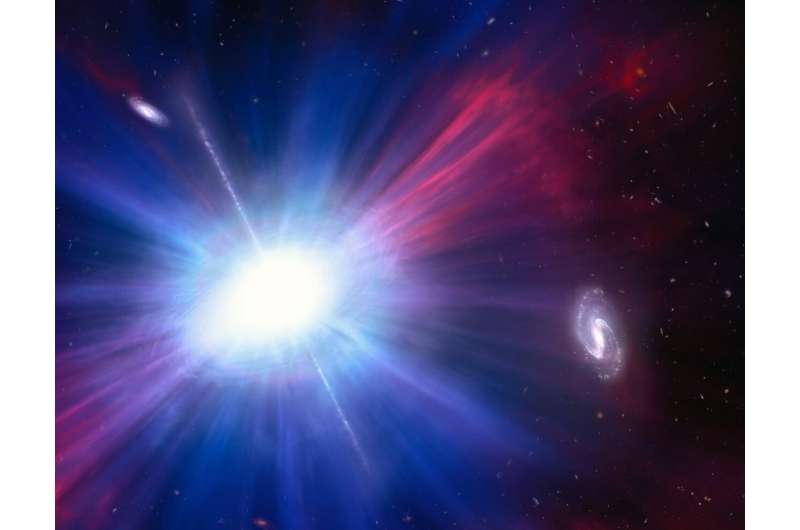
Astronomers have captured a breathtaking glimpse of a supernova dating back to the dawn of the universe, thanks to the James Webb Space Telescope (JWST). The discovery provides an unprecedented window into the early cosmic era, offering insights into the life cycles of the first stars and the formation of elements that seeded future galaxies.
The supernova, observed billions of light-years away, represents one of the earliest stellar explosions ever detected. By studying its light, scientists can analyze the chemical composition, energy output, and expansion dynamics, shedding light on how early stars lived and died. Such supernovae played a critical role in enriching the interstellar medium with heavy elements, laying the foundation for planets, galaxies, and eventually life.
JWST’s powerful infrared instruments allowed astronomers to peer through cosmic dust and observe the supernova in exquisite detail. Infrared imaging is essential for detecting light from such distant events, as the expansion of the universe stretches visible light into longer wavelengths. The telescope’s sensitivity and resolution enable researchers to capture data that was previously unattainable with older observatories.
Preliminary analysis suggests that the supernova belonged to a massive star that exhausted its nuclear fuel rapidly, triggering a catastrophic collapse and explosion. Observing these ancient events helps scientists refine models of stellar evolution, particularly in the universe’s formative epochs, when conditions were markedly different from today.
This discovery also provides a critical benchmark for understanding the timeline of cosmic evolution. By dating the supernova and analyzing its characteristics, researchers can better constrain when the first generations of stars emerged and how they influenced the formation of early galaxies. These findings have implications for cosmology, star formation theories, and the chemical evolution of the universe.
JWST’s detection highlights the telescope’s growing role as a tool for exploring the earliest cosmic events. Beyond supernovae, the observatory has already provided groundbreaking observations of distant galaxies, exoplanets, and the interstellar medium, revolutionizing our understanding of the universe’s infancy.
Scientists plan to continue monitoring the supernova and search for additional early-universe stellar explosions. Each discovery builds a more complete picture of the universe’s first billion years, an era that set the stage for the complex structures we see today.
For astronomers and space enthusiasts alike, this observation is a vivid reminder of humanity’s ability to peer across billions of years of cosmic history, witnessing the deaths of stars that existed shortly after the Big Bang. With JWST continuing to push the boundaries of discovery, the early universe is becoming increasingly accessible, revealing its secrets one spectacular event at a time.








Leave a Reply