

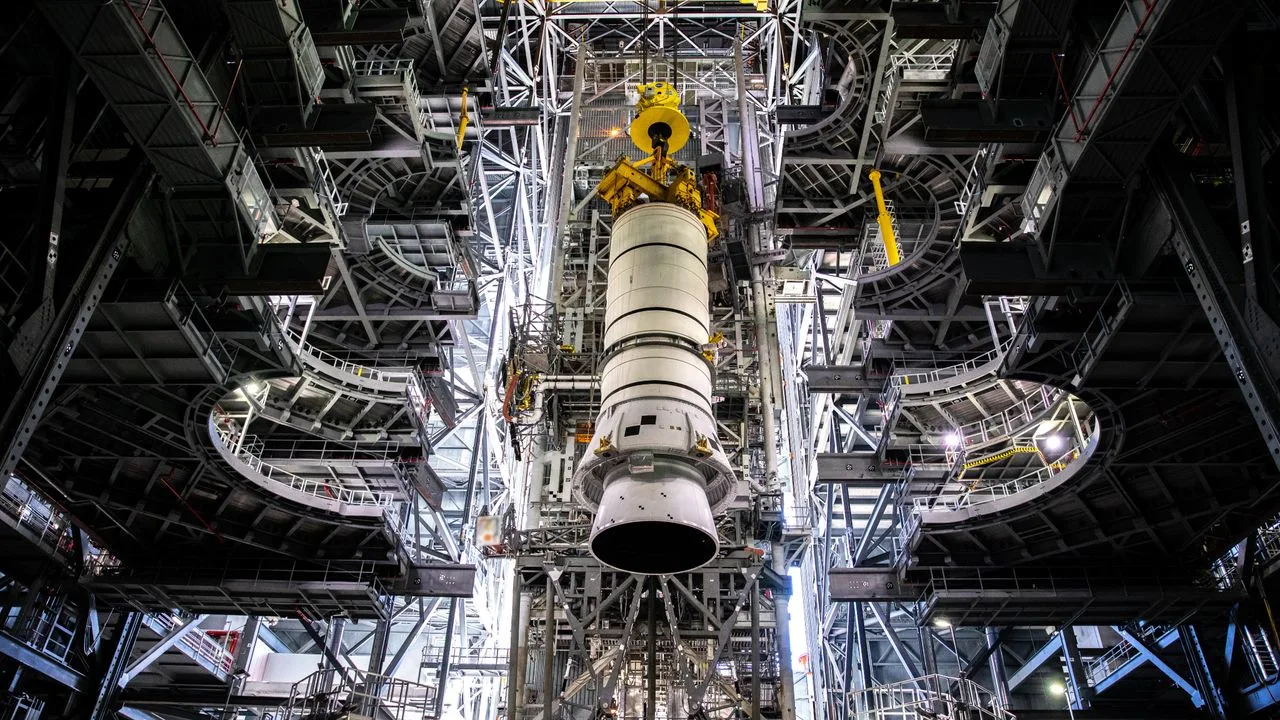
NASA has reached a major milestone in its Artemis lunar program as the Artemis II Space Launch System (SLS) rocket and Orion spacecraft began the highly anticipated rollout to Launch Pad 39B at Kennedy Space Center in Florida. This carefully orchestrated movement marks a critical stage in preparations for the first crewed lunar mission in over 50 years, bringing astronauts one step closer to orbiting the Moon.
The rollout process involves moving the fully stacked rocket and crew capsule out of the Vehicle Assembly Building onto the crawler transporter, a massive vehicle designed to safely transport the 322‑foot‑tall (98 meters) SLS rocket and its 11‑million‑pound load across the four‑mile path to the launch pad. The transporter moves at a cautious pace of roughly one mile per hour, ensuring every safety protocol is followed during this historic operation.
The Artemis II Mission: First Humans Beyond Low Earth Orbit in Decades
Artemis II will carry a crew of four astronauts on a roughly 10-day mission that will loop around the Moon before returning to Earth. The crew includes a mix of highly experienced NASA astronauts and an international partner:
- Commander Reid Wiseman
- Pilot Victor Glover
- Mission Specialist Christina Koch
- Canadian Space Agency astronaut Jeremy Hansen
This mission represents humanity’s first venture beyond low Earth orbit since the Apollo program ended in 1972, setting the stage for future lunar landings and deeper space exploration initiatives, including eventual missions to Mars.
Pre‑Launch Preparations and Testing
Once the rocket reaches Launch Pad 39B, NASA technicians will conduct an extensive series of pre-launch operations, including integration with ground systems, activation of electrical connections, testing of cryogenic propellant lines, and verification of communications networks. A wet dress rehearsal, which involves fueling the rocket and simulating the countdown without astronauts on board, is planned to ensure all systems perform flawlessly.
NASA continues to monitor weather conditions closely, as factors such as wind, temperature, and lightning risk can impact both rollout and launch operations. Every precaution is taken to maintain crew safety and mission integrity.
Timeline and Launch Window
NASA has indicated that the earliest possible launch could occur in early February 2026, with additional opportunities extending into March. The precise date will depend on the outcomes of final testing, weather conditions, and spacecraft readiness. Regardless, the rollout signifies that the mission is entering its final phase of preparations, and the Artemis II crew is on track to make history.
Looking Beyond Artemis II
The success of Artemis II will validate the SLS rocket and Orion spacecraft for future missions, including Artemis III, which aims to land astronauts on the lunar surface. Insights gained from this mission will inform operations for longer-duration lunar and deep-space missions, helping NASA refine spacecraft systems, crew health monitoring, and emergency protocols.
The Artemis II rollout has generated excitement worldwide, capturing public interest and reaffirming NASA’s commitment to returning humans to the Moon while laying the groundwork for sustained exploration beyond Earth orbit.














Leave a Reply