

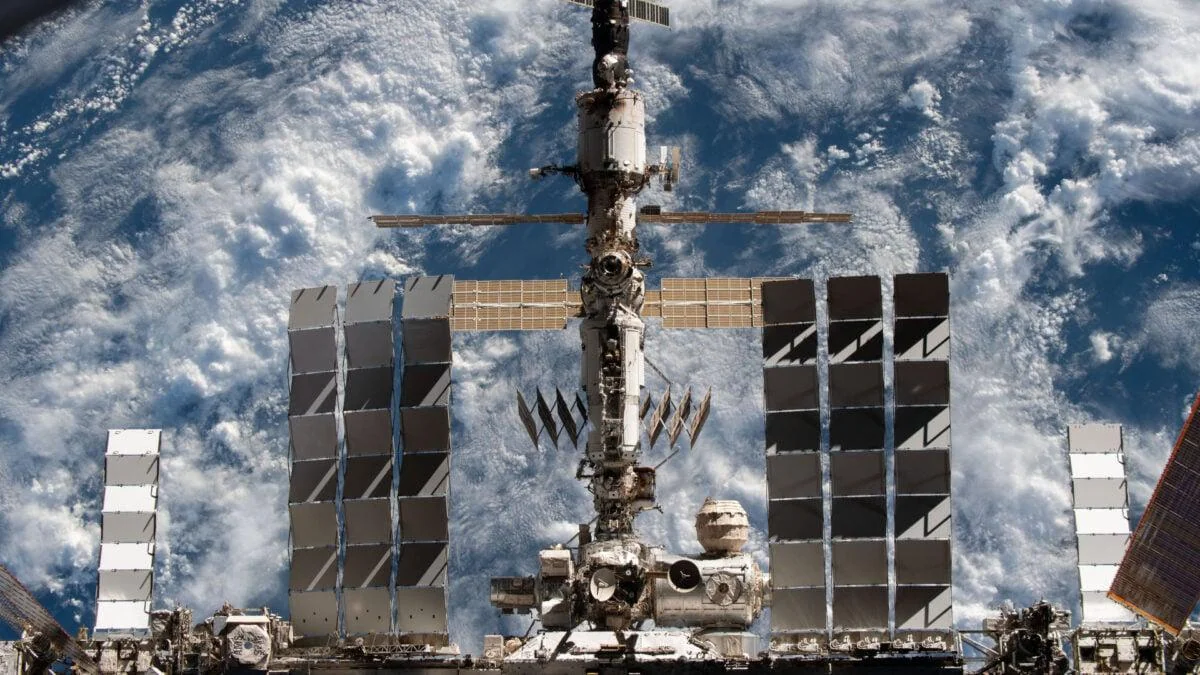
Scientists have discovered that viruses which evolved aboard the International Space Station (ISS) developed genetic changes that made them significantly more effective at infecting and killing bacteria once returned to Earth. This surprising result sheds light on how microgravity can alter the evolutionary dynamics of viruses and bacteria, with potential implications for medicine and long-duration space missions.
Evolution in Microgravity
The study focused on bacteriophages, viruses that specifically infect and destroy bacteria. Researchers compared two populations of these viruses and their bacterial hosts: one grown on Earth under normal gravity, and the other aboard the ISS in microgravity conditions. Over time, both viruses and bacteria evolved in response to each other, creating an evolutionary “arms race” that unfolded very differently in space than on Earth.
In microgravity, fluids do not mix as they do on Earth, reducing the frequency of encounters between viruses and bacteria. This forced the viruses to adapt in novel ways, favoring mutations that improved their ability to locate and attach to bacterial cells despite the sparse environment. Meanwhile, the bacteria also evolved structural changes in their cell walls that enhanced their defenses against infection.
Genetic Adaptations and Enhanced Infectivity
Genome analysis revealed that the space-evolved viruses acquired mutations in key proteins responsible for recognizing and binding to bacterial cells. These changes allowed the viruses to attach more efficiently and infect bacteria more successfully than their Earth-bound counterparts. When tested against bacterial strains, including some that normally resist infection, the space-adapted viruses demonstrated markedly higher effectiveness at killing their hosts.
The findings indicate that microgravity can accelerate evolutionary pressures in unexpected ways, producing organisms with capabilities that are different — and sometimes enhanced — compared to those evolved under normal Earth conditions.
Implications for Medicine and Space Exploration
The results have significant implications for both biomedical research and future space missions. On Earth, bacteriophages are being explored as alternatives or supplements to antibiotics, particularly against drug-resistant bacteria. Understanding how microgravity shapes viral evolution could inform the development of more potent phage therapies.
For long-duration space missions, the study highlights the need to monitor how microbes, including viruses and bacteria, might evolve in microgravity. Such changes could affect astronaut health or the behavior of beneficial microbial populations aboard spacecraft, making microbial monitoring and management a critical component of spaceflight.
The Road Ahead
While the findings are promising, challenges remain. Conducting experiments in space is costly, and reproducing microgravity conditions on Earth is technically complex. Further research is needed to fully understand which genetic changes confer enhanced viral activity and how these adaptations could safely be applied in medicine.
Nonetheless, this study demonstrates the power of microgravity to reshape evolution in fundamental ways. It opens a new window into how life responds to extreme environments and provides valuable insights for both space biology and the development of new infection-fighting strategies on Earth.
















Leave a Reply