

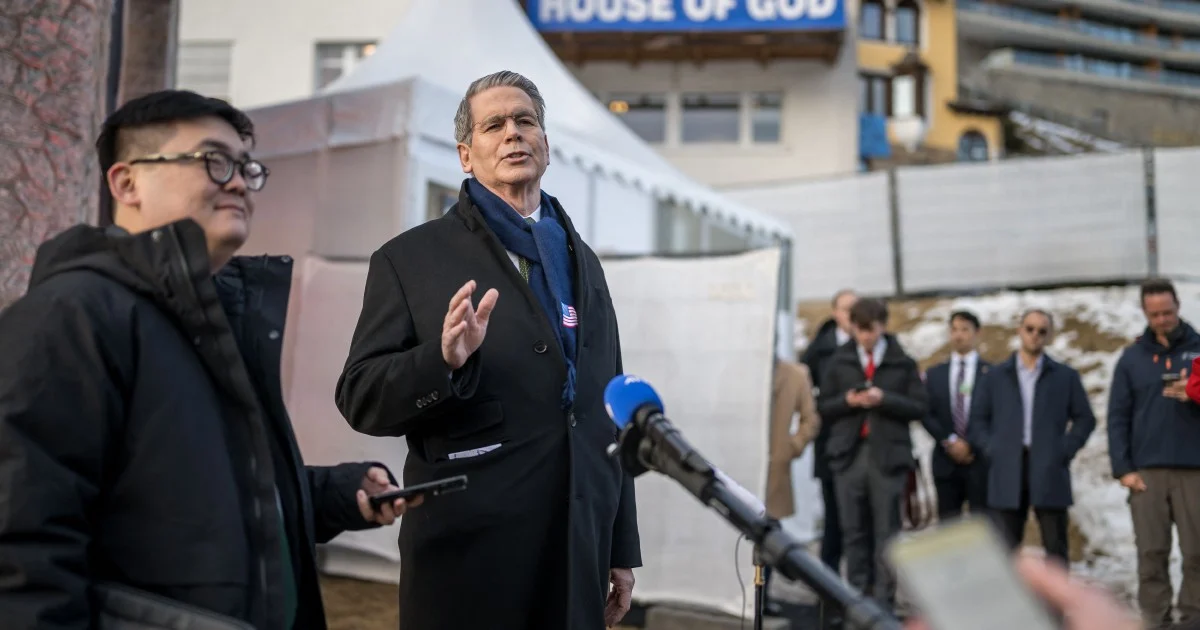
At the World Economic Forum in Davos, U.S. Treasury Secretary Scott Bessent moved to cool growing international anxiety over Greenland, urging political leaders, investors, and commentators to step back from what he described as exaggerated fears. His remarks came as renewed debate over Greenland’s strategic future has unsettled relations between the United States and Europe and injected uncertainty into global markets.
The controversy has been reignited by strong statements from President Donald Trump, who has reiterated that the United States has a long-term strategic interest in Greenland. The Arctic island, which is an autonomous territory within the Kingdom of Denmark, holds immense geopolitical value due to its location, natural resources, and growing importance as climate change opens new shipping routes. Danish and Greenlandic officials, however, have firmly rejected any suggestion that the territory could be transferred or sold, emphasizing their sovereignty and self-determination.
Speaking on the sidelines of the Davos gathering, Bessent sought to reframe the issue as a political dispute rather than an imminent economic crisis. He argued that speculation about severe retaliation from Europe, including drastic financial measures, had spiraled beyond reality. According to the Treasury Secretary, markets and governments should avoid reacting to headlines and instead focus on long-term fundamentals and diplomacy.
One of the most sensitive concerns raised in recent days has been the possibility of European governments reducing their holdings of U.S. government debt as a form of pressure. Bessent dismissed such ideas as impractical, stressing that U.S. Treasury bonds remain a cornerstone of the global financial system. He noted that large-scale selloffs would likely hurt those taking such actions as much as the United States, making them an unlikely tool in any political disagreement.
Trade tensions have also hovered in the background of the debate. The Trump administration has signaled that tariffs could be used as leverage in broader negotiations with European partners, while the European Union has prepared countermeasures should trade relations deteriorate. Despite this, Bessent emphasized that escalation was not inevitable and warned against repeating cycles of retaliatory tariffs that have previously damaged global growth and strained alliances.
Beyond economics, the Greenland issue has exposed deeper political rifts. European leaders have voiced concern about the implications for NATO unity and Arctic stability, while financial markets have reacted nervously to the uncertainty. Fluctuations in equities and increased interest in safe-haven assets reflect investor unease over how far the dispute could go if rhetoric hardens on both sides.
Bessent’s appearance in Davos appeared designed to reassure allies and investors alike that Washington does not seek a rupture with Europe. He underscored the importance of dialogue, patience, and measured responses, suggesting that behind-the-scenes diplomacy remains active even as public statements grow sharper.
As global attention remains fixed on the Arctic and its rising strategic importance, the Treasury Secretary’s message was clear: the situation, while serious, does not warrant panic. Whether calmer language will ease tensions in the weeks ahead remains uncertain, but for now, U.S. officials are signaling that restraint, not confrontation, is the preferred path forward.











Leave a Reply