

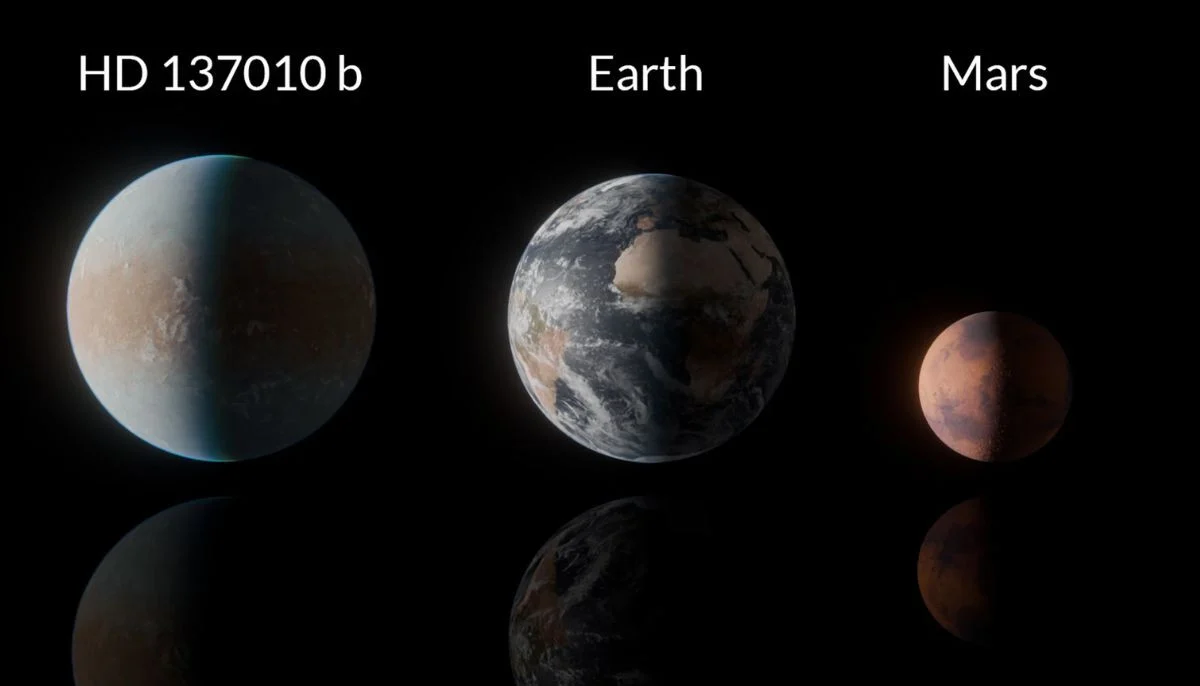
Astronomers have identified a new Earth-sized exoplanet located about 146 light-years from Earth, sparking excitement in the search for worlds that could support life. The planet, known as HD 137010 b, orbits a sun-like star and may lie within its star’s habitable zone, where conditions could theoretically allow liquid water to exist.
A Familiar Size, an Extreme Climate
HD 137010 b is only slightly larger than Earth, with an orbit taking roughly 355 days to circle its star — remarkably similar to our own year. Despite these similarities, the planet’s star is cooler and less luminous than the Sun. As a result, surface temperatures are estimated to hover around −70 °C, making it a frozen world unless it possesses a thick, heat-retaining atmosphere.
Scientists say that if HD 137010 b has a dense greenhouse effect, it could maintain warmer conditions suitable for liquid water. Without such an atmosphere, the planet would resemble a frigid desert, highlighting the challenges in determining true habitability from distance alone.
How It Was Discovered
The planet was detected through analysis of data from past space missions, using the transit method, which measures tiny dips in a star’s brightness as a planet passes in front of it. This method allows astronomers to determine the planet’s size, orbit, and potential position within the habitable zone.
The discovery demonstrates that even previously collected data can yield new insights, underscoring the ongoing value of careful observation and analysis in the search for Earth-like worlds.
Looking Forward
HD 137010 b’s relatively close distance makes it a prime candidate for follow-up observations with next-generation telescopes. Scientists hope to study its atmosphere — if one exists — to search for signs of water vapor, greenhouse gases, and other indicators of potential habitability.
While humans cannot travel to a planet 146 light-years away with current technology, HD 137010 b adds to the growing catalog of Earth-like candidates, bringing researchers closer to understanding whether life could exist beyond our solar system. Each discovery provides vital information about how planets form, evolve, and maintain conditions conducive to life.













Leave a Reply