

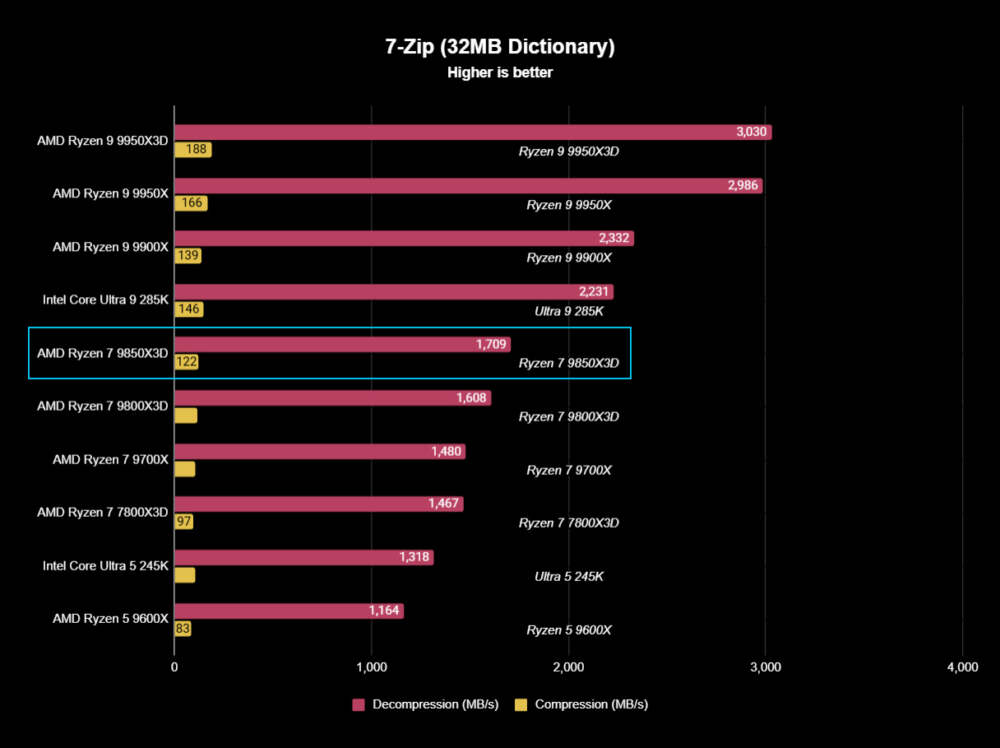
AMD’s latest desktop processor, the Ryzen 7 9850X3D, has arrived as a refreshed version of a familiar design — promising improved performance thanks to 3D V‑Cache technology. While it delivers modest gains in real‑world computing and gaming, its substantially higher power consumption raises questions about efficiency and value for many users. Here’s a closer look at what the new CPU offers, how it performs, and where it fits in today’s competitive processor landscape.
What’s New With the Ryzen 7 9850X3D?
The Ryzen 7 9850X3D builds on AMD’s established Zen 4 architecture, combining eight cores and sixteen threads with an enhanced 3D V‑Cache layer. This stacked cache design increases the amount of high‑speed on‑chip memory, which can benefit workloads that are latency‑sensitive — particularly gaming and certain productivity tasks.
On paper, the 9850X3D is positioned as a premium mainstream choice, slotting between standard Ryzen 7000-series models and AMD’s higher‑end X‑branded parts. It aims to offer performance close to the top of the stack, while maintaining a price point more accessible than enthusiast‑tier processors.
Performance: Slight Gains, Not Dramatic Leaps
Independent testing shows that the Ryzen 7 9850X3D outperforms its predecessor in a number of scenarios, but not by a wide margin. Key observations include:
- Gaming: The chip delivers slightly better frame rates than non‑3D V‑Cache Ryzen 7 models in many popular titles. However, the improvement is often single‑digit percentages, noticeable in benchmarks but modest in everyday play.
- Productivity and Creative Workloads: Applications such as video encoding, 3D rendering, and content creation tools see incremental improvements. These gains are real, but professionals who already use high‑core‑count CPUs may not find them transformative.
- Responsiveness: General system responsiveness remains strong, with quick application load times and fluid multitasking.
In most tests, the Ryzen 7 9850X3D holds its own against competing Intel processors in similar segments. However, the margin of advantage is smaller than some enthusiasts might have expected given the premium positioning of the 3D V‑Cache feature.
Power Consumption: A Notable Trade‑Off
Perhaps the most significant aspect of the 9850X3D is its power draw. Under load, especially in sustained gaming or heavy workloads, the chip consumes noticeably more power than previous Ryzen 7 models and many rival Intel CPUs.
This higher power requirement impacts several areas:
- Thermal Output: Systems running the 9850X3D tend to generate more heat, requiring robust cooling solutions to maintain optimal performance and prevent throttling.
- Energy Efficiency: Compared to its performance gains, the increased wattage results in lower overall efficiency. For users focused on energy‑savings or building quieter, cooler rigs, this might be a deterrent.
- System Cost: The need for effective cooling — and possibly a more powerful power supply — can add to the total cost of ownership.
In essence, buyers get a chip that is somewhat faster, but also hungrier for power, making the performance‑per‑watt equation less favourable compared with other options.
Who Should Consider the Ryzen 7 9850X3D?
This processor makes sense for specific types of users:
• Gamers who prioritize marginal FPS improvements: Enthusiasts chasing every bit of performance may appreciate the modest gains in frame rates.
• Users wanting a premium mainstream CPU: Those who want solid performance across both games and everyday productivity without jumping to a flagship model might find this chip appealing.
However, it may be less compelling for:
• Energy‑conscious builders: If efficiency and thermals are priorities, rival processors with better power profiles could be more attractive.
• Professionals requiring high multi‑thread throughput: Workstations relying on multi‑core performance might benefit more from CPUs with higher overall core counts.
Comparison With the Competition
Against AMD’s own lineup, the 9850X3D sits comfortably above standard Ryzen 7 models but below the most powerful Ryzen 9 series. When compared with competing chips from other manufacturers, it holds its own in performance tests but does not create a decisive lead.
Intel’s recent offerings, for example, provide comparable performance with often better energy efficiency, which could sway buyers toward those alternatives depending on their priorities.
Final Verdict: Worth It for Some, Not All
The AMD Ryzen 7 9850X3D is a capable and capable‑looking processor with story‑worthy technology behind it. Its 3D V‑Cache enhancements deliver real performance improvements, especially in gaming, but the higher power consumption tempers the overall appeal. For users who want the best performance and are willing to accommodate the cooling and energy requirements, it is a compelling choice. For others focused on efficiency and balanced performance, alternatives may offer better overall value.















Leave a Reply