

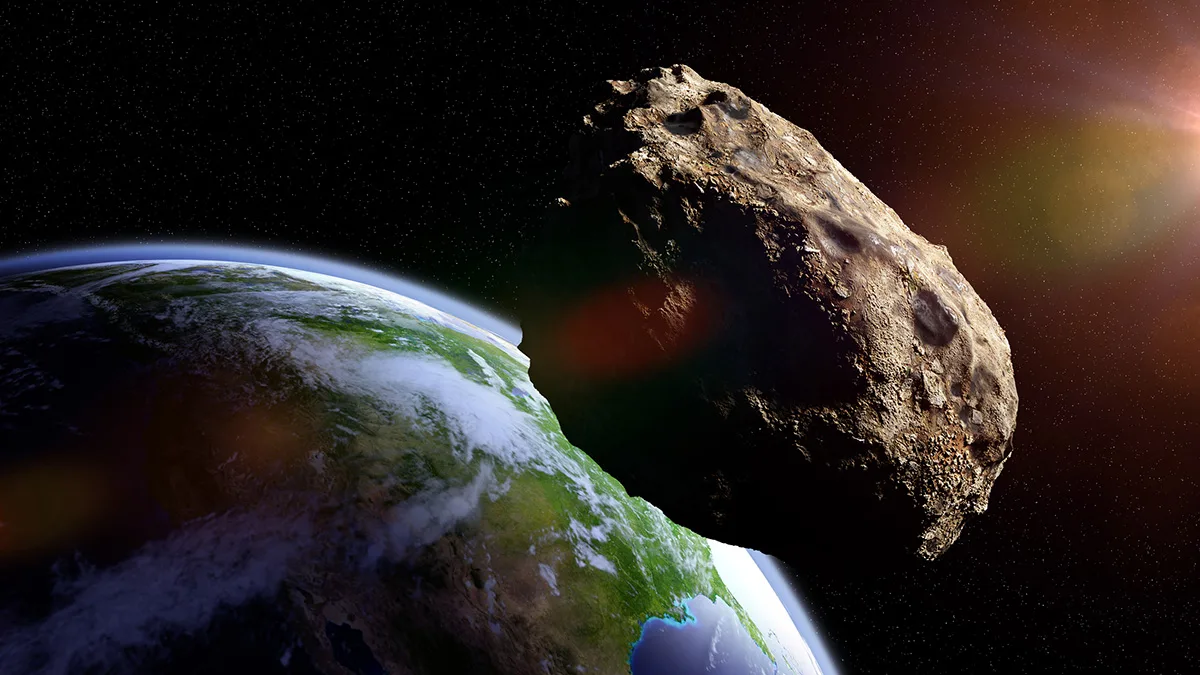
A large asteroid known as 2025 FA22 is set to fly past Earth on 18 September 2025. Although its size and previous risk estimates caught attention, scientists are now certain there is no danger of collision.
What We Know So Far
- 2025 FA22 is estimated to measure between 130 and 290 meters in diameter, making it roughly comparable in size to a large skyscraper.
- Discovered earlier this year by the Pan-STARRS 2 telescope in Hawaii, it was for a time considered a possible future risk, including a very small chance of impact in 2089. However, later observations refined its orbit and ruled out any such risk.
- Its closest approach to Earth will occur early in the morning — astronomers have calculated this flyby to be safely distant, about twice the distance from the Earth to the Moon at its nearest point.
Significance of the Flyby
- Even though it’s safe, 2025 FA22 provides a rare opportunity: scientists around the world will observe it to refine models of asteroid behavior. Telescopes and observatories will measure its position, brightness, shape, and surface properties.
- The European Space Agency (ESA) and the International Asteroid Warning Network (IAWN) have organized a campaign to gather detailed data through techniques like astrometry (tracking its motion and position precisely) and polarimetry (studying how sunlight reflects off its surface to infer composition and texture).
Why It Was Once Seen as Risky
- Early data on the asteroid’s orbit hinted at a small chance of impact decades from now. That led to its brief appearance on risk-assessment lists used by space agencies.
- As more tracking data came in, scientists were able to narrow down the path of the asteroid much more accurately, which eliminated the danger. This is a good example of how repeated observations reduce uncertainty for near-Earth objects.
What Happens Next
- Over the next few days and weeks, astronomers will continue monitoring 2025 FA22. The ongoing observational campaign will help improve knowledge about the asteroid’s trajectory and physical properties.
- While the public can’t feel worried, the event is interesting for enthusiasts: those with decent telescopes should be able to see it when it’s at its brightest.
Bottom Line
Asteroid 2025 FA22 is set for a close but safe flyby. It shows how modern astronomy and asteroid-tracking systems work: spotting something with possible concern, tracking it well, and ensuring public safety by ruling out risks. The coming observations will also help bolster Earth’s preparedness in case a more dangerous asteroid ever appears.











Leave a Reply