

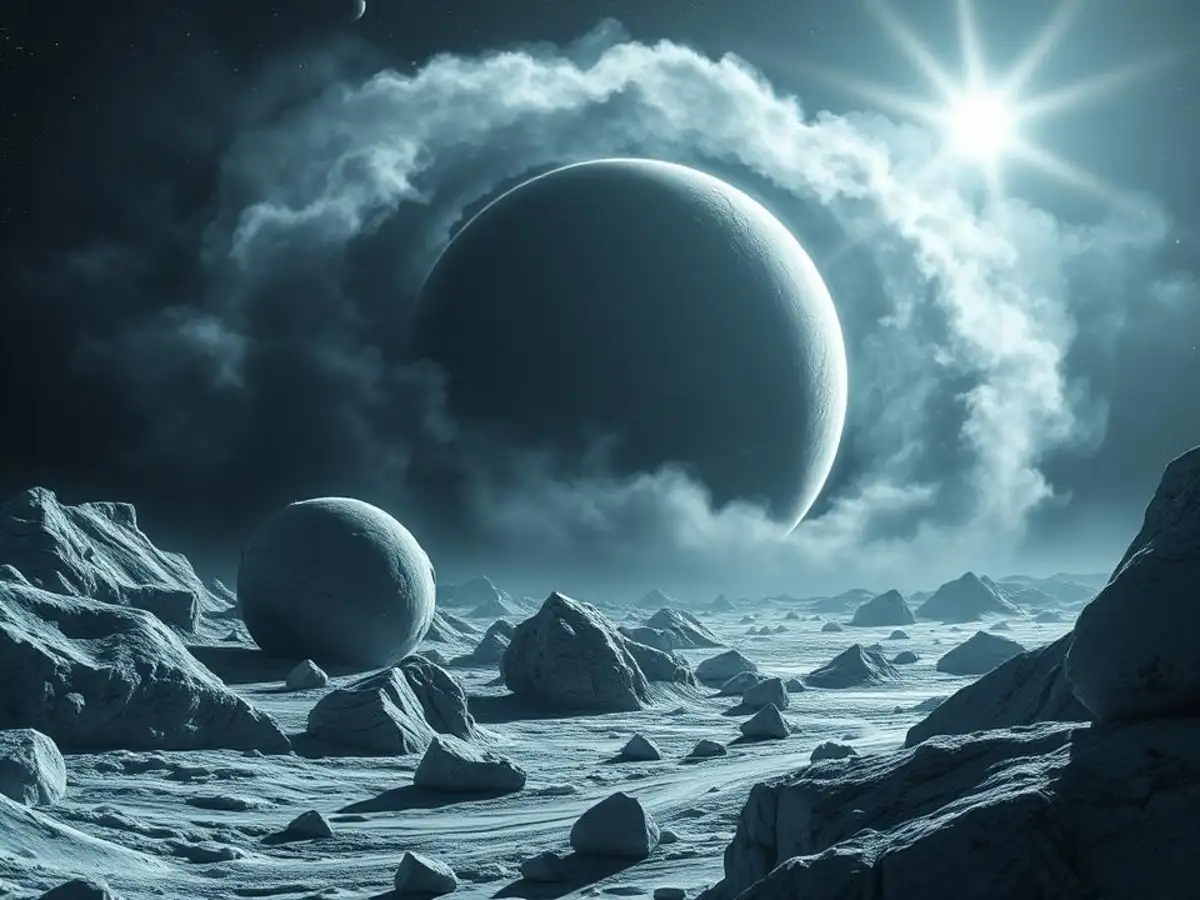
A new study suggests that a previously unknown planet, informally dubbed “Planet Y,” may be orbiting the Sun far beyond Neptune. Researchers from Princeton University and the Institute for Advanced Study have observed unusual gravitational effects in the Kuiper Belt that could be explained by a planet with a mass between Mercury and Earth.
What Is Planet Y?
Planet Y is hypothesized to be a rocky or icy planet situated at a distance of approximately 100 to 200 astronomical units (AU) from the Sun. This would place it well beyond the known planets, in a region populated by icy bodies and dwarf planets. The proposed planet’s gravity could be influencing the orbits of distant objects in the Kuiper Belt, causing a detectable warp in their trajectories.
Evidence Supporting Its Existence
The primary evidence for Planet Y comes from the observation of a 15° tilt in the orbits of trans-Neptunian objects (TNOs) between 80 and 200 AU. This alignment cannot be attributed to chance or observational bias. Simulations indicate that a planet with the proposed mass and orbit could account for these anomalies. This discovery adds to the growing body of evidence suggesting that our solar system may harbor more planets than previously thought.
Implications for Solar System Formation
The potential existence of Planet Y challenges current models of solar system formation. If confirmed, it would imply that the early solar system was more dynamic, with planets migrating and interacting in ways that have not been fully understood. Such a discovery could also provide insights into the distribution of mass in the outer solar system and the processes that led to the formation of known planets.
Next Steps
To confirm the existence of Planet Y, astronomers plan to conduct further observations using advanced telescopes, such as the Vera C. Rubin Observatory. These observations will aim to directly detect the proposed planet or its effects on nearby objects. If Planet Y is real, it could reshape our understanding of the solar system’s architecture and the processes that govern planetary formation.








Leave a Reply