

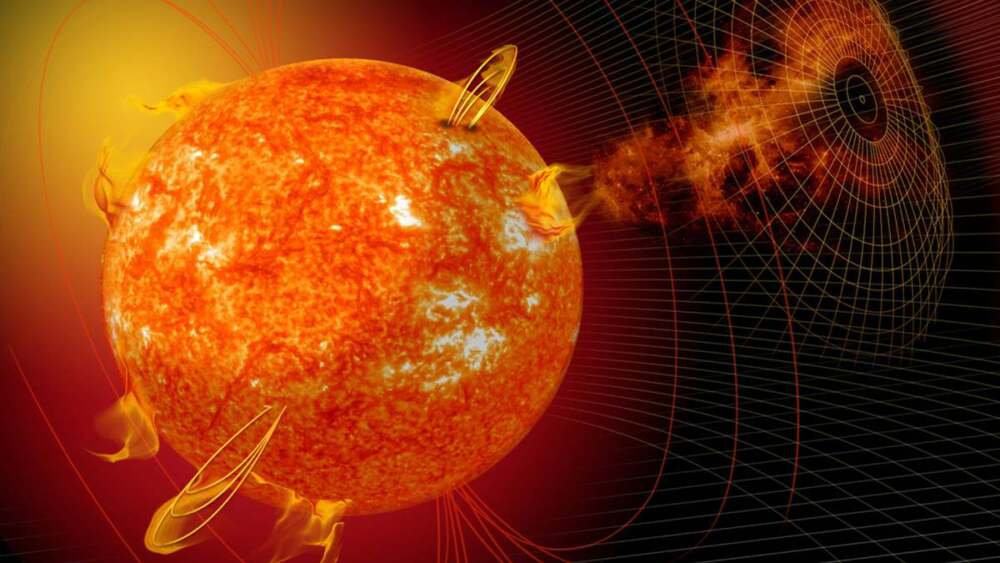
Astronomers are issuing urgent warnings about a growing and often underestimated danger from space — volatile bursts of solar energy that could disrupt life on Earth in ways most people never think about. Recent findings have revealed that so-called “space tornadoes” and other plasma disturbances within solar storms may be far more unpredictable and hazardous than previously believed. With Earth’s monitoring systems lagging behind, experts fear our planet remains dangerously exposed.
The Silent Menace From the Sun
Space weather refers to the constantly shifting conditions in space caused by the Sun’s activity. When the Sun releases massive explosions of charged particles — known as solar flares or coronal mass ejections — they race through the solar system and interact with Earth’s magnetic field. While most of the time these interactions are harmless, extreme solar events can generate intense geomagnetic storms, capable of knocking out satellites, disrupting navigation systems, and even crippling power grids.
What worries scientists now is that new research indicates there may be smaller, fast-moving magnetic structures, sometimes called flux ropes or plasma vortices, hidden within these larger solar eruptions. Unlike the massive, well-studied coronal ejections, these smaller “space tornadoes” can spin and shift rapidly, changing magnetic polarity and catching Earth’s defenses off guard.
If they hit at the right angle, even a modest burst could interfere with communications, satellites, and electrical systems — and we might not see it coming until it’s too late.
A Blind Spot in Our Space Weather Systems
Currently, most of Earth’s space weather warnings rely on one or two monitoring spacecraft positioned between our planet and the Sun. These probes — including the aging ACE and DSCOVR satellites — sit along a narrow line in space known as the L1 Lagrange Point, roughly one million miles from Earth.
That single vantage point is like trying to predict a hurricane using one weather buoy in the middle of the ocean. Scientists can see large eruptions coming straight toward Earth, but smaller, angled, or rotating structures can easily pass unnoticed. As a result, space agencies often have only minutes to react before geomagnetic storms hit.
Researchers argue that this setup leaves humanity vulnerable to events that could temporarily disable GPS systems, interrupt global internet connections, and trigger widespread power surges in electrical grids.
Growing Solar Activity Raises the Stakes
The concern comes at a particularly sensitive moment. The Sun is entering one of its most active periods in more than a decade — part of its natural 11-year cycle. Over the past year, astronomers have already observed a spike in sunspots, solar flares, and CME activity, all of which increase the likelihood of geomagnetic disturbances reaching Earth.
Experts warn that the combination of rising solar activity and outdated infrastructure could lead to “space weather black swan” events — unpredictable incidents with massive global consequences. A major storm could cost the world economy hundreds of billions of dollars in damages, crippling communication networks, navigation systems, and satellites used for finance, defense, and weather prediction.
What Astronomers Want to See Happen
To reduce the risk, scientists are calling for an overhaul of how Earth monitors space weather. Their proposals include:
- Deploying multiple satellites positioned at different angles around Earth and the Sun. This would create a 3D view of solar activity, making it easier to detect small magnetic disturbances before they reach us.
- Developing solar-sail spacecraft that can hover in flexible orbits and remain in view of the Sun for longer periods, providing more consistent data.
- Improving predictive models using artificial intelligence and high-resolution simulations to anticipate how magnetic structures evolve and interact with Earth’s magnetic field.
- Building stronger ground infrastructure — from satellite hardening to more resilient power grids — to ensure essential systems can withstand sudden surges in solar radiation.
What’s at Risk
A severe geomagnetic storm could have cascading effects across modern civilization. Experts outline several potential scenarios:
- Power grid failures: Geomagnetic currents can overload transformers, causing blackouts that could take weeks to repair.
- Satellite malfunctions: Communication, weather, and navigation satellites could experience electronic disruptions or orbit shifts.
- Aviation and astronaut hazards: Increased radiation levels could endanger astronauts and airline passengers on polar routes.
- Internet instability: Subsea cables and communication hubs could experience interference, slowing or disabling global networks.
The last major incident of this kind — known as the Carrington Event in 1859 — set telegraph wires ablaze and caused widespread electrical disruptions. Scientists warn that a similar storm today would have catastrophic consequences for a world dependent on digital technology.
Racing Against Time
Despite repeated warnings, progress toward a global early-warning system has been slow. Funding challenges, bureaucratic hurdles, and competing priorities have delayed efforts to expand space weather monitoring. Astronomers caution that we may be entering a new era of solar volatility without the proper tools to defend ourselves.
If the Sun releases a major solar storm tomorrow, Earth might get less than an hour’s warning before its electromagnetic pulse reaches the planet. That’s not enough time to power down vulnerable infrastructure or protect satellites from damage.
For many experts, the takeaway is clear: humanity must start treating space weather as seriously as climate change or cybersecurity. The technology that drives modern civilization — from banking and GPS to communications and defense — all depends on it.
Looking to the Future
There is hope that recent attention will accelerate change. NASA, the European Space Agency, and several private research groups are exploring next-generation satellites that can provide more reliable, multi-directional space weather monitoring. Meanwhile, artificial intelligence tools are being trained to predict small-scale solar activity using decades of observational data.
But as one scientist noted, even the best model won’t help if we ignore the warnings. The universe, after all, doesn’t take notice of human schedules. The Sun will flare when it pleases — and it’s up to us to be ready when it does.








Leave a Reply