

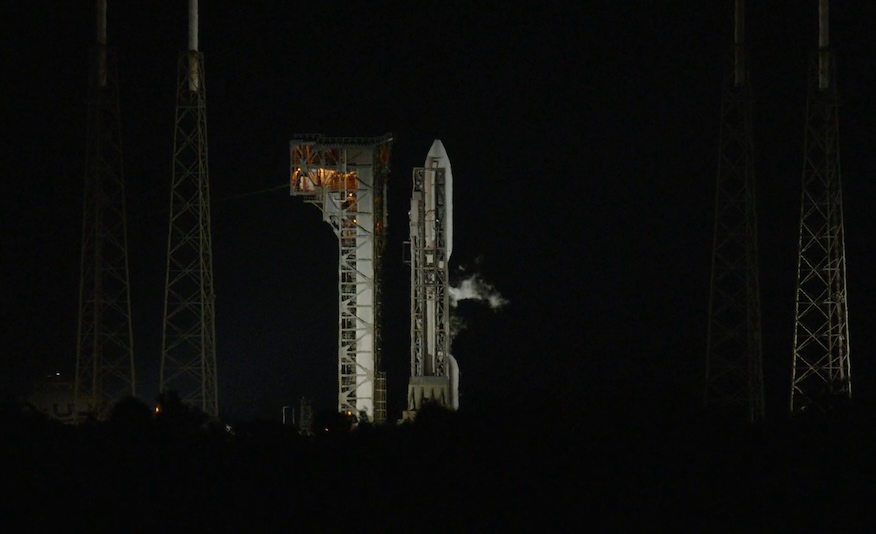
Cape Canaveral, FL – For the second consecutive night, United Launch Alliance (ULA) postponed the launch of its Atlas 5 rocket carrying the ViaSat-3 F2 communications satellite. The delay was caused by a persistent problem with a vent valve on the rocket’s first-stage liquid oxygen tank, which prevented a safe liftoff.
Originally scheduled for 10:16 p.m. EST, the launch was called off shortly before the window opened. Launch Director James Whelan and the ULA team cited the recurring vent valve issue, stating that thorough evaluation of the hardware is necessary before another attempt. A new launch date has yet to be announced.
The launch attempt faced additional challenges from overcast skies and intermittent rain, with weather conditions giving only a 50-50 chance of meeting launch criteria. Despite these obstacles, ULA had proceeded with pre-launch activities, including liquid oxygen loading on both the booster and the Centaur upper stage.
The ViaSat-3 F2 satellite, manufactured by Boeing and weighing six metric tons, is designed to provide Ka-band network capabilities, significantly boosting internet capacity across the Americas by more than 1 terabit per second. Once successfully deployed into geostationary transfer orbit, the satellite is expected to enter service in early 2026 following comprehensive on-orbit testing at its operational slot of 79 degrees West longitude.
This mission follows the ViaSat-3 F1 launch in 2023, which encountered technical difficulties with its antenna, affecting initial service capacity. The new satellite aims to overcome these setbacks and expand the company’s high-speed satellite internet network.
ULA continues to work closely with teams to resolve the valve issue and is committed to ensuring a safe and successful launch for the critical communications payload.















Leave a Reply