

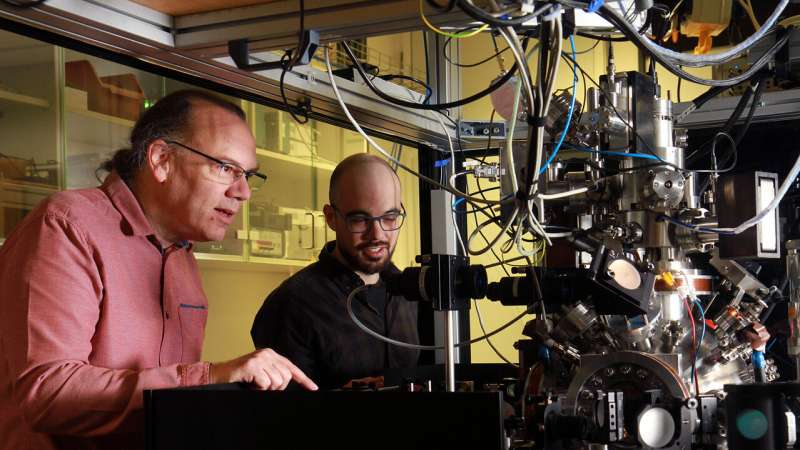
Physicists have achieved a breakthrough in quantum research by demonstrating that Bose-Einstein condensates (BECs) can replicate Shapiro steps, a phenomenon previously observed only in superconducting systems. This discovery opens new avenues in the study of quantum transport, ultracold atoms, and potential applications in quantum technologies.
Bose-Einstein condensates are states of matter formed when atoms are cooled to near absolute zero, causing them to occupy the same quantum state and behave collectively like a single quantum entity. These condensates have long been a playground for exploring quantum mechanics on a macroscopic scale, but reproducing behaviors associated with electronic systems has remained a challenge—until now.
The team created atomic Josephson junctions, where two BECs are separated by a narrow barrier, allowing quantum tunneling of atoms. When driven by an external oscillating field, the atomic flow exhibited discrete jumps in current, analogous to Shapiro steps seen in superconducting Josephson junctions under microwave irradiation. These steps represent quantized synchronization between the oscillating drive and the tunneling atoms, demonstrating a striking parallel between ultracold atomic systems and electronic superconductivity.
“This is a remarkable demonstration of how phenomena thought to be exclusive to solid-state physics can emerge in atomic systems,” said Dr. Elena Morozov, lead researcher on the study. “It confirms that Bose-Einstein condensates are versatile platforms for exploring quantum dynamics and could pave the way for atom-based quantum devices.”
The implications of this research are significant. Atomic Josephson junctions could serve as ultra-sensitive quantum sensors, simulate complex condensed matter systems, or provide new building blocks for quantum information processing. Unlike electronic systems, atomic systems offer unprecedented control over interaction strength, geometry, and external driving forces, making them ideal for testing fundamental quantum theories.
Experts note that replicating Shapiro steps with BECs highlights the universality of quantum phenomena. It suggests that behaviors previously thought to belong only to superconducting circuits can manifest in entirely different physical systems, deepening our understanding of coherence, tunneling, and quantum synchronization.
The discovery also sparks excitement for future experiments, including multi-junction atomic arrays, hybrid quantum systems combining ultracold atoms with photonic or superconducting circuits, and precision tests of quantum mechanics at macroscopic scales.
As atomic Josephson contacts continue to reveal new quantum behaviors, researchers anticipate a surge of innovation in quantum simulation, sensing, and information technologies, firmly establishing Bose-Einstein condensates as a cornerstone of next-generation quantum science.















Leave a Reply