

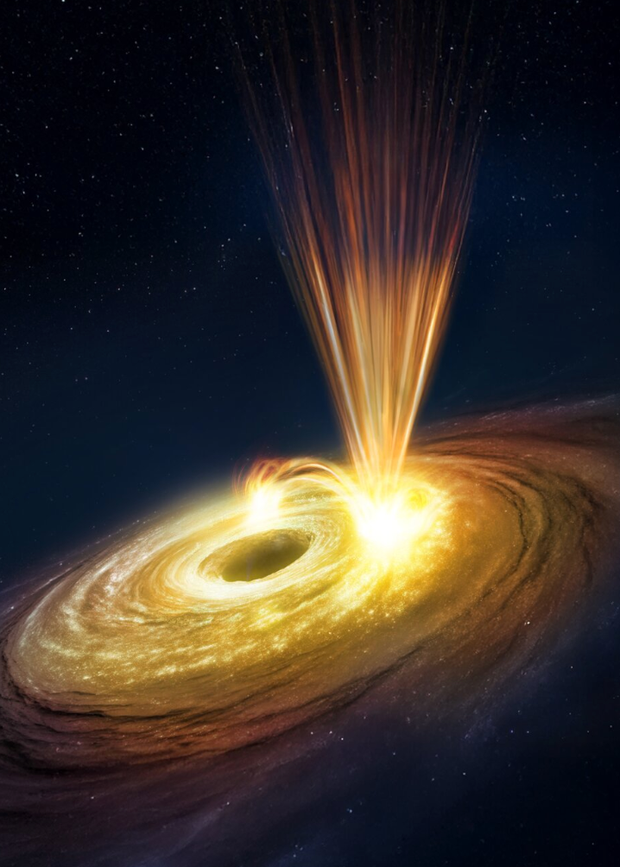
Astronomers have observed a black hole generating winds at staggering speeds of 130 million miles per hour, a phenomenon that experts describe as “almost too big to imagine.” The discovery provides new insight into the extreme environments surrounding supermassive black holes and the powerful forces at play in the hearts of galaxies.
The Discovery
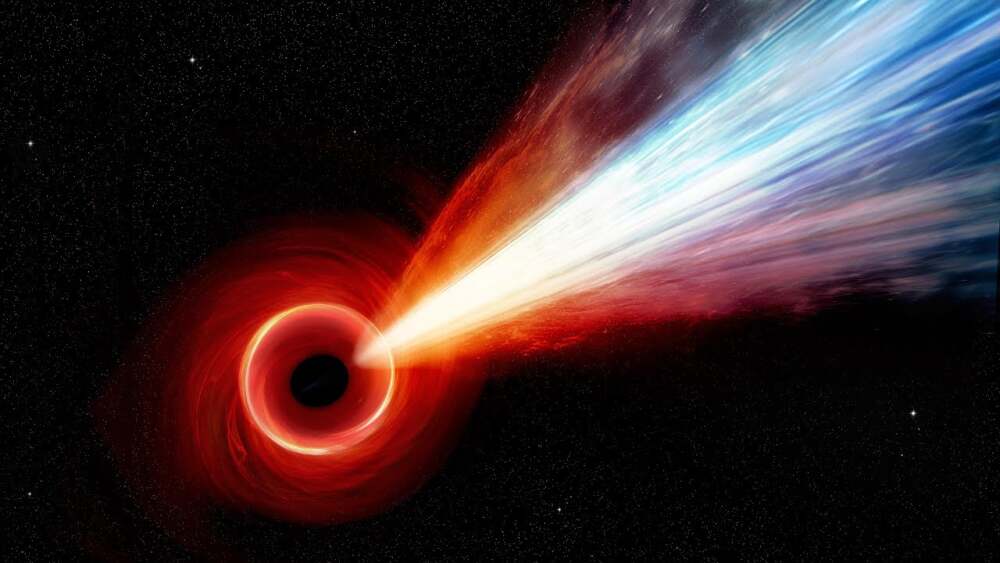
Using advanced space telescopes and spectroscopic analysis, researchers identified the extraordinary outflow of matter from the black hole’s accretion disk. These winds are composed of ionized gas accelerated to nearly 20 percent of the speed of light, making them some of the fastest black hole-driven winds ever recorded.
The black hole itself resides in a distant galaxy several billion light-years from Earth. Despite its vast distance, the energetic winds have detectable effects on the surrounding interstellar medium, influencing star formation and the evolution of the host galaxy.
Scientific Significance
Black hole winds of this magnitude are rare and can have profound implications for astrophysics:
- Galaxy Evolution: These high-speed winds can blow away gas and dust that would otherwise form new stars, shaping the lifecycle of galaxies.
- Accretion Dynamics: Observing such extreme winds helps scientists understand how black holes grow and how matter behaves in ultra-intense gravitational fields.
- Cosmic Feedback: The discovery provides evidence of feedback mechanisms, where black holes regulate the energy and matter distribution in their galactic environments.
Dr. Elena Marquez, a leading astrophysicist involved in the research, noted that “the scale of energy and speed we are seeing here is almost beyond human comprehension. It reshapes our understanding of how black holes influence their galaxies.”
Why It Matters
This observation adds to the growing body of evidence that supermassive black holes are not passive cosmic objects but active engines capable of dramatically altering their surroundings. By studying these extreme phenomena, astronomers hope to unlock deeper insights into the formation and evolution of galaxies across the universe.
The discovery also demonstrates the power of modern astronomical instruments to capture events occurring billions of light-years away, offering a glimpse into the most extreme processes in the cosmos.
Looking Ahead
Future observations aim to monitor similar black holes to determine how common such ultra-fast winds are and how they impact their host galaxies over cosmic timescales. Researchers are also working on theoretical models to simulate these extreme environments, bridging the gap between observation and understanding.








Leave a Reply