

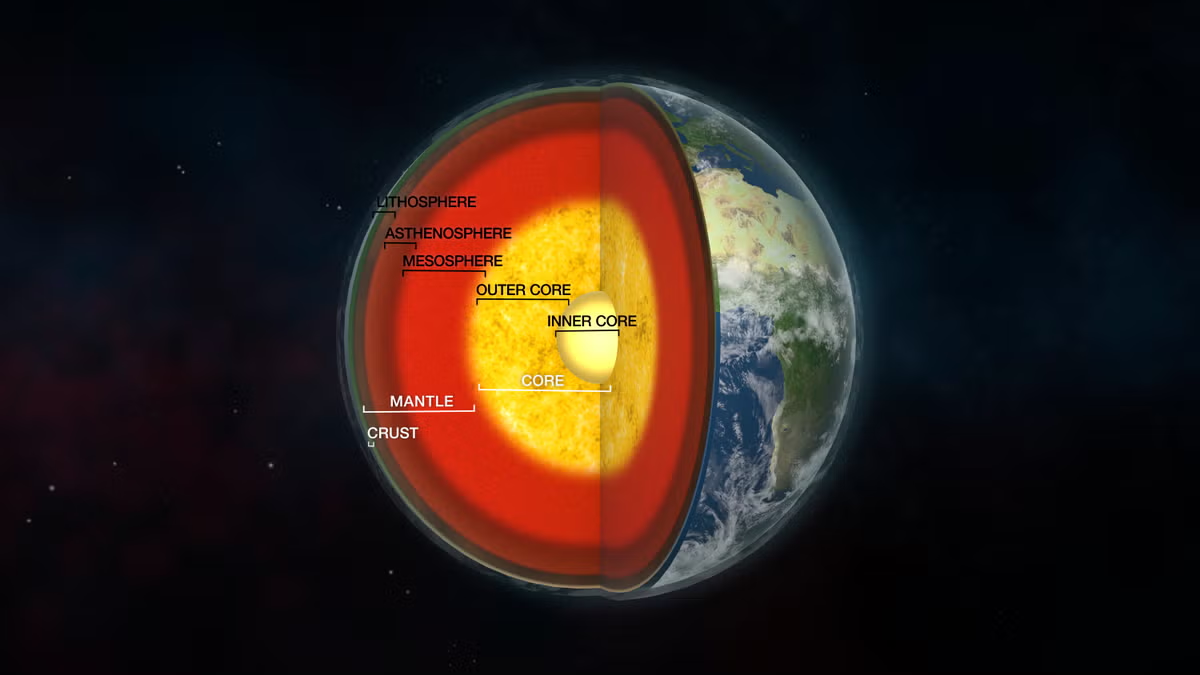
Recent research into Earth’s deep interior has revealed giant, slowly shifting structures — sometimes called “blobs” — deep in the planet’s mantle. These enormous upwellings of hot rock appear to connect with some of the most destructive volcanic events in Earth’s history, and may even play a role in how continents develop or break apart millions of years from now.
What Are These Mantle Blobs?
- Under Africa and the Pacific Ocean, geologists have identified massive zones in the lower mantle — around 2,000 to 3,000 kilometers below the surface — where hot, dense material forms these so-called blobs.
- These blobs are sources for mantle plumes: vertical or near-vertical channels of magma or partially molten rock that rise upwards, sometimes with great tilt, towards Earth’s crust.
What the Recent Study Finds
- The blobs are not static. Over geological time (spanning hundreds of millions of years), they appear to move — albeit very slowly, perhaps only a few centimeters per year.
- Earth’s surface volcanic or eruptive hot spots often align with the locations of these blobs, or where plumes rising from them poke through the crust. This suggests a direct connection between deep-mantle dynamics and surface volcanism.
- Computer models that simulate mantle convection and plume formation confirm that as these blobs shift, their plumes can tilt, branch, or wander, creating complex patterns of volcanic activity over geologic eras.
Why It Matters: From Ancient Catastrophes to Future Landscapes
- Some of Earth’s most dramatic eruptions — including lava floods that once stretched over millions of square kilometers — may owe their scale and placement to these deep mantle blobs. Eruptions driven by large plumes above these blobs have had global impacts: climate disruption, mass extinctions, and reshaped landmasses.
- The shifting of these deep blobs could influence continental structure long before humans walk the Earth. The rising plumes can heat, weaken, or domed uplift crustal areas. Over millions of years, this may contribute to how continents drift, break apart, or even how new landforms emerge.
- Regions currently thought of as stable may be underlain by slowly growing or migrating plumes; in the distant future, these could become active zones of volcanism or tectonic stress.
Challenges, Unknowns, and Risks
- Timescales are huge. Because blob movement and plume growth happen over tens to hundreds of millions of years, predicting specific volcanic hazards in human lifetimes remains speculative.
- The exact chemical and thermal structure of these blobs is still being studied. Their internal composition — how much molten rock vs solid mantle, how hot, how dense — will affect how “active” their plumes can be.
- Heat, pressure, and the interaction with tectonic plates complicate the picture. Not all plumes make it to the surface, and not all surface volcanic or tectonic phenomena are explained by mantle blobs — plate boundaries, crustal weaknesses, and surface geology still play huge roles.
Conclusion
The discovery of giant mantle blobs deep under Earth is changing how geologists think about the planet’s architecture and volcanism. These mega-structures may have powered ancient cataclysmic eruptions, helped in forming early continents, and could even shape future continental drift and volcanic risk zones. While we’re far from being able to say “this volcano will erupt in your lifetime because of a blob beneath Africa,” the insights are expanding our understanding of Earth’s deep engine — and that engine is more dynamic, branching, and influential than previously believed.










Leave a Reply