

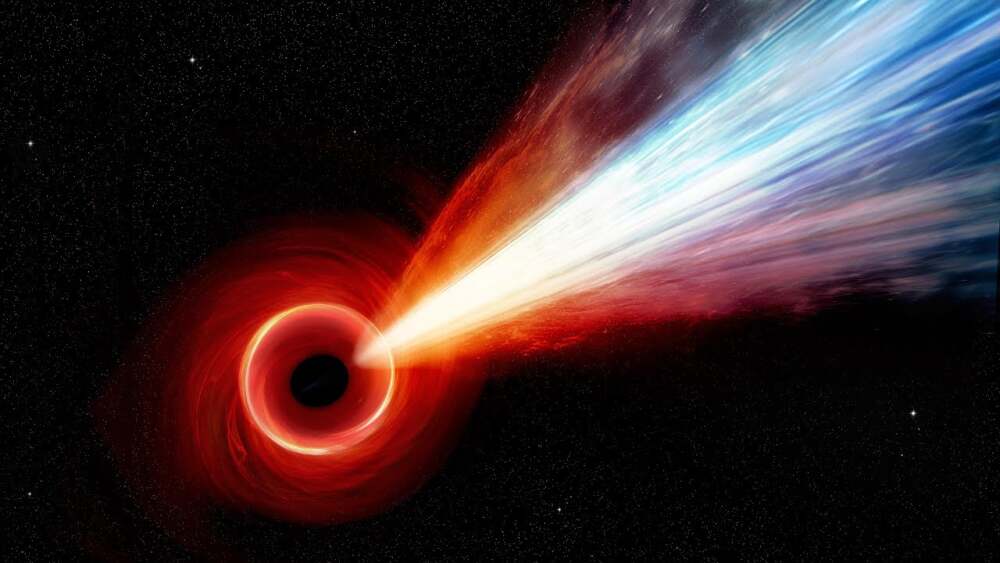
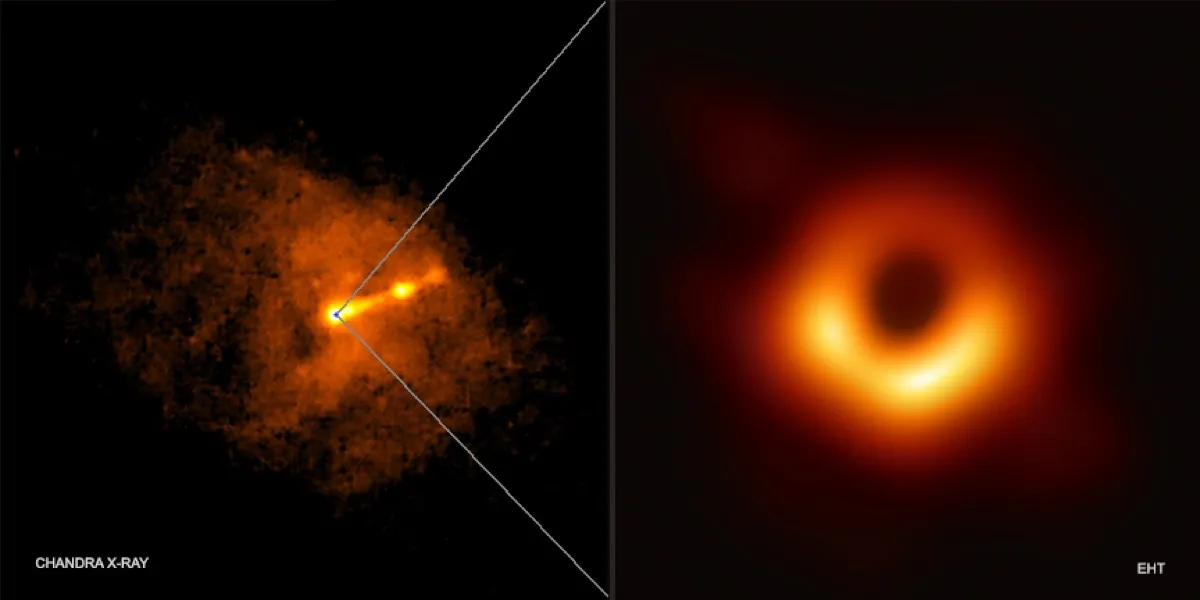
In a groundbreaking discovery, astronomers have traced a colossal jet of energetic particles, stretching 3,000 light-years, directly to the first black hole ever photographed. This finding offers unprecedented insight into how black holes can launch powerful jets that shape the evolution of galaxies across the universe.
The focus of this research is M87*, the supermassive black hole at the heart of the giant elliptical galaxy Messier 87, approximately 55 million light-years from Earth. With a mass about 6.5 billion times that of the Sun, M87* captured global attention in 2019 when scientists revealed the first-ever image of a black hole’s shadow, surrounded by a glowing ring of superheated matter.
Pinpointing the Jet’s Origin
While astronomers had long observed the enormous jet of charged particles emanating from M87*, locating its precise launch point proved challenging. Using high-resolution data and advanced modeling, researchers successfully linked the jet’s base to a compact region just 0.09 light-years from the black hole, directly associating it with the black hole’s shadow. This marks the first direct confirmation of where such enormous cosmic jets originate.
“This discovery bridges the gap between theory and observation, showing for the first time exactly where the jet is launched from the black hole’s surroundings,” said one of the lead scientists.
The Power Behind the Jets
These jets are among the universe’s most energetic phenomena. They occur when matter spiraling into the black hole forms a superheated accretion disk. Magnetic fields in this disk can twist and accelerate particles away from the black hole’s poles at near-light speeds, producing jets that extend thousands of light-years into space.
Such jets significantly impact their host galaxies. They can heat interstellar gas, regulate star formation, and redistribute matter across vast distances. Understanding these jets helps scientists learn how black holes influence galaxy evolution on enormous scales.
A Milestone in Black Hole Science
Linking a jet’s base to the black hole’s event horizon represents a major milestone in astrophysics. Researchers can now test theoretical models with real observational data and begin to understand the complex mechanisms behind jet formation and behavior. Future studies aim to create dynamic “movies” of jet activity, capturing how these immense structures form and evolve over time.
“This achievement is a testament to the collaborative effort and advanced technology required to observe phenomena on scales previously unimaginable,” said another astrophysicist involved in the research.
Why It Matters
By directly observing where and how jets emerge from supermassive black holes, scientists gain deeper insight into the forces shaping galaxies and the broader universe. Black holes, once considered passive cosmic sinkholes, are now recognized as powerful engines driving large-scale changes across the cosmos. This discovery brings humanity a step closer to understanding some of the universe’s most awe-inspiring and energetic phenomena.








Leave a Reply