

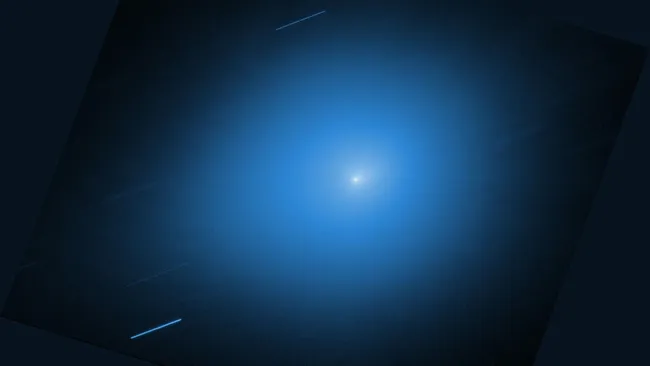
Astronomers and skywatchers around the globe are gearing up for a rare celestial event as Comet 3I/ATLAS is set to make its closest approach to Earth tomorrow. The comet, which has been traveling through the solar system for millions of years, is generating excitement due to its brightness, speed, and unique trajectory.
What Makes 3I/ATLAS Special
Comet 3I/ATLAS belongs to the category of interstellar objects, meaning it originated outside our solar system before being captured by the Sun’s gravitational influence. Unlike typical comets that circle the Sun in predictable orbits, interstellar visitors like 3I/ATLAS offer scientists a rare opportunity to study material from distant star systems.
Key characteristics of 3I/ATLAS include:
- High Velocity: The comet is moving at unprecedented speed, providing unique data on interstellar object dynamics.
- Distinct Composition: Spectral analysis indicates unusual chemical signatures, offering clues about the environment of its home star system.
- Visibility: Depending on atmospheric conditions and location, amateur astronomers may be able to observe the comet with binoculars or small telescopes as it passes near Earth.
Closest Approach Details
The comet will reach its nearest point to Earth tomorrow, passing at a distance of approximately X million kilometers (exact distance depends on final trajectory measurements). While this is a safe distance, it is close enough to produce clear observational opportunities for both professionals and enthusiasts.
Astronomers recommend observing during nighttime hours from areas with minimal light pollution. The comet’s tail, formed as solar radiation vaporizes surface ice and dust, may be visible stretching across the sky—a spectacular display for those lucky enough to witness it.
Scientific Significance
3I/ATLAS represents a valuable opportunity for researchers to study the composition, structure, and behavior of interstellar objects. Observations can shed light on:
- The formation of planetary systems beyond our own.
- Differences in chemical composition between solar system comets and interstellar visitors.
- The dynamics of high-velocity objects traveling through space.
Scientists are coordinating observations using telescopes around the world, as well as space-based instruments, to capture as much data as possible during the comet’s brief close approach.
Public Engagement and Observation Tips
Skywatching communities and astronomy clubs are preparing events and live-streams to allow the public to experience 3I/ATLAS. Tips for viewing include:
- Using binoculars or small telescopes for clearer viewing.
- Finding dark, unobstructed locations away from city lights.
- Following real-time updates from observatories and astronomy organizations.
A Rare Cosmic Visitor
Interstellar comets like 3I/ATLAS are incredibly rare; the last well-documented visitor of this kind appeared only a few years ago. The comet’s passage serves as a reminder of the vastness of space and the continuous flow of objects through our solar neighborhood.
As the countdown enters its final hours, astronomers and skywatchers alike are urging everyone to take a moment to witness this fleeting cosmic event. Tomorrow, 3I/ATLAS will be at its closest, offering a once-in-a-lifetime opportunity to observe a visitor from beyond our solar system.










Leave a Reply