

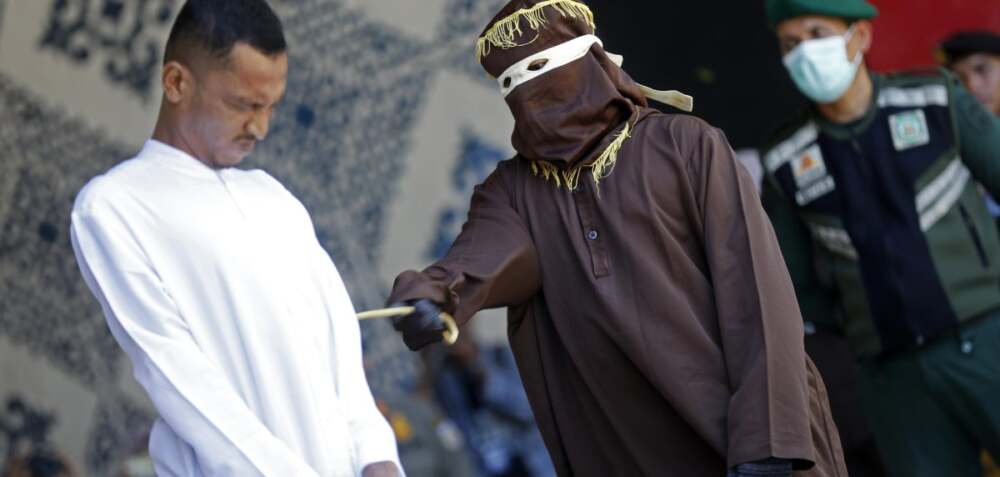
In a stark demonstration of strict Islamic law enforcement in Indonesia’s Aceh province, a man and a woman were each subjected to 140 cane strokes in a public park as punishment for sex outside marriage and alcohol consumption. The severe corporal sentence has reignited debates over human rights, religious law and legal autonomy within Indonesia’s largest Muslim-majority nation.
Aceh, located on the northern tip of Sumatra, is the only Indonesian province granted special autonomy to implement Sharia law — a legal framework based on conservative interpretations of Islamic teachings. Under this system, acts such as extramarital sex, drinking alcohol, gambling and same-sex relations are criminalised and can be punished with public caning, fines or short jail terms.
Public Punishment Draws Crowds
The sentencing took place in a public space in Banda Aceh, the provincial capital, where local residents gathered to witness the enforcement. Both individuals stood before a crowd as Sharia police carried out the caning with rattan sticks. Each received 100 lashes for engaging in sexual relations outside marriage and 40 lashes for consuming alcohol, totalling 140 strikes per person.
The female recipient reportedly struggled under the punishment and fainted during the ordeal before being attended to by medical personnel. The man remained standing throughout the session, which was overseen by officers from the Wilayatul Hisbah, the local Sharia enforcement agency.
Expanded Enforcement Alongside Other Cases
In the same session, other individuals also received caning sentences for different offences. Among them were members of the Sharia police force themselves, who were punished after being found in a private setting together, resulting in 23 strokes each.
Local authorities emphasised that the enforcement applied impartially, including to those responsible for upholding the laws. They defended the actions as necessary to uphold the moral code and deter similar behaviour within the community.
Legal Framework and Autonomy
Aceh’s Sharia code, known locally as qanun, allows judges wide discretion in determining punishment severity for a range of “moral crimes.” The province’s special status within Indonesia — a diverse archipelago with a majority Muslim population but secular national constitution — permits the enforcement of Islamic criminal law alongside the national legal system.
While many in Aceh support the moral framework, believing it preserves cultural and religious values, the severity of punishments such as corporal caning remains controversial among legal experts and human rights observers within and outside Indonesia.
Human Rights Concerns Intensify
Civil liberties organisations have strongly criticised the use of public caning, describing it as cruel, degrading and in violation of international human rights standards. Opponents argue that corporal punishment inflicts lasting physical and psychological harm and disproportionately affects marginalised groups.
More broadly, human rights advocates contend that punishing consensual behaviour — such as private adult relationships or moderate alcohol consumption — violates individual freedoms. They have called on both provincial and national lawmakers to reconsider these punitive measures and align Indonesia’s legal practices with international norms.
National and Local Reactions
Within Aceh, opinions on the punishment are mixed. Some local residents defended the caning as appropriate within the context of Islamic moral values, asserting that public enforcement encourages community adherence to religious teachings. Others, particularly younger citizens and human rights advocates, have expressed discomfort with the severity of the punishment and the spectacle it creates.
National leaders in Indonesia, while recognising the province’s autonomous rights, have faced increasing pressure to address concerns about human rights and legal reform. Critics argue that while respecting local cultural norms is important, physical punishment for personal behaviour raises ethical and legal questions that extend beyond provincial boundaries.
Broader Implications
The high-profile case has drawn attention to the complexity of legal pluralism in Indonesia — balancing respect for regional autonomy with national and international commitments to human dignity and justice. As debates continue, Aceh’s enforcement of Sharia law remains one of the most vivid and controversial expressions of this legal and cultural tension, highlighting the ongoing challenge of reconciling traditional religious practices with evolving understandings of human rights.















Leave a Reply