

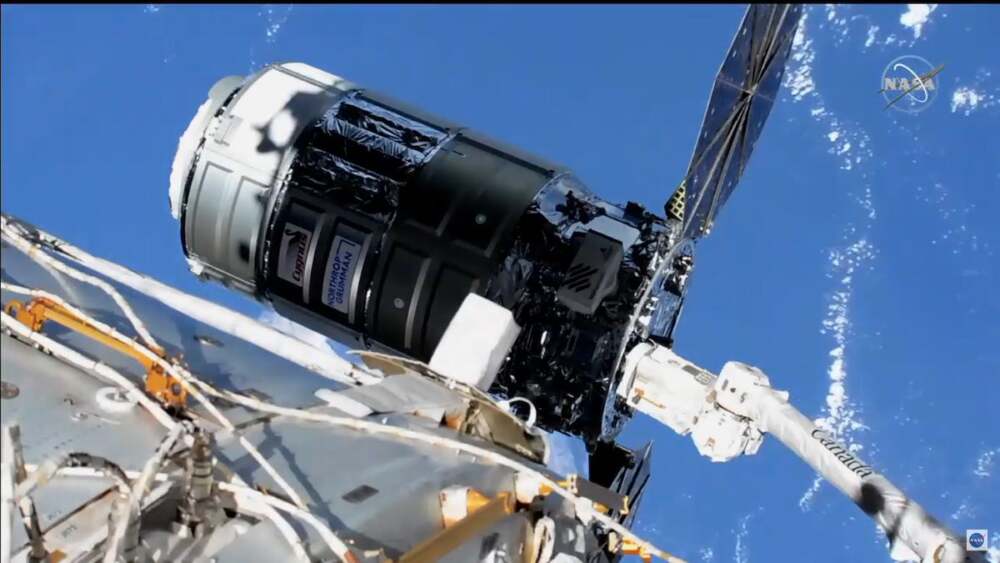
Northrop Grumman has officially launched its latest upgrade to the Cygnus cargo spacecraft, dubbed Cygnus XL, marking one of the most substantial boosts in payload capacity for resupply missions to the International Space Station (ISS) in recent years. The mission, called NG-23, took off aboard a SpaceX Falcon 9 rocket from Florida and is expected to dock with the ISS in mid-week.
What Makes Cygnus XL a “Chonker”
- Bigger Payload: Cygnus XL hauls around 11,000 pounds (just under 5,000 kilograms) of supplies to the ISS—about a 25% increase over previous versions of Cygnus. This allows more materials per flight, reducing the number of resupply missions needed overall.
- More Volume Inside: Its pressurized cargo compartment has been expanded. This gives researchers more room for experiments, supplies, and equipment, particularly items that demand careful packaging or climate control (like scientific crystals or biological research materials).
- Enhanced Efficiency: With this upgrade, Northrop Grumman can carry out the same resupply efforts with fewer launches, which may translate to cost savings and reduced logistical complexity over the long run.
Mission NG-23: What’s On Board
The supplies loaded into Cygnus XL for the NG-23 mission are diverse:
- Materials to grow semiconductor crystals in microgravity. These help in researching materials with potential applications in electronics or optics.
- Equipment aimed at improving cryogenic fuel tank performance—a critical technology for deep-space missions or long-duration storage of cold fuels.
- Specialized systems to maintain water purity and reduce microbial growth aboard the ISS, including ultraviolet light cleaning setups.
- Essentials and experimental gear for ongoing scientific work: pharmaceutical crystal growth, environmental monitoring, and more.
Operational Notes & Arrival
- The spacecraft is not designed to dock itself; instead, it will be captured using the station’s robotic arm and then attached to one of the ISS’s berthing ports.
- Once its mission is complete, Cygnus XL will remain berthed for some time before departing. As usual, after unloading, it will eventually be deorbited where it burns up in Earth’s atmosphere.
Why This Matters
- Greater Capacity Means More Science: With the larger volume and mass capability, scientists can send up more sophisticated experiments or larger batches of them, accelerating research cycles.
- Cost and Launch Efficiency: Fewer launches needed for the same total resupply will ease scheduling constraints, reduce launch-vehicle demand, and potentially lower costs.
- Preparing for Deeper Space: Technologies refined here—like reliable handling of cold fuels, material science in microgravity, and resource management—feed directly into what’s needed for longer, more ambitious space missions in the future.
Conclusion
Cygnus XL earns its “chonker” nickname not just for its heft, but for how its upgrades actively enhance ISS resupply capability. It’s a smart step forward: more room, more payload, more science, fewer flights. For Northrop Grumman, NASA, and the broader space research community, this mission signals a maturing of cargo spacecraft technology — making research in orbit more sustainable and ambitious.














Leave a Reply