

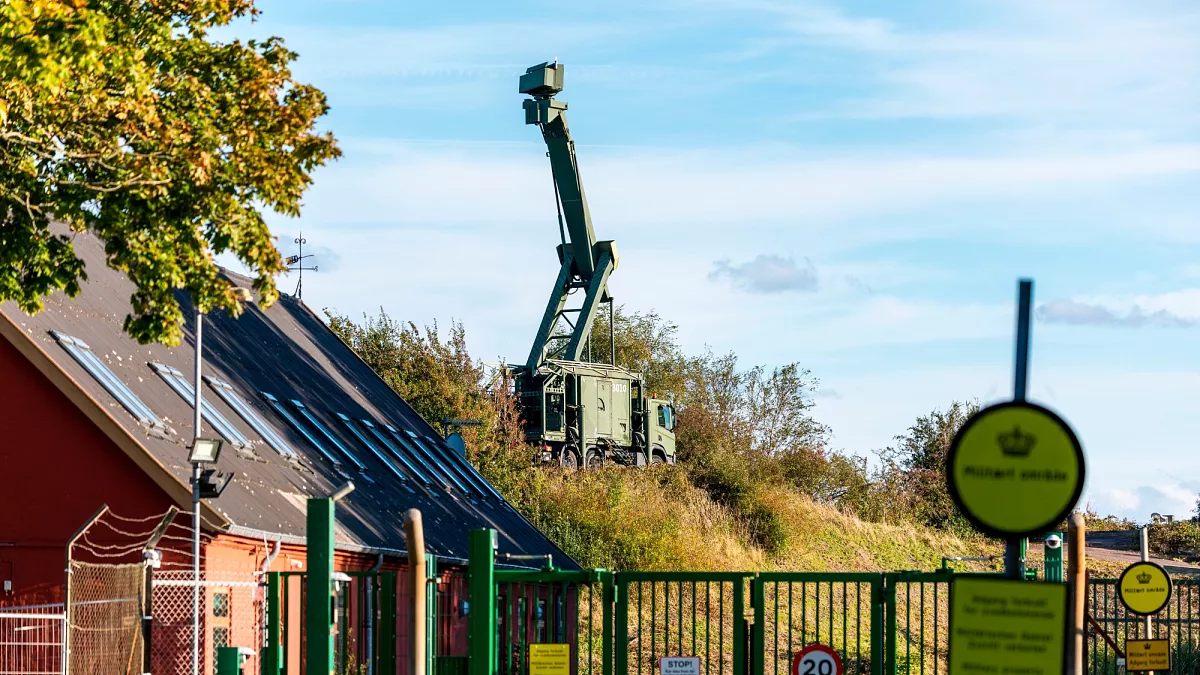
Danish authorities have confirmed new sightings of unidentified drones over military facilities, intensifying concerns about the country’s ability to protect its critical infrastructure from emerging aerial threats.
Overnight Activity Reported
The Danish Armed Forces stated that drones were detected at several of its locations overnight. While officials declined to identify exact sites, local police confirmed that one or two drones were seen near Karup air base in western Denmark, one of the nation’s largest and most strategically important military complexes.
This latest incident follows a week of repeated drone appearances that briefly disrupted civilian airports, including Copenhagen Airport, and affected other regional hubs.
Hybrid Attack Concerns
Officials have described the intrusions as part of a hybrid threat — tactics designed to probe defenses, cause disruption, and spread uncertainty without direct confrontation. The prime minister recently labeled drone incursions as the “most serious assault on Denmark’s infrastructure in recent years.”
The timing is particularly sensitive as Denmark prepares to host a major European summit in Copenhagen. Security services fear further incursions could embarrass the government or escalate into more serious provocations.
Regional Context
Neighboring Norway also reported possible drone activity near its Ørland air force base, which hosts F-35 fighter jets. Guard posts outside the base perimeter recorded unusual movements that authorities are now investigating.
Across Europe, governments are increasingly concerned about the rise of drones as low-cost tools of intelligence gathering and disruption.
Steps Toward Defense
To counter the immediate threat, Denmark has accepted Sweden’s offer to deploy anti-drone technology ahead of the summit. Military and intelligence agencies are also analyzing drone flight paths, control signals, and potential launch sites to identify who may be behind the operations.
While no state or group has claimed responsibility, security analysts argue that only a handful of actors possess both the motive and capability to carry out sustained intrusions of this scale.
What’s Next
- Investigations will focus on intercepting or recovering drones to trace their origin.
- Security forces will conduct live tests of counter-drone systems in sensitive areas.
- Copenhagen is expected to consult NATO allies on a broader regional defense strategy against aerial incursions.
For Denmark, the issue goes beyond airspace safety. It raises critical questions about whether Europe’s smaller nations are equipped to defend against an increasingly common weapon in modern conflict — drones designed not for open war, but for quiet, persistent pressure.

















Leave a Reply