

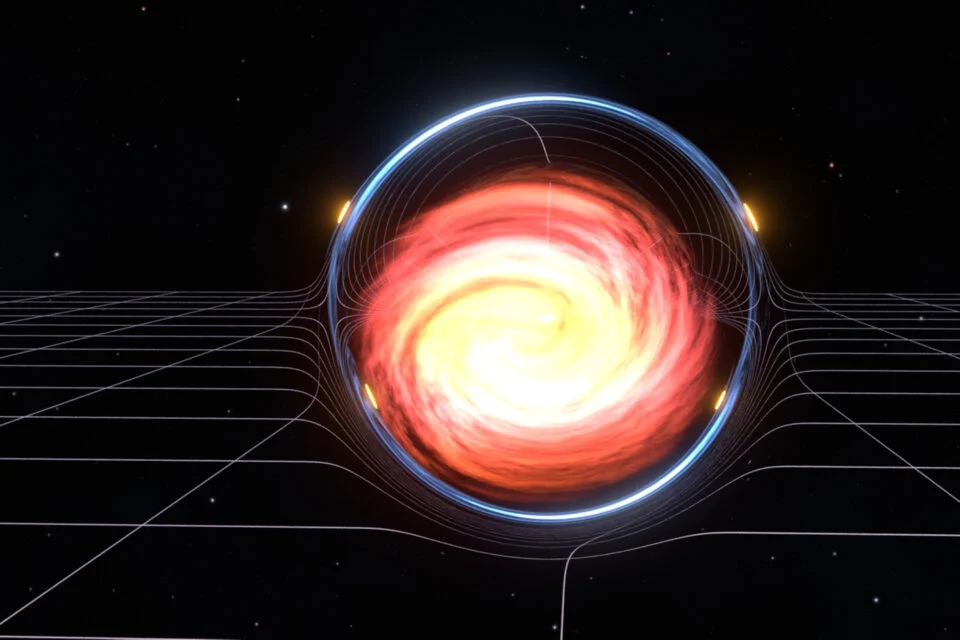
Astronomers have unveiled a mind-bending discovery: an ultrabright supernova observed through a phenomenon known as an Einstein Cross, offering a rare glimpse of stellar explosions from a distance previously thought unobservable. The finding provides new opportunities to study the early universe and the extreme physics of supernovae.
An Einstein Cross occurs when the gravity of a massive foreground object, such as a galaxy, bends and magnifies the light from a more distant source, creating multiple images of the same astronomical event. In this case, the gravity lensing effect allowed scientists to detect a supernova located billions of light-years away—so far that, under normal circumstances, it would have been too faint to observe.
The supernova is classified as Type Ia, an exploding white dwarf in a binary system, which astronomers often use as “standard candles” to measure cosmic distances. What makes this event extraordinary is its apparent brightness, amplified by gravitational lensing, and the sheer distance involved. Observing such a supernova gives researchers insight into star formation, galaxy evolution, and the rate of cosmic expansion at earlier epochs of the universe.
Dr. Priya Kapoor, an astrophysicist involved in the study, explained: “Gravitational lensing is like nature’s telescope. It allows us to see events that would otherwise be invisible and offers a direct window into the distant cosmos. Discovering a supernova at this distance is unprecedented—it pushes the limits of what we thought was observable.”
High-resolution imaging and spectroscopic analysis have allowed scientists to study the supernova’s composition, energy output, and host galaxy environment. Preliminary results indicate the explosion was consistent with known Type Ia supernova mechanisms but provides unique clues about the interstellar medium and chemical evolution in galaxies from the early universe.
This discovery also has implications for cosmology. Observing distant supernovae with lensing magnification can improve measurements of the Hubble constant, helping resolve discrepancies between different methods of calculating the universe’s expansion rate.
The finding underscores the power of combining gravitational lensing, space-based telescopes, and advanced imaging techniques to explore extreme cosmic phenomena. Researchers hope that further discoveries of this kind will refine our understanding of stellar life cycles, the distribution of dark matter, and the evolution of galaxies across cosmic time.







Leave a Reply