

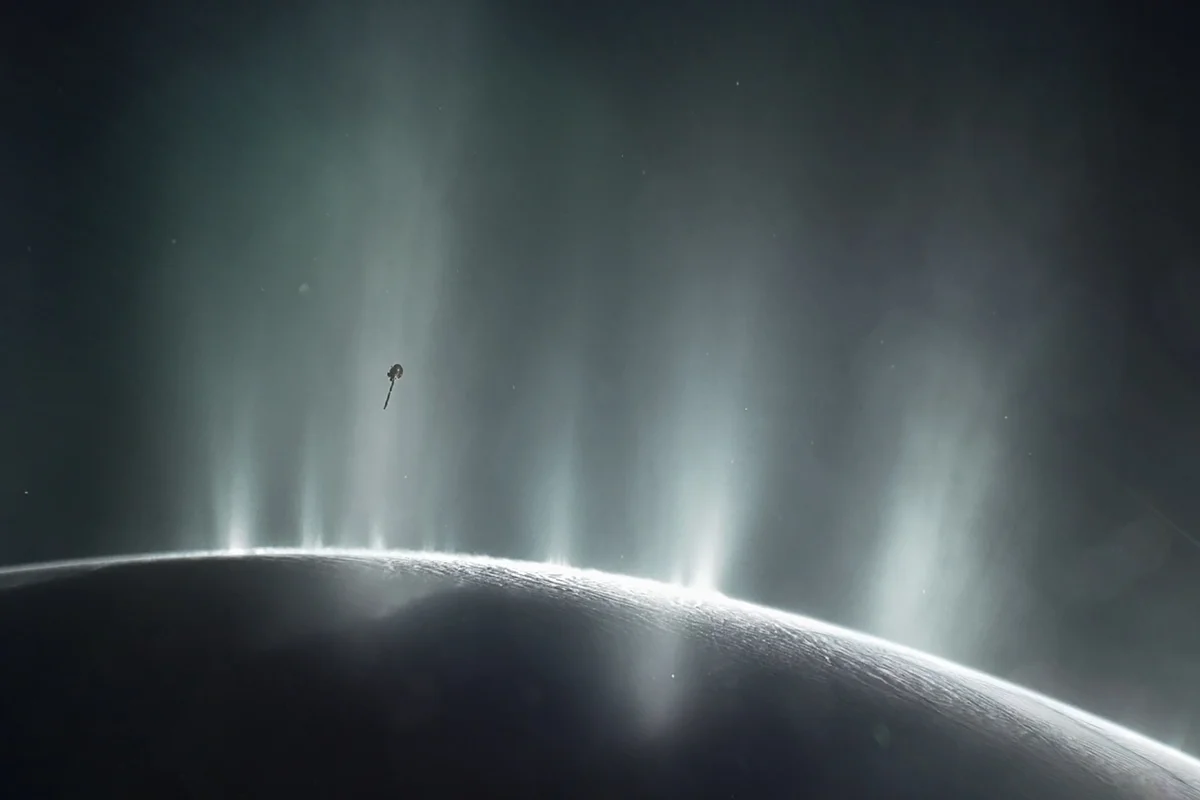
Saturn’s icy moon Enceladus has once again captured the attention of the scientific world. New findings based on NASA’s Cassini spacecraft data have revealed a richer and more complex mix of organic compounds than previously detected. These discoveries strengthen the possibility that Enceladus—only about 500 kilometers across—might be one of the most promising places in our solar system to search for extraterrestrial life.
The Power of the Plumes
Enceladus is not an ordinary moon. Beneath its frozen surface lies a global ocean of liquid water, kept warm by tidal heating as Saturn’s gravity flexes and squeezes the moon’s interior. Through cracks near its south pole, known as the “tiger stripes,” enormous geysers blast jets of water vapor, ice grains, salts, and organic molecules into space.
NASA’s Cassini spacecraft, which orbited Saturn from 2004 to 2017, made multiple daring flybys through these plumes. By directly sampling the material ejected into space, Cassini gave scientists a glimpse of the moon’s subsurface ocean without the need for a lander or a drill.
New Organic Molecules Discovered
In the latest analysis of Cassini’s archived data, researchers studied the youngest ice grains collected during the flybys. These particles, freshly expelled from the plumes, showed minimal exposure to space radiation, preserving their chemical signatures.
What they found surprised them: new varieties of organic molecules not previously seen. These compounds appear to originate directly from Enceladus’ hidden ocean, reinforcing the idea that chemical processes inside the moon are ongoing and possibly favorable to life.
Organic compounds are the building blocks of life. While their presence alone does not confirm biology, their diversity and freshness suggest that Enceladus is a dynamic, chemically active world with potential pathways for habitability.
The Case for Habitability
To be considered “habitable,” an environment must provide three key ingredients: liquid water, chemical building blocks, and a source of energy.
- Liquid water: Enceladus clearly has it in abundance, with a vast global ocean beneath its icy shell.
- Building blocks: The detection of organic molecules—carbon-rich compounds essential to life—makes the ocean chemically interesting.
- Energy: The constant tidal flexing of the moon provides internal heat, and interactions between water and rock at the ocean floor could generate hydrothermal vents, similar to those on Earth’s seafloor that teem with microbial life.
Scientists now argue that Enceladus is not just theoretically habitable but a prime candidate for harboring microbial life in its ocean.
How Enceladus Stacks Up Against Other Ocean Worlds
Enceladus is often compared to Europa, Jupiter’s icy moon, which also hides a global ocean beneath its crust. While Europa has been a focal point for upcoming NASA and ESA missions, Enceladus offers a unique advantage: its plumes naturally eject ocean material into space, allowing for direct sampling without having to penetrate kilometers of ice.
In this sense, Enceladus might actually be the more accessible laboratory for testing theories about life beyond Earth.
Remaining Mysteries
Despite the tantalizing evidence, there are critical questions that remain unanswered:
- Is the concentration of organics high enough to support life? Trace amounts are promising, but scientists need to know how abundant and diverse these molecules are.
- What chemical reactions are occurring in the ocean? Hydrothermal activity at the seafloor could provide energy-rich environments, but this remains to be proven.
- Do the organics show patterns consistent with biology, or are they purely geological? Distinguishing between abiotic and biotic origins will be one of the hardest challenges.
- How stable is the ocean? Understanding how long these habitable conditions have persisted will shape our assessment of whether life has had enough time to emerge.
Why Future Missions Are Crucial
The findings have reignited calls for a dedicated mission to Enceladus. While Cassini provided groundbreaking data, its instruments were not designed to directly detect life.
Proposals include:
- An Enceladus Orbiter: To repeatedly fly through plumes with next-generation instruments.
- A Lander: To touch down near the tiger stripes and analyze fresh ice deposits.
- A Sample Return Mission: To bring pristine plume material back to Earth for detailed study in laboratories.
NASA and international space agencies are reviewing mission concepts, and private organizations have also expressed interest in fast-tracking exploration.
A Gateway to the Bigger Question
The new evidence from Enceladus highlights a broader shift in planetary science: the recognition that ocean worlds beyond Earth may be the most likely places to find life. Mars once held that role, but its arid conditions and radiation exposure make it less favorable today. By contrast, moons like Enceladus, Europa, and even Titan may be far more promising.
Each discovery on Enceladus adds momentum to the search for life in the solar system. And each new clue draws us closer to answering one of humanity’s most profound questions: Are we alone?
Conclusion
Enceladus, once a tiny overlooked moon of Saturn, has transformed into a central character in the story of astrobiology. The discovery of new organic compounds doesn’t prove life exists there—but it provides the strongest evidence yet that Enceladus’ ocean could support it.
If life is eventually confirmed beneath the icy shell of this distant world, it would not only reshape science—it would forever alter our understanding of humanity’s place in the cosmos.












Leave a Reply