

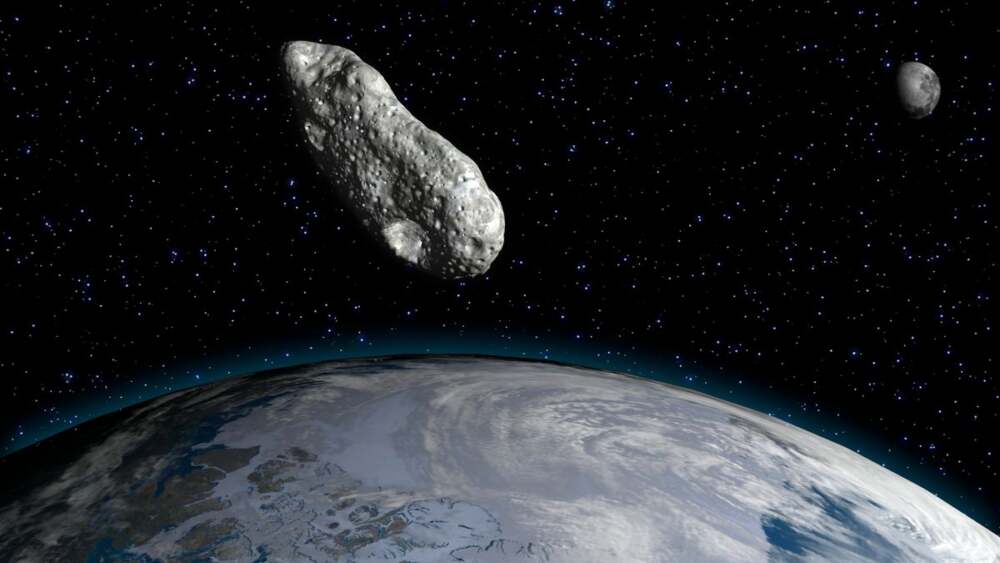
In a rare and dramatic celestial event, the European Space Agency (ESA) has confirmed that an asteroid designated 2025 TF made a remarkably close pass by Earth on October 1, 2025 — flying over Antarctica at an altitude comparable to that of the International Space Station (ISS). While the object posed no threat to life on the planet, the near miss underscores both the capabilities and limitations of current asteroid detection systems.
The Close Encounter: A Brush With Earth
At 00:47:26 UTC ± 18 seconds on October 1, 2025, asteroid 2025 TF traversed the skies over Earth’s southern hemisphere, coming within 428 ± 7 kilometers of Earth’s surface. To put that into perspective, that altitude is similar to where the ISS orbits, putting the asteroid’s trajectory in the realm of near-Earth space traffic.
Astronomers estimate the asteroid’s diameter to be between 1 and 3 meters, making it relatively small in cosmic terms. Because of its size, it posed no significant risk — such objects usually burn up harmlessly in the upper atmosphere, sometimes producing spectacular fireballs or, on rare occasions, dropping small meteorites.
ESA’s Planetary Defence Office, in collaboration with observatories such as the Las Cumbres Observatory in Australia, tracked 2025 TF following its discovery, using telescopes to refine its orbit, trajectory, and passage details.
A Discovery After the Flyby
What makes this encounter particularly notable is that astronomers first identified 2025 TF after it had already passed Earth. The asteroid was first detected by the Catalina Sky Survey several hours post-flyby. Despite this, follow-up observations by ESA and partner facilities enabled astronomers to reconstruct its path with surprising precision.
Finding such a small object only after its closest approach highlights both the difficulty and urgency in detecting small asteroids with potential near-Earth trajectories. While larger objects are relatively easier to spot and monitor well in advance, meter-scale rock fragments challenge even the best detection systems.
Why It Matters
- Validation of Detection Systems
Though late in discovery, the successful triangulation of 2025 TF’s trajectory demonstrates the effectiveness of coordinated observation networks. It shows scientists can still derive meaningful data from brief windows of opportunity. - Close Call Reminder
While this particular asteroid was harmless, its proximity serves as a reminder that space is dynamic and full of potential hazards. The more close approaches that occur — even with small asteroids — the better prepared scientists and defense agencies can be. - Calibration for Future Missions
Thanks to this event, astronomers gain real data on how small bodies behave when near Earth. This helps refine orbital models and risk assessments for other near-Earth objects (NEOs). - Inspiration for Planetary Defense
Events like this strengthen the case for increased investment in early-warning systems, more powerful telescopes, and space-based observation platforms capable of spotting tiny but consequential objects.
How It Was Tracked
Once discovered, astronomers used multiple telescopes to gather follow-up measurements. By correlating observations from different vantage points, they were able to compute with high confidence the asteroid’s path, velocity, and proximity at its nearest approach.
The tracking effort involved ESA scientists and collaborating observers, who quickly shared data to confirm and refine calculations. Because the object passed over Antarctica, many ground-based telescopes elsewhere had a favorable view during or shortly after its transit.
The Technical Challenge of Small Asteroids
Small asteroids like 2025 TF present significant detection problems:
- Low brightness: Their small surfaces reflect very little sunlight, making them faint and easily lost in sky surveys.
- Rapid motion: They can move quickly across the sky, further complicating detection and tracking.
- Late discovery window: Many are only spotted after passing Earth, limiting response options.
While objects of this size rarely pose a catastrophic threat, their sporadic nature makes them ideal test cases for refining survey techniques and planetary defense strategies.
What Happens Next?
Now that 2025 TF is safely past Earth, scientists will continue to observe it to refine its orbit and future trajectory. If feasible, long-term orbital models may project its path years forward to determine whether it might return for another flyby.
At the same time, agencies like ESA and its international partners will review how the detection and tracking process went, identifying gaps and opportunities to improve early-warning capabilities.
Looking forward, the event builds momentum for planned missions and programs focused on NEO detection, tracking, and mitigation.
Broader Context: Near-Earth Object Monitoring
The flyby of 2025 TF is part of a growing catalog of near-Earth objects that come close — sometimes extremely close — to our planet. Monitoring these is critical not only for safety but also for scientific insight into the solar system’s small-body population.
In the coming years, improved instruments, ground and space-based telescopes, and international cooperation will all play a role in protecting Earth from surprises. The mission is not simply to detect, but to understand orbital mechanics, anticipate future threats, and, if necessary, develop techniques to deflect dangerous asteroids.
Final Thoughts
While the October 1 passage of asteroid 2025 TF was harmless, it was a moment that caught the attention of astronomers and space-watchers alike. The fact that it flew within hundreds of kilometers of Earth — essentially brushing the edge of low-Earth space — underscores how dynamic our cosmic neighborhood is.
Rather than raising alarm, the event should encourage vigilance, investment, and public awareness. Every asteroid that comes close is a chance to test our defense systems, sharpen our tools, and deepen humanity’s ability to navigate a universe where near-misses are more common than many would expect.











Leave a Reply