

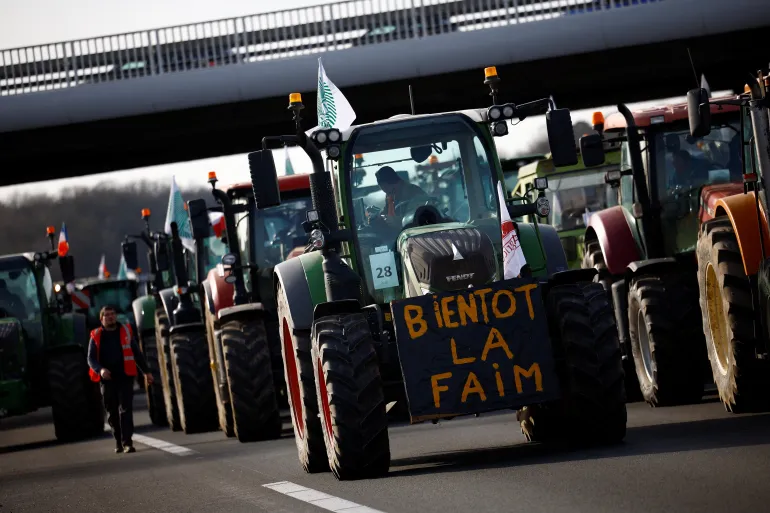
French farmers have taken to the roads, fields, and city outskirts in renewed protest against the European Union’s proposed trade agreement with Mercosur, a South American trade bloc. At the heart of their opposition lies a deep fear that the deal could undermine local agriculture, weaken food standards, and threaten rural livelihoods across France.
What Is the EU–Mercosur Trade Deal?
The EU–Mercosur agreement is a long-negotiated trade pact between the European Union and four South American countries: Brazil, Argentina, Uruguay, and Paraguay. Its goal is to reduce tariffs, boost exports, and strengthen economic ties between the two regions. For European industries such as cars, machinery, and pharmaceuticals, the deal promises expanded access to fast-growing markets.
For many farmers, however, it represents a serious threat.
Fear of Cheap Agricultural Imports
One of the biggest concerns among French farmers is the expected influx of cheaper agricultural products, particularly beef, poultry, sugar, and soy. Mercosur countries are among the world’s largest agricultural exporters and can often produce food at lower costs due to cheaper land, labor, and looser regulations.
French farmers argue they cannot compete with large-scale South American producers selling meat and crops at prices far below European production costs. They warn that this imbalance could push many small and medium-sized farms out of business.
Unequal Standards and “Unfair Competition”
French agricultural unions say the deal creates unfair competition because Mercosur producers are not required to follow the same strict rules imposed on EU farmers. European agriculture is governed by tight regulations on pesticides, animal welfare, environmental protection, and labor rights.
Farmers claim imported products may be produced using substances or practices banned in the EU, effectively penalizing European farmers for following higher standards while rewarding foreign producers who do not face the same constraints.
Environmental and Climate Concerns
Environmental issues are another major source of opposition. Critics of the deal argue it could accelerate deforestation in South America, particularly in the Amazon, by increasing demand for beef and soy exports. French farmers, many of whom are under pressure to adopt greener practices, say the deal contradicts Europe’s climate and sustainability goals.
They question how the EU can ask its farmers to reduce emissions and protect biodiversity while simultaneously encouraging imports linked to environmental destruction abroad.
Pressure on Rural Communities
Beyond economics, French farmers see the agreement as a threat to rural life itself. Farming in France is not only an industry but also a cultural foundation of the countryside. Many protesters fear that falling prices and increased competition will accelerate farm closures, depopulation of rural areas, and the loss of generational farming traditions.
For younger farmers already struggling with debt, rising costs, and climate challenges, the deal feels like another blow in an already fragile sector.
Political Sensitivity in France
Agriculture carries strong political weight in France, where farmers have a long history of mobilization and influence. With elections often looming, opposition to the EU–Mercosur deal has become a sensitive issue for French leaders, who must balance trade ambitions with domestic unrest.
While the French government has expressed reservations and demanded stronger environmental and safety guarantees, many farmers say these assurances are not enough.
Why the Protests Matter
The backlash against the EU–Mercosur deal highlights a broader tension within global trade: how to open markets without sacrificing local livelihoods, food safety, and environmental responsibility. For French farmers, the issue is not just trade—it is about survival, fairness, and the future of European agriculture.
As negotiations continue, their protests signal that any agreement lacking strong protections for farmers and the environment will face fierce resistance on the ground.











Leave a Reply