

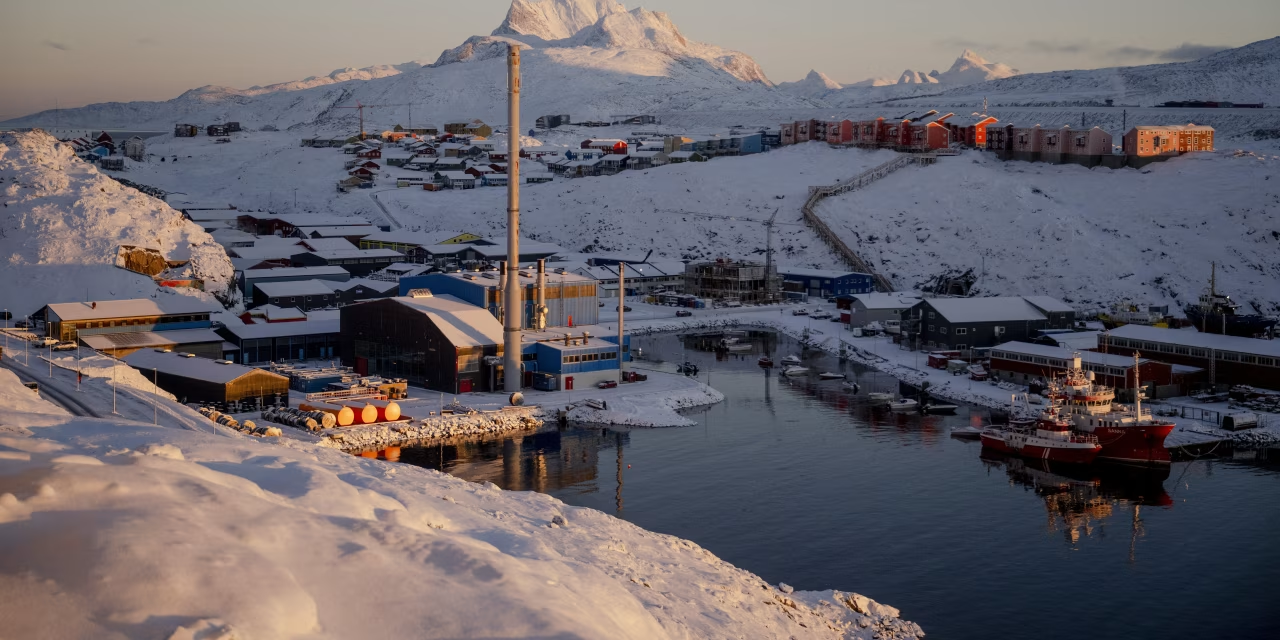
The North Atlantic Treaty Organization was created to ensure that its members would never fight one another. Yet history shows that even the strongest alliances are not immune to internal tension, and today Greenland has unexpectedly become a symbol of how fragile unity can be when strategic interests collide.
Greenland, a vast Arctic island governed by Denmark, has gained new importance as melting ice opens access to rare minerals, shipping routes, and military positioning in the High North. Recent political rhetoric from the United States suggesting that Washington could seek control of Greenland — even hinting at the use of force — has caused shockwaves across Europe. Denmark has firmly rejected any such notion, while Greenland’s own leaders have stressed that their future must be decided only by the people who live there.
This disagreement may seem extraordinary, but NATO has faced similar moments before when member states stood on opposite sides of dangerous disputes.
One of the earliest examples was the series of confrontations known as the Cod Wars between the United Kingdom and Iceland during the Cold War. The two NATO allies clashed repeatedly over fishing rights in the North Atlantic. Warships and fishing boats engaged in aggressive maneuvers, collisions occurred at sea, and tensions ran so high that Iceland even threatened to leave NATO. Only heavy diplomatic pressure prevented the situation from spiraling out of control.
A much more serious crisis erupted in 1974 when Turkey invaded Cyprus following a coup supported by Greece. Both Greece and Turkey were NATO members, yet they found themselves on opposite sides of a military operation. The conflict split the alliance and forced Greece to temporarily withdraw from NATO’s military command. Although open war between the two was avoided, the damage to alliance unity was deep and long-lasting.
Another lesser-known but dangerous confrontation happened in the mid-1990s when Canada and Spain faced off over fishing rights in the North Atlantic. Canadian authorities seized a Spanish fishing vessel, and naval forces were deployed by both sides. Though shots were fired in warning, diplomacy eventually prevailed before the standoff turned violent.
These incidents show that NATO’s promise of unity has been tested before, but never in quite the same way as the Greenland issue. What makes the current situation especially troubling is that it involves the possibility of a superpower applying pressure on a much smaller ally over territory that is legally protected under the alliance’s collective defense framework.
If a NATO member were to use military force against another, it would place the entire alliance in an impossible position. The organization is built on the idea that an attack on one is an attack on all, yet it has no clear mechanism for handling a war between its own members. Such a crisis could paralyze decision-making, weaken global confidence in NATO, and embolden rival powers that are eager to see Western unity collapse.
For Denmark and Greenland, the issue is one of sovereignty and self-determination. For NATO, it is a test of whether its founding principles still hold in a world where power politics is returning. For the global community, it is a reminder that even alliances built on shared values can be strained when strategic and economic interests come into play.
Greenland, once seen as a remote and frozen outpost, now stands at the heart of a debate that could shape the future of the world’s most powerful military alliance.











Leave a Reply