

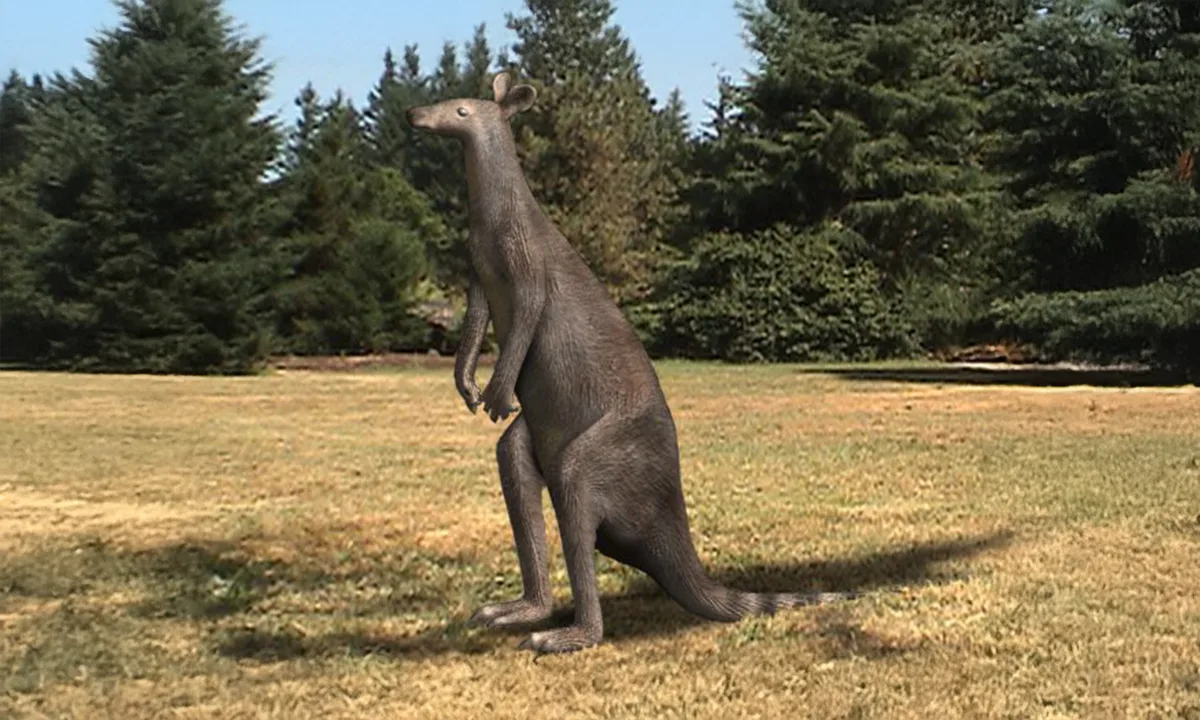
Recent scientific findings are transforming our understanding of how some of Australia’s most iconic prehistoric animals moved. Long before humans arrived on the continent, massive kangaroo ancestors weighing up to 250 kilograms dominated the landscape — yet for years researchers wondered whether such heavy animals could actually hop like their modern relatives. New evidence now suggests these giants may indeed have been capable of hopping, overturning longstanding assumptions about their locomotion and ecology.
Rethinking a Classic Image: More Than Just Big Wallabies
Today’s kangaroos are renowned for their ability to hop gracefully and efficiently, using powerful hind legs and elastic tendons to travel large distances with minimal energy. But scaling that motion up to an animal weighing 250 kilograms — about the size of a small adult male polar bear — appeared biomechanically unlikely. For decades, scientists suggested that these prehistoric giants walked on all fours or adopted a bounding gait entirely unlike the distinct kangaroo hop we recognize today.
However, a detailed biomechanical analysis of fossilized hindlimbs, feet, and tendon attachment sites tells a more nuanced story. These fossils reveal that key features associated with hopping — especially robust heel bones and reinforced tendon attachment points — were present in these large species. These adaptations likely helped absorb and return the energy of landing forces, much like in modern kangaroos. Instead of being grounded, slow movers, the giants seem to have retained the anatomical potential for hopping, at least in limited ways.
Hopping, But Not Like Today’s Kangaroos
Researchers emphasize that although these prehistoric kangaroos had the structures needed for hopping, their huge size would have affected how they moved. The hopping motion of a 250‑kilogram animal wouldn’t have looked like a kangaroo’s bound today; instead, they might have used a mixed locomotion strategy — combining short, powerful hops with slower strides or weight‑bearing steps.
In practical terms, this means that when fleeing danger or crossing uneven terrain, these animals could have produced strong, short hops. For longer distances or when conserving energy, they may have relied on alternate movements, possibly using all four limbs or a slow, shuffling gait. This versatility would have given them an advantage in a range of habitats — from open grasslands to rugged, rocky country.
Why This Matters: Ecology, Behavior, and Extinction
Understanding how these giants moved has broader implications beyond biomechanics. Mobility influences feeding patterns, territorial ranges, predator avoidance, and even social behavior. If these large kangaroos could hop, even occasionally, it suggests they were more agile and adaptable than previously believed.
This adaptability may have helped them exploit diverse resources across ancient Australia — yet it also raises new questions about why they eventually vanished. Many scientists point to rapid climate shifts and the disappearance of lush grasslands at the end of the last Ice Age as key factors in their extinction. However, the revelation that they retained some hopping ability suggests their decline was not simply a result of biomechanical limitations.
A Richer Picture of Prehistoric Australia
The new findings add depth to our understanding of ancient Australian ecosystems, where giant kangaroos shared the land with enormous wombat ancestors, giant monitor lizards, and other members of the prehistoric megafauna. It reveals a dynamic landscape where evolutionary innovation allowed even massive animals to retain traits once thought impossible for their size.
This research also highlights the power of combining fossil evidence with modern biomechanical models. By examining bone structure, tendon attachment sites, and limb proportions in detail, scientists can reconstruct not just what these animals looked like, but how they lived and moved.
As paleontologists continue to uncover new specimens and refine their methods, our picture of prehistoric life becomes ever more vivid — and more surprising. Far from being awkward giants, these ancient kangaroos may have bounded across their world with more agility than we ever gave them credit for.













Leave a Reply