

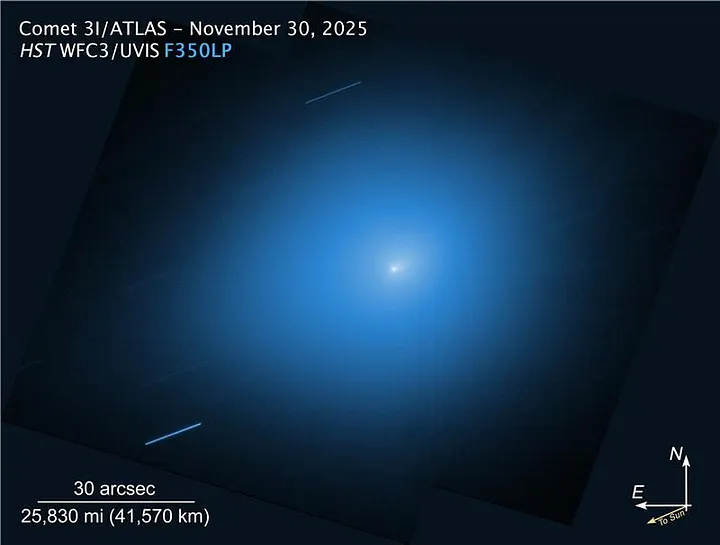
Astronomers have unveiled a striking new image of 3I/ATLAS, a rare interstellar object passing through our solar system, captured by the Hubble Space Telescope. The observations provide a closer look at the object’s structure and composition, offering scientists a unique opportunity to study material from beyond our solar neighborhood.
What Is 3I/ATLAS?
3I/ATLAS is an interstellar visitor — the third confirmed object of its kind detected traveling through the solar system from another star system. Its elongated shape and unusual trajectory indicate it originated outside the Sun’s gravitational influence, making it an invaluable subject for astronomers seeking clues about other planetary systems.
The object was first spotted by the Asteroid Terrestrial-impact Last Alert System (ATLAS), a sky survey dedicated to detecting potentially hazardous asteroids. Since its discovery, 3I/ATLAS has been closely monitored to determine its orbit, composition, and physical characteristics.
Insights from Hubble
The Hubble image reveals 3I/ATLAS in unprecedented detail, showing a faint, diffuse coma surrounding the object. This cloud of gas and dust suggests that 3I/ATLAS is active, sublimating volatile materials as it passes close to the Sun.
Researchers are particularly interested in the following features:
- Shape and Rotation: Hubble data helps determine the object’s dimensions and spin rate.
- Surface Composition: Variations in brightness provide clues about the types of materials present.
- Activity Levels: Observations of the coma and dust tail allow scientists to compare interstellar objects to comets and asteroids within our solar system.
Why It Matters
Interstellar objects like 3I/ATLAS offer a rare window into the building blocks of other star systems. By studying its composition, astronomers can infer conditions in distant planetary nurseries and test theories about how planetary systems form and evolve.
“This is a once-in-a-lifetime opportunity to study material that has traveled light-years from another star,” said one astronomer involved in the Hubble observations. “Every new detail we uncover helps us understand our place in the galaxy.”
Looking Ahead
3I/ATLAS will continue its journey out of the solar system, but scientists are seizing every moment to collect data before it becomes too faint to observe. Follow-up observations with ground-based telescopes and other space observatories will complement Hubble’s findings, potentially unlocking secrets about the chemistry and dynamics of interstellar visitors.
The stunning image serves as a reminder of the vastness of space and the interstellar connections that pass quietly through our cosmic neighborhood.











Leave a Reply