

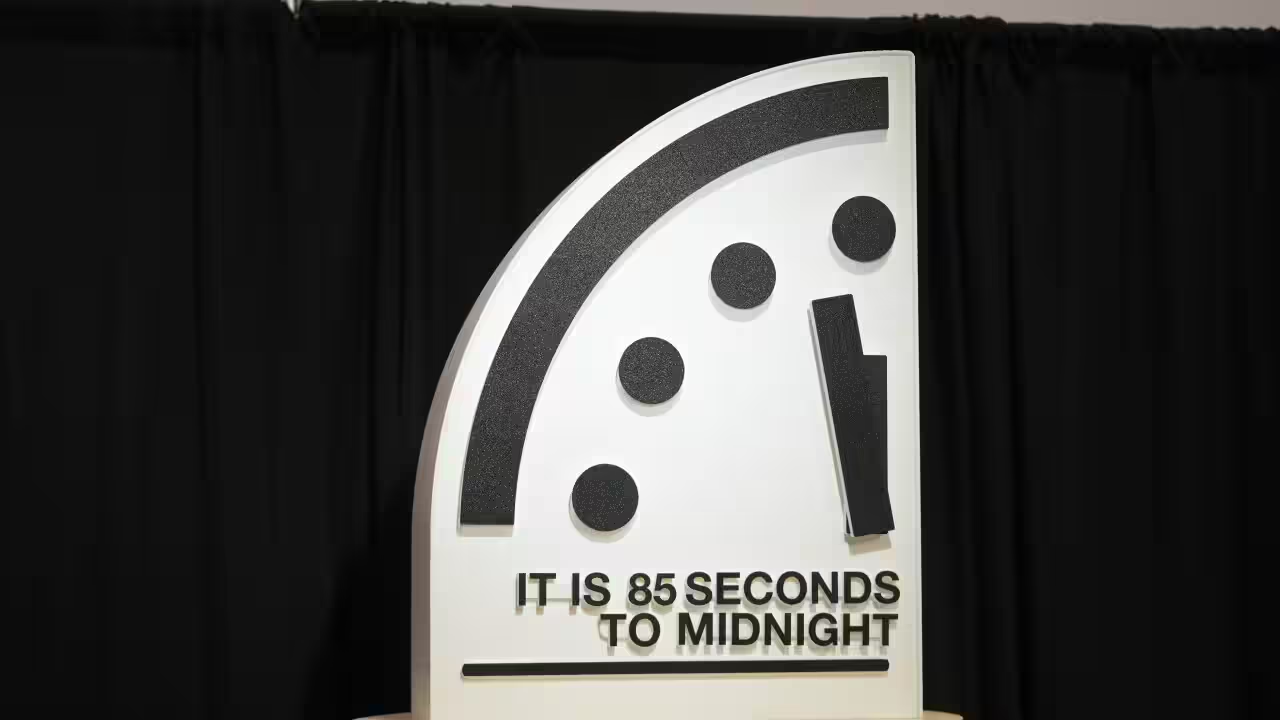
The world’s leading nuclear and climate scientists have delivered their starkest warning yet: the Doomsday Clock now stands at just 85 seconds before midnight, the closest point to global catastrophe in the clock’s nearly 80-year history.
Updated annually by the Bulletin of the Atomic Scientists, the Doomsday Clock is a symbolic measure of how close humanity is to self-inflicted disaster. Midnight represents existential catastrophe — whether from nuclear war, climate collapse, or other human-driven threats. This year’s adjustment signals that global dangers are not only persisting, but intensifying.
Why the Clock Moved Closer
Scientists cited a convergence of worsening risks across several fronts:
Nuclear tensions remain a central concern. Arms control agreements that once helped limit the spread and size of nuclear arsenals have weakened or expired. At the same time, rivalry among major powers has deepened, increasing the risk of miscalculation, escalation, or conflict involving weapons of mass destruction.
Climate change is accelerating faster than many mitigation efforts. Record-breaking temperatures, severe storms, droughts, and wildfires are becoming more frequent and more destructive. Experts warn that political gridlock and slow transitions away from fossil fuels are leaving the world dangerously unprepared for long-term environmental disruption.
Emerging technologies are also raising alarm. Rapid advances in artificial intelligence, biotechnology, and cyber capabilities hold enormous promise — but without effective international rules and safeguards, they could be misused in ways that destabilize societies, economies, and security systems.
Compounding all of these threats is a decline in global cooperation. International institutions designed to manage shared risks are struggling amid geopolitical rivalry, nationalism, and eroding trust between major powers. Scientists behind the clock argue that this breakdown in diplomacy makes every other danger harder to contain.
A Symbolic Warning, Not a Prediction
The Doomsday Clock is not a literal countdown to disaster. Instead, it serves as a visual shorthand for the state of global risk. Its purpose is to cut through political noise and remind leaders — and the public — that human choices are pushing the planet toward or away from catastrophe.
Historically, the clock has moved backward when major arms control treaties were signed or when international cooperation improved. It has moved forward during periods of heightened conflict or environmental neglect. The 2026 setting at 85 seconds to midnight reflects a belief among scientists that recent global developments have taken the world in the wrong direction.
Can the Clock Turn Back?
Despite the grim reading, experts stress that the future is not predetermined. Steps that could push the clock away from midnight include renewed nuclear arms negotiations, stronger commitments to cut greenhouse gas emissions, and international agreements governing powerful new technologies.
The message behind this year’s update is urgent but not hopeless: humanity still has agency. Political will, scientific collaboration, and public pressure could slow — and even reverse — the march toward midnight.
For now, however, the clock’s hands sit closer than ever to the symbolic end of days, serving as a sobering reminder that the greatest threats to human survival are, ultimately, of our own making.








Leave a Reply