

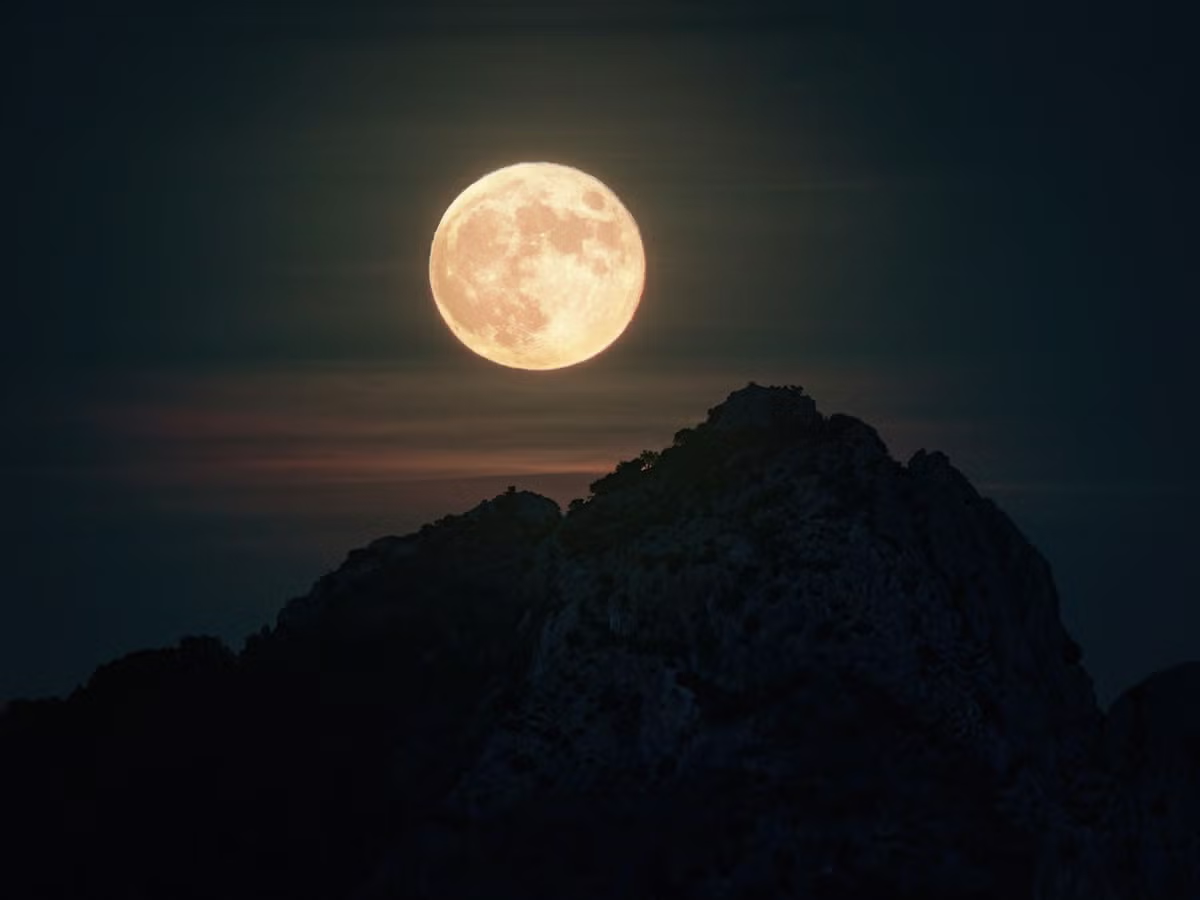
Skywatchers around the world are set to witness one of the most breathtaking lunar events of the year — the Hunters’ Moon, a radiant full Moon that will light up the night sky with extraordinary brilliance. This natural wonder, long celebrated in folklore and astronomy alike, will appear larger, brighter, and more luminous than usual, offering a striking view for millions of people across the Northern Hemisphere.
The October full Moon has captivated generations with its glowing orange hue and mystical charm. This year’s appearance, coinciding with near-perigee — the Moon’s closest point to Earth in its orbit — adds an extra dimension to its splendor, creating what many observers affectionately call a “super” Hunters’ Moon.
A Moon Steeped in History and Tradition
The Hunters’ Moon has deep roots in human history. In ancient times, it marked the period after the Harvest Moon, when fields were cleared and hunters took advantage of the moonlight to track game before the onset of winter. Its steady light allowed communities to extend their activities late into the night — storing food, preparing for the colder months, and marking the shift from harvest to hunting season.
Cultures across the world have celebrated this moon in poetry, ritual, and art. For many Indigenous tribes in North America, the October full Moon signified preparation and reflection — a moment when nature entered a cycle of rest. The warm glow of the Hunters’ Moon, appearing just as autumn deepens, symbolized both abundance and change.
The Science Behind the Hunters’ Moon
Unlike other full Moons, the Hunters’ Moon rises just minutes later each night, creating a series of bright evenings instead of a single brilliant display. This phenomenon occurs because of the Moon’s orbital path relative to the Earth and Sun during this time of year.
The result is a Moon that seems to linger longer on the horizon, creating the impression of a fuller, brighter sky across several nights. The orange and red hues that many observers notice are caused by atmospheric scattering — when light travels through thicker layers of Earth’s atmosphere, filtering out shorter blue wavelengths and allowing the longer red and yellow tones to dominate.
This year, the spectacle is enhanced by the Moon’s position near its closest orbital point to Earth, known as perigee. That makes it appear roughly 7% larger and up to 15% brighter than the average full Moon, intensifying its visual impact.
How and When to Watch the Moon Tonight
The Hunters’ Moon will rise just after sunset, bathing the landscape in an ethereal golden glow. For the best view, look toward the eastern horizon about 15–30 minutes after sunset. As it climbs higher in the sky, the Moon will shift from a deep amber tone to a brilliant silver-white as atmospheric distortion lessens.
Here’s how to make the most of tonight’s viewing:
- Check your local moonrise time: It will rise shortly after sunset and remain visible through most of the night.
- Find an open area: Choose a viewing spot free of tall buildings or trees to catch the full horizon glow.
- Use binoculars or a telescope: This allows you to see the Moon’s surface in remarkable detail — from the dark basalt plains of the lunar maria to the bright rays of craters like Tycho and Copernicus.
- Bring a camera: Even a smartphone can capture striking photos. Adjust exposure settings to avoid overexposure, and include foreground elements (like trees or buildings) for perspective.
- Avoid city lights: Urban glare can wash out subtle details; rural or elevated areas provide the best clarity.
Why the Moon Looks Bigger on the Horizon
Many viewers notice that the Moon seems unusually large when it’s near the horizon — a psychological trick known as the Moon Illusion. The human brain compares the Moon’s size against nearby objects such as trees, hills, or buildings, which makes it appear much larger than when it’s high overhead. Despite appearances, the Moon’s size does not physically change during the night.
However, the combination of this optical illusion and the supermoon-like proximity this year will make tonight’s lunar display especially captivating.
A Feast for the Eyes — and the Camera
For photographers and astronomy enthusiasts, the Hunters’ Moon is a dream subject. Its warm coloration, steady glow, and low trajectory make for compelling compositions. Long-exposure shots taken with a tripod can capture intricate surface textures, while wide-angle images including landscapes or silhouettes offer a dramatic sense of scale.
Experts suggest starting with ISO 200–400, aperture f/8, and shutter speeds between 1/60 and 1/250 seconds. As the Moon brightens, reducing exposure will prevent overexposure and maintain the soft contrast that defines lunar photographs.
Global Excitement and Astronomical Significance
Astronomy enthusiasts across continents are preparing for the event, with observatories hosting public viewings and local astronomy clubs organizing “Moon walks” and night-sky tours. For scientists, events like this also present valuable opportunities to study the Moon’s brightness, atmospheric effects, and its relationship to Earth’s orbital mechanics.
Beyond its scientific interest, the Hunters’ Moon serves as a reminder of humanity’s timeless fascination with the cosmos. Every full Moon connects us to our ancestors — those who looked up centuries ago to the same glowing disk, guided by its light for survival, storytelling, and spiritual meaning.
A Moment of Cosmic Reflection
As darkness settles tonight, the Hunters’ Moon will rise — steadfast, silent, and magnificent. Whether seen from a bustling city rooftop or a quiet field, its glow will reach all who take a moment to look upward. In an age of constant change, the Moon remains a shared anchor — a celestial rhythm that unites us across cultures, generations, and continents.
So, if clouds part and fortune favors your skies, step outside and let the Hunters’ Moon remind you of nature’s enduring beauty — vast, luminous, and utterly timeless.







Leave a Reply