

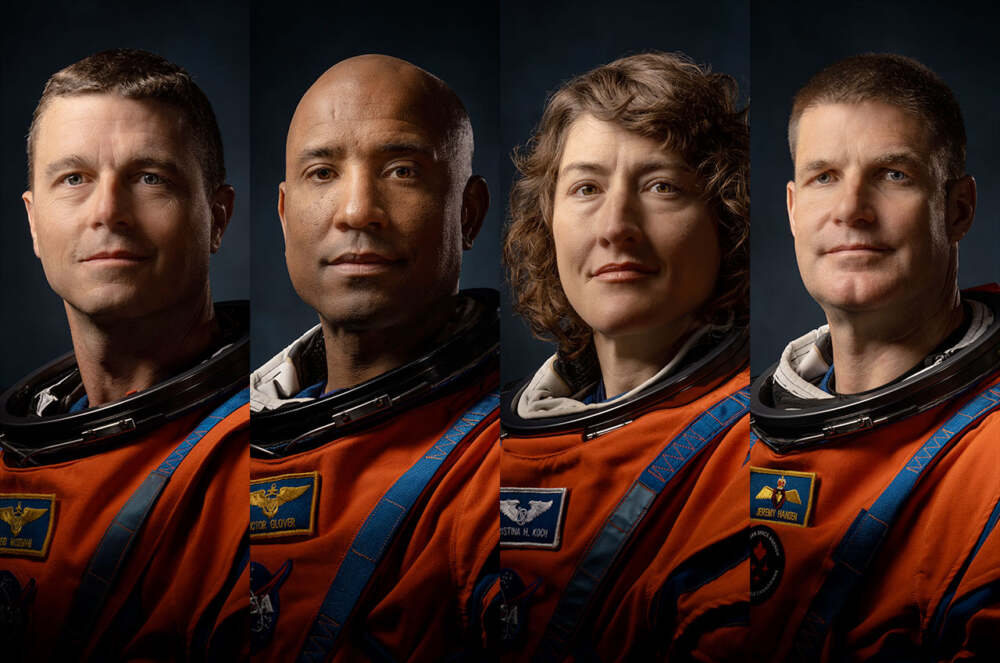
When the Artemis II crew blasted off—and then settled into the silence of deep space—what followed was far more than routine flight operations. In their own words, the four astronauts described a whirlwind of checks, emotions, and technical feats as they began their journey around the Moon. Their accounts reveal both the precision of spaceflight and the human wonder that underlies every mission.
Lift-Off: The Moment Everything Changes
In the minutes after ignition, the crew felt the full force of acceleration. One astronaut described the experience as “the most energetic thing you’ve ever done,” a burst of power that compresses time and human perception into a sharp, singular moment.
As the rocket climbed, attitudes were checked, systems came online, and the crew’s focus shifted from the thrill of launch to immediate operational discipline. The spacecraft’s orientation had to be perfect. Communications links, power systems, and life support were all scrutinized with care, because in space, even a small misstep can cause cascading complications.
A Storm of Checklists, Systems, and Surprises
Once in orbit, the real work began. Checks of the propulsion stage, solar array deployment, and separation of the launch abort system moved in quick succession. The crew mused about toggling between minutes of adrenaline and periods of intense technical focus: graph monitors, valve actuations, telemetry readouts, reconfiguring power buses, and ensuring every system responded within tolerances.
They spoke frankly about juggling thousands of procedures while maintaining calm, a skill honed through years of simulation and training. At times, the pace was so dense that the astronauts said it felt like “doing the most” for an extended stretch—no time to relax, just continuous responsibility.
A few moments even amused them: things like removing survival suits, configuring cameras, taking off gloves—actions that seem small but are heavy in microgravity and under time pressure.
Reflections in Silence & the Weight of the Mission
Amid the technical choreography, the astronauts took moments to reflect. They mentioned how the view beyond the windows—blackness, Earth, stars—reminded them of why they trained for years. One remarked on the “wild perspective shift” that occurs when you leave Earth behind: suddenly, the planet is smaller, and the infinite silence is real.
They also described a mental shift: moving from terrestrial thinking (ground communications, schedules, Earth-based priorities) to deep space mode—where orbital mechanics, radiation, spacecraft health, and mission margins dominate.
These reflections, spoken quietly between system calls, offered glimpses of humans confronting a frontier. The crew expressed humility and awe in equal measure—and a constant awareness that any error now would have no safety net.
Navigating the Free-Return Course & Moonward Trajectory
Artemis II was configured on a free-return trajectory—meaning the flight path is carefully orchestrated so that gravity from the Earth and Moon alone can bring the spacecraft home if no major propulsive corrections are made. But that doesn’t mean autopilot takes over.
The crew described burn sequences, mid-course corrections, and trajectory checks as “delicate art.” Early commands had to ensure the spacecraft lined up for its lunar swingby and return arc. They synchronized with ground stations, adjusted navigation, and validated software autonomy.
They relayed exhilaration when successful maneuvers confirmed the path was good, and cautious optimism whenever small deviations required tweaks. Throughout, redundancy, cross-checking, and calm decisiveness were their guiding principles.
Challenges & Micro-moments of Vulnerability
Even in the early hours, the crew confronted subtle challenges. Systems sometimes reported borderline values; adjustments had to be made to align sensors. Communications latencies—and the real possibility of data dropouts—kept ground teams and crew on high alert.
One astronaut confessed to the odd sensation of moments of doubt: “Did we turn that valve? Did that sensor activate?” But the training, the mission protocols, and mutual trust with colleagues pushed them forward.
They also joked (quietly) about the absence of familiar reference points—no horizon to judge vertical, no ambient noise, and the constant hum of life support reminding them they were in a sealed spaceship.
What’s Ahead: The Moon, Return, and Legacy
In the hours that followed, the crew prepared for longer-duration tasks: lunar flyby preparations, science instrument activations, system rest periods, and trajectory fine-tuning.
Their mindset was clear: success would be measured not in spectacle, but in returning home safely after circling the Moon—validating Orion’s systems, life support, navigation, and spacecraft behavior under deep-space conditions.
They expressed pride in walking in the footsteps of Apollo, but also awareness that this mission is a stepping stone. What they learn now will lay the foundation for Artemis III and the broader return to human lunar presence.
Closing Thoughts
The first hours of Artemis II were hectic, exacting, and deeply human. From the crushing power of lift-off to the controlled calm of orbital checks, the crew lived the duality of spaceflight: it is both engineered precision and personal sacrifice, thrilling wonder and measured focus.
They speak not as heroes, but as pilots entrusted with humanity’s next small step. Their words remind us that space missions are not only testbeds of technology, but chapters in human ambition—where every decision, every check, and every reflection matters.















Leave a Reply