

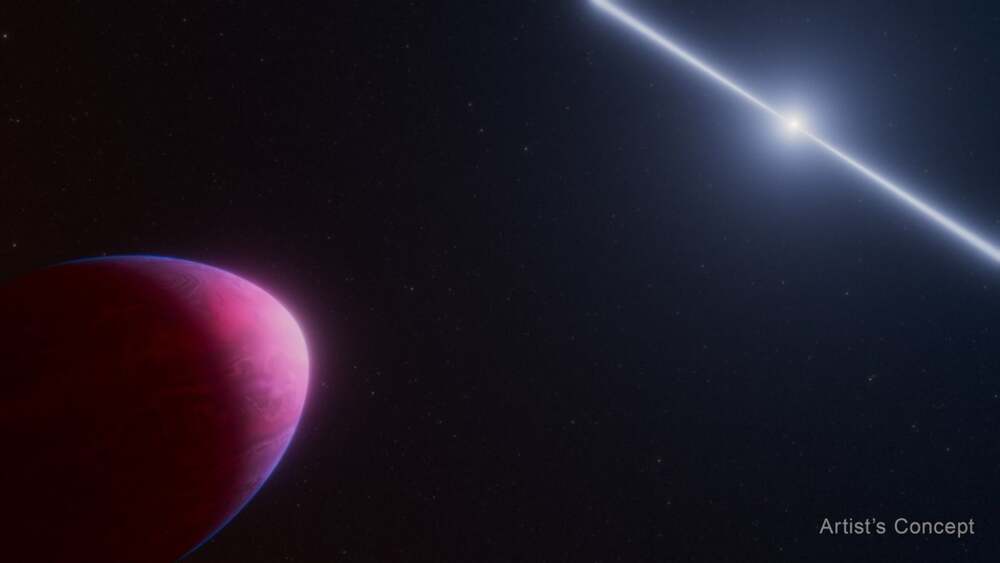
Astronomers are scratching their heads after the James Webb Space Telescope (JWST) captured images of an exoplanet with an unusual lemon-like shape, defying conventional understanding of planetary formation and structure. The discovery has been described by researchers as “baffling” and “unlike anything seen before.”
A World That Breaks the Mold
Located hundreds of light-years from Earth, this newly observed exoplanet exhibits a distinctly elongated, lemon-shaped profile, a striking departure from the spherical shapes that dominate planetary systems. Scientists suggest that a combination of rapid rotation, extreme tidal forces, and atmospheric dynamics may be responsible for the unusual form, but exact explanations remain speculative.
Dr. Elena Ramirez, an astrophysicist involved in the study, remarked, “We’ve observed strange exoplanets before, but this is in a category of its own. Its shape challenges our current models of planetary physics and formation.”
How JWST Captured the Anomaly
The James Webb Space Telescope, renowned for its infrared imaging capabilities, allowed scientists to analyze both the exoplanet’s shape and atmospheric composition. Observations suggest:
- The planet is gas-dominated, with a thick, possibly turbulent atmosphere.
- Rapid rotational velocity may be flattening and stretching the planet, giving it a lemon-like appearance.
- Intense gravitational interactions with a nearby star or companion planet may contribute to tidal distortion.
These factors combined could explain the exoplanet’s unusual geometry, though researchers caution that further study is required.
Implications for Planetary Science
The discovery of this lemon-shaped exoplanet is rewriting our understanding of planetary diversity. Astronomers previously assumed most planets would form into near-spherical shapes due to gravity, but this find suggests:
- Extreme planetary shapes may be more common than previously thought, particularly in tightly-packed or highly active systems.
- Current models of atmospheric dynamics and rotational physics may need refinement to account for unusual morphologies.
- Observing distorted planets can reveal new insights into the interplay between gravity, rotation, and tidal forces in alien solar systems.
Public Fascination and Scientific Curiosity
The bizarre appearance of this exoplanet has captured the imagination of both the scientific community and the public. Social media has erupted with memes, illustrations, and fan theories, with many jokingly dubbing it the “lemon planet.”
For scientists, however, the focus is on serious analysis: determining how such a planet forms, how stable its orbit is, and whether extreme shapes like this could exist elsewhere in the galaxy.
The Next Steps
Researchers plan to continue monitoring this exoplanet with JWST and complementary ground-based telescopes. They aim to:
- Map its atmospheric composition for unusual chemicals or weather patterns
- Measure orbital dynamics to understand the influence of nearby celestial bodies
- Model rotational and tidal effects to predict long-term structural stability
This discovery reinforces JWST’s status as a game-changing tool in astronomy, capable of revealing worlds that challenge both imagination and scientific theory.












Leave a Reply