

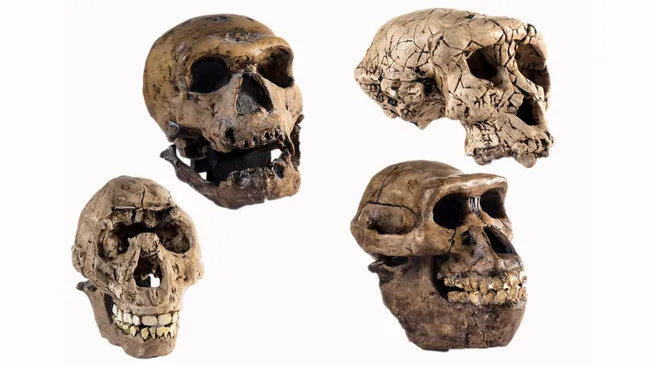
A new study has sent shockwaves through the field of paleoanthropology, challenging long-held assumptions about one of the most iconic fossils in human evolution. Researchers now claim that Australopithecus afarensis—famously represented by the 3.2-million-year-old specimen known as “Lucy”—may not be a direct ancestor of modern humans after all. The revelation has ignited intense debate among scientists, anthropologists, and enthusiasts alike.
Lucy, discovered in 1974 in Ethiopia’s Afar region, has long been celebrated as a crucial link in the story of human evolution. Her remarkably complete skeleton provided evidence of bipedalism in early hominins, suggesting that walking upright predated significant increases in brain size. For decades, Lucy was portrayed as a cornerstone in understanding the evolutionary pathway that led from early primates to Homo sapiens.
The new study, published in a leading scientific journal, draws on advanced imaging technology, comparative anatomy, and phylogenetic analysis to reevaluate Lucy’s place in the human family tree. The researchers argue that while Lucy exhibits traits associated with early bipedalism, certain anatomical features—particularly in the pelvis, ribcage, and limb proportions—suggest she may represent a side branch rather than a direct line to modern humans.
“Our findings indicate that Australopithecus afarensis may have been one of several hominin species evolving in parallel,” said Dr. Elena Marquez, lead author of the study. “While Lucy walked upright, she may not be part of the direct lineage that eventually led to Homo sapiens. Evolution is more like a branching bush than a straight ladder.”
This reinterpretation has profound implications for our understanding of human evolution. If Lucy and her species were indeed a side branch, it could mean that other, less well-known hominins contributed more directly to the development of modern humans. Fossils previously considered peripheral or enigmatic may need to be reevaluated in light of these findings, potentially rewriting the evolutionary timeline.
The study has sparked immediate debate among experts. Some praise the research for using cutting-edge analytical techniques that bring fresh insight into long-studied fossils. Others caution that definitive conclusions are premature, noting that the fossil record remains fragmentary and that evolutionary pathways are notoriously complex.
Dr. Samuel O’Connor, a paleoanthropologist not involved in the study, emphasized the need for cautious interpretation. “Lucy has been an invaluable reference point for decades. While this study raises important questions, it doesn’t diminish her significance. We are still learning how different hominin species interacted and evolved over millions of years.”
Public fascination with Lucy has only intensified since the announcement. Social media platforms and news outlets are buzzing with discussions about what this new perspective means for our understanding of human origins. Educators and museums are already considering how to present these nuanced findings to audiences who have long regarded Lucy as a definitive ancestor.
The debate also highlights the dynamic nature of science. As new techniques—such as high-resolution CT scanning, 3D modeling, and genetic analysis of ancient remains—become available, previously held assumptions are increasingly subject to scrutiny. Lucy, once a fixed symbol of human ancestry, is now part of an evolving narrative that emphasizes the complexity and diversity of our evolutionary history.
In conclusion, while Lucy may no longer be viewed as a direct ancestor, her discovery remains pivotal. She continues to provide invaluable insight into the morphology, behavior, and environmental adaptations of early hominins. The latest findings reinforce the idea that human evolution is not a linear journey but a branching, intricate process, one that scientists will continue to unravel for decades to come.














Leave a Reply