

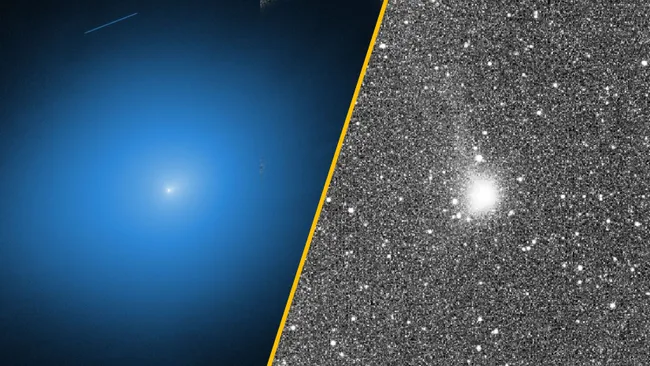
Astronomers are closely monitoring Comet 3I/ATLAS as it approaches a relatively close encounter with Earth, thanks to striking new images captured by NASA and the European Space Agency (ESA). The images reveal increased activity in the comet’s nucleus, providing scientists with valuable data on its composition and behavior.
Comet 3I/ATLAS, classified as an interstellar object, has intrigued researchers since its discovery. Observations indicate that the comet is beginning to develop a bright coma and tail as it warms during its journey through the inner solar system. The activity suggests that volatile ices are sublimating and releasing dust, creating the glowing spectacle seen in recent telescopic images.
NASA’s Hubble Space Telescope and ESA’s ground-based observatories have captured high-resolution images showing jets of gas and dust emanating from the comet’s surface. Scientists say these jets provide clues about the comet’s rotation, structure, and potential origin from beyond our solar system.
“Every close approach is a unique opportunity to study an interstellar visitor in detail,” said Dr. Elena Rodriguez, a planetary scientist involved in the observations. “By monitoring 3I/ATLAS, we can better understand how such objects behave and what they can tell us about planetary systems beyond our own.”
The comet is not expected to pose any threat to Earth, but its close passage allows researchers to conduct spectroscopy and other analyses to identify chemical signatures. These measurements can offer insights into the primordial materials that formed in distant star systems and survived the journey through interstellar space.
Amateur astronomers are also gearing up for the encounter, with clear skies expected to offer good viewing opportunities in the coming weeks. The brightening of 3I/ATLAS could make it visible through small telescopes and even binoculars for keen skywatchers.
As the comet continues its approach, both professional and amateur observations will help build a comprehensive picture of this rare visitor from the stars, shedding light on the mysteries of interstellar travel and the building blocks of distant planetary systems.








Leave a Reply