

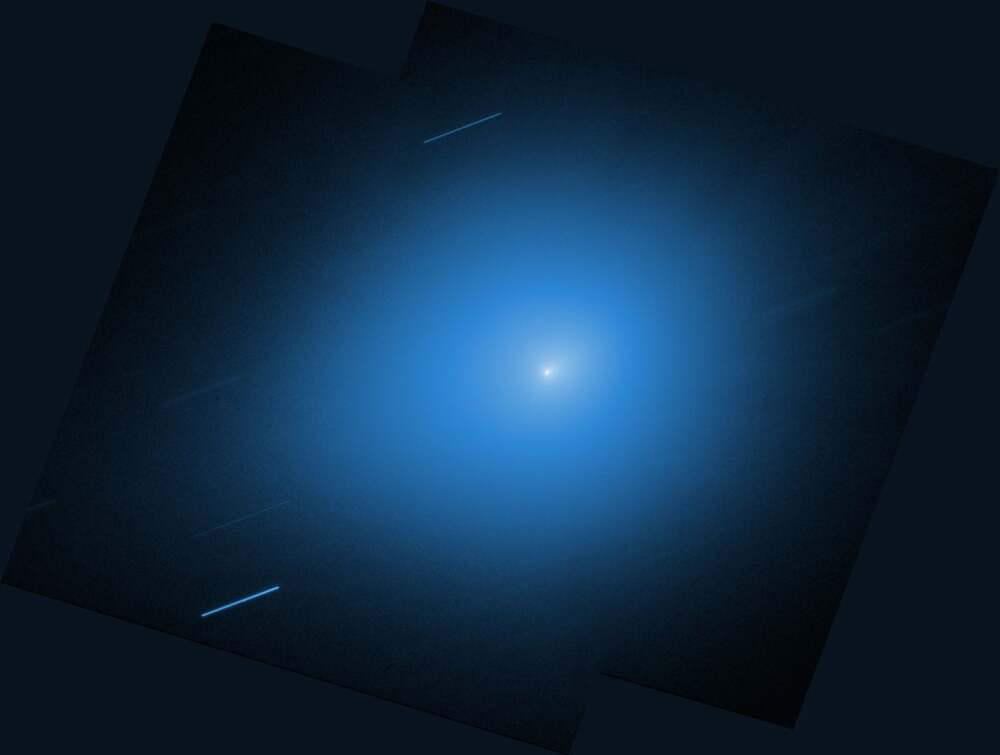
NASA’s Hubble Space Telescope has once again turned its gaze toward the interstellar visitor 3I/ATLAS, offering astronomers fresh data on one of the most intriguing objects ever observed in our solar system. First detected in 2020, 3I/ATLAS captured global attention due to its unusual trajectory and the fact that it originated from beyond our solar system, making it only the third confirmed interstellar object ever observed.
The latest observations reveal unexpected details about 3I/ATLAS’s composition and behavior. Hubble’s high-resolution imaging detected subtle outgassing from the object, indicating that it may contain volatile ices similar to those found in comets. Researchers also noted slight variations in its brightness, suggesting an irregular shape or a possible rotation that exposes different surfaces to sunlight.
These findings are helping scientists refine models of how such interstellar objects form and travel across the galaxy. “Every time we observe 3I/ATLAS, we learn more about materials that exist outside our solar system,” said one NASA astronomer. “It’s like receiving a tiny, natural sample of another star system without leaving Earth.”
The object’s peculiar trajectory continues to interest researchers. Unlike comets and asteroids native to our solar system, 3I/ATLAS is moving at a speed and angle that confirms its interstellar origin. Hubble’s precise measurements of its motion and brightness will allow astronomers to better understand its path and predict how long it will remain observable from Earth.
Beyond the immediate scientific insights, 3I/ATLAS offers a rare opportunity to study the building blocks of other star systems. The observations could inform future missions aimed at intercepting or studying interstellar visitors, a frontier that holds enormous potential for understanding the diversity of planetary systems in our galaxy.
Hubble’s latest observations reinforce the telescope’s legacy as a vital tool in uncovering the mysteries of space, providing an unparalleled view of objects that challenge our understanding of the cosmos.







Leave a Reply